
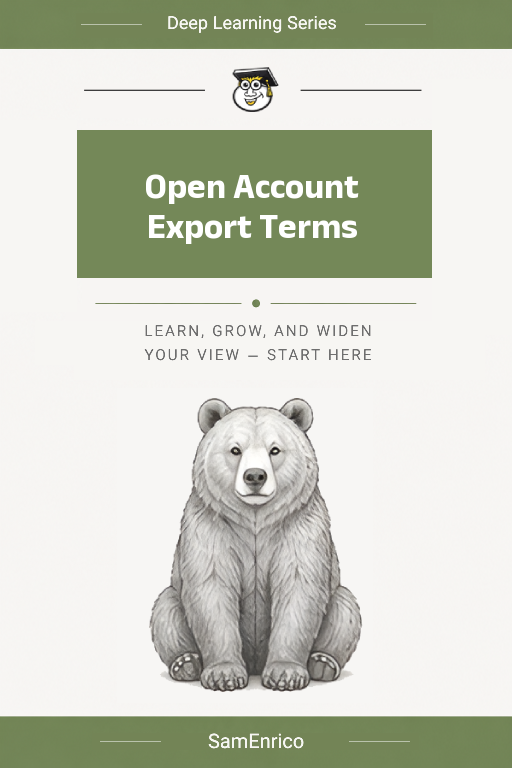
Non-FictionBusiness BriefOpen Account
Open Account Export Terms eBook
Offer open account terms to trusted international
Offer open account terms to trusted international buyers to win more business as African exporter.
Formats
Free sample
Chapter 1: The Million-Dollar Handshake--–- The container had been sitting at the Mombasa port for eleven days. Inside were forty thousand dollars' worth of Kenyan green coffee beans, bagged, graded, and ready for a specialty roaster in Hamburg. The buyer had sent three urgent emails that morning. The exporter, a woman named Wanjiku who had built her business from a single pickup truck to a thriving export operation, stared at her phone.She had a choice.Option one: demand the confirmed Letter of Credit as usual. Wait another two weeks for the banks to finish their dance.
Risk losing the buyer to a competitor who could move faster.Option two: release the container on open account terms. Trust the buyer to pay in sixty days. Get the beans on the ship today.She chose option one. The buyer chose a different supplier from Vietnam. Wanjiku lost the contract.Eighteen months later, that Hamburg roaster was buying two containers a month from Vietnam.
Wanjiku's business had not grown at all. She was still demanding cash before shipment, still waiting for LCs to clear, still wondering why her competitors seemed to be winning deals she could not even see.This book is for Wanjiku. And for you.The Open Account Trap That Nobody Talks About If you are an African exporter reading this book, you have been trained to believe that demanding cash in advance or a confirmed Letter of Credit is the responsible thing to do. Your bank told you this. Your trade association told you this.
Perhaps your father or mother, who built the business before you, told you this. It sounds like wisdom. It sounds like caution. It sounds like the safe path.It is none of those things.It is the fastest way to ensure you never grow beyond a certain size. It is the reason your competitors from Southeast Asia, Eastern Europe, and Latin America are taking market share you could have owned.
And it is based on a fundamental misunderstanding of how international trade actually works in the twenty-first century.Let me say this as directly as possible: the global shift from Letters of Credit to Open Account terms is not coming. It has already happened. And African exporters have been left behind.Consider the numbers. In 1990, approximately eighty percent of international trade transactions were conducted using Letters of Credit. By 2020, that number had inverted.
Today, eighty to ninety percent of trade between Europe, North America, and developed Asia happens on Open Account terms. The LC is no longer the default. It is the exception.Why did this happen? Because buyers discovered that LCs are expensive, slow, and administratively burdensome. A typical LC transaction ties up the buyer's credit line for weeks or months.
Bank fees of one to two percent of the transaction value are common. The documentation requirements are so precise that a single comma in the wrong place can trigger a rejection. Large buyers hate LCs with a passion that borders on contempt.So they stopped using them. And they started demanding Open Account terms from their suppliers.Everywhere except Africa.When European or American buyers source from Vietnam, they offer sixty-day terms as a matter of course. When they source from Poland or Mexico, they offer ninety days.
But when they source from Nigeria, Kenya, or South Africa, they ask for LCs or cash in advance. Not because they are biased, necessarily. Because they have learned that African suppliers rarely offer Open Account, and when they do, they often do it badly.This is the invisible barrier. It is not a wall. It is a subtle, pervasive discount that buyers apply to every quote from an African exporter.
"We will pay you less because you make us use an LC." "We will buy from someone else because you cannot offer terms." "We trust you less because you are from a place where trade credit is not standard."You cannot see this barrier. You can only feel its effects in the deals you lose and the margins you sacrifice.The African Discount: A Mathematical Nightmare Let me introduce a concept that will appear throughout this book. I call it the African Discount.The African Discount is the penalty that buyers implicitly apply to quotes from African suppliers. It manifests in three ways.First, direct price pressure. A buyer might say, "We will pay you five percent less than your quote because we have to use a Letter of Credit, and that costs us money." Sometimes they say it explicitly.
More often, they simply take your price and compare it to a competitor from another region who offers better terms, then choose the competitor without explanation.Second, lost deals. You never even get to the price negotiation because the buyer sees "LC only" on your proposal and moves on to the next supplier. This is silent. You never know it happened.Third, reduced negotiating power. When you demand cash before shipment, you position yourself as a supplier who cannot trust their own product or their own customers.
That perception weakens every other aspect of your negotiation.Here is the math that proves why this matters. Consider an exporter of shea butter from Ghana to a cosmetics manufacturer in France. The product cost to produce is fifty thousand dollars. The exporter wants to make a twenty percent margin, so they quote sixty thousand dollars.The buyer says, "We will pay your sixty thousand, but we need a confirmed Letter of Credit. Our bank charges one point five percent for LC confirmation, and we also have to pay for the transfer.
That costs us about one thousand dollars. Also, our credit line is tied up for sixty days, which has a real cost to us. Can you reduce your price by two thousand dollars?"The exporter agrees. Their margin drops from twenty percent to about sixteen and a half percent. This happens deal after deal.Now consider the same exporter, but this time they have export credit insurance and offer sixty-day Open Account terms.
They quote the same sixty thousand dollars. The buyer says, "Great. No LC fees, no credit line blockage. We accept."The exporter's margin stays at twenty percent. They have also saved themselves the administrative cost of managing an LC, which typically adds another half percent to their overhead.Over ten deals per year, that two to three percent margin difference becomes real money.
For a business doing one million dollars in annual exports, switching from LC to insured Open Account adds thirty thousand dollars to the bottom line. For a five-million-dollar exporter, that is one hundred fifty thousand dollars.The African Discount is not a conspiracy. It is not racism. It is not even unfair. It is a rational response to a marketplace where most African suppliers have not yet learned to offer competitive payment terms.
The buyer is not punishing you. They are simply optimizing their own supply chain. If you cannot offer the terms that ninety percent of their other suppliers offer, you are at a disadvantage.The good news is that this disadvantage is entirely fixable. You do not need to change your product, your quality, or your delivery times.…
This is the end of the free sample. Get the eBook to keep going. Buy now
About this book
Details
- Author
- Quezada Jillian
- Publisher
- SamEnrico
- Language
- English
- Genre
- Non-Fiction, Business Brief, Open Account
- Released
- 2026-05-27
- Pages (approx.)
- 146
- Available as
- eBook, Audiobook

Read better in the ZLOADR app
Your eBooks on your phone or tablet. Sign in with your SamEnrico account and start reading.
More by Quezada Jillian
 Reverse Mortgage for Downsizing AnalysisQuezada Jillian$11.99
 Stimulant Craving ManagementQuezada Jillian$11.99
 Name Memorization ScienceQuezada Jillian$11.99
 Mentoring Self Esteem GuideQuezada Jillian$11.99
 Half Sibling ReconciliationQuezada Jillian$11.99
 Senior Nap GuidelinesQuezada Jillian$11.99
 Compulsive Spender's Financial AuditQuezada Jillian$11.99
 OKRs for Engineering TeamsQuezada Jillian$11.99
 The Poisoner of Montreal: The Deadly Vendetta of Thérèse DéryQuezada Jillian$11.99
 The Lion’s Den: South Africa’s Greatest Prison BreakQuezada Jillian$11.99
 A Collector's Handbook to the Lamborghini IiQuezada Jillian$11.99
 API Reporting and Reconciliation HandbookQuezada Jillian$12.99
You may also like
 Hong Kong Handover 1997Dunn Johnnie$11.99
 Zumba For Postnatal Recovery CourseNeal Christian$11.99
 Zumba for BeginnersLadner Nikia$11.99
 YouTube Comment Mining GuideHumes Pandora$12.99
 Worry Box MeditationCarlin Rudy$11.99
 Workplace Stress MeditationNguyen Lynn$11.99
 Workplace Stress and Sleep RepairHawley Ivory$11.99
 Workplace Perfectionism CureDelaney Jeffry$11.99
 Workplace Injustice Anger GuideWallen Isabelle$11.99
 Work Addiction and Burnout LinkGreenwood Ester$11.99
 Women in Yoga and WellnessBeattie Galina$11.99
 Women in Stand Up ComedyChun Evangeline$11.99