
Non-FictionBusiness BriefFintech
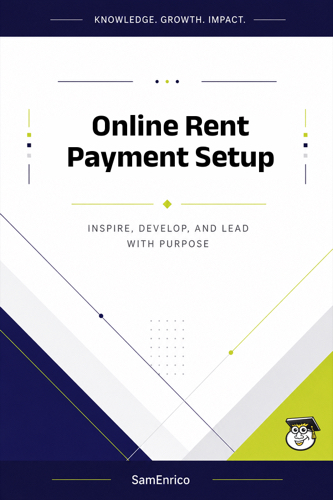
Online Rent Payment Setup eBook
Accepts digital payments.
Accepts digital payments.
Formats
Free sample
Chapter 1: The Paper Tax--For most landlords, the single most expensive line item on their profit-and-loss statement isn't maintenance, property taxes, or even vacancies. It's something they have never calculated, never tracked, and probably never even considered a cost at all. It is the slow, invisible bleed of time, energy, and money caused by collecting rent the old-fashioned way.If you are reading this book, you already know the rituals. The first of the month arrives, and with it comes a familiar low-grade anxiety. You wait by the mailbox or the office door.
The checks trickle in—some early, most on time, a few conspicuously absent. You text a tenant: "Hey, just checking on rent." They reply, "Oh, I put it in the mail yesterday." Three days pass. No check. Another text. Another promise.
By the tenth of the month, you are chasing, cajoling, and calculating late fees by hand on a spreadsheet that never quite balances. You drive to the bank, stand in line, deposit a stack of checks, and hope none bounce. When one does, you pay a fee, then drive back to the tenant's door to collect cash or a money order. You repeat this process every single month, for every single unit, forever.What if you stopped?What if, instead of chasing payments, payments simply arrived—automatically, predictably, and without a single trip to the bank? What if your tenants actually preferred the new system because it was easier than writing a check?
What if the time you currently spend on rent collection could be reallocated to finding better tenants, improving your properties, or simply living your life?This chapter will quantify exactly how much the old way is costing you. Not in vague terms, but in dollars and cents, hours and minutes. You will calculate your personal Paper Tax—the hidden cost of paper-based rent collection. And by the end of this chapter, you will understand why the shift to digital payments is not a nice-to-have upgrade. It is a financial imperative.The Invisible Expense You Have Never Calculated Most landlords think of rent collection as a fixed cost of doing business.
You own the property. The tenant pays rent. There is some administrative overhead, but that is just part of the job. This is a dangerous misconception.The Paper Tax is the sum total of every minute, every dollar, and every missed opportunity caused by collecting rent manually. It has five components, and most landlords have never measured a single one.Component One: The Time Sink Let us start with the most obvious cost: your time.
If you own one or two units, you might spend an hour per month on collection. If you own ten units, that number grows. If you own fifty units, you are likely spending entire days on rent collection.Let us build a realistic model. A landlord with ten units spends approximately:2 hours preparing and sending rent reminders (texts, emails, calls)30 minutes collecting and sorting incoming checks1 hour driving to the bank and waiting in line30 minutes entering payments into a spreadsheet or accounting software1 hour chasing late payers (multiple texts and calls)30 minutes calculating and applying late fees manually That is five and a half hours per month. Sixty-six hours per year.
For a landlord who values their time at just $50 per hour, that is $3,300 in annual labor cost. For a landlord who values their time at $100 per hour (not uncommon for professionals with full-time jobs plus rental properties), that is $6,600 per year.Now multiply that across a decade. A landlord with ten units loses $33,000 to $66,000 in time value over ten years. And that is just the first component.Component Two: The Direct Cash Losses Paper-based collection creates direct, out-of-pocket costs that digital systems eliminate. Consider the following:NSF fees.
When a tenant's check bounces, your bank charges you a fee—typically $25 to $50. The tenant may reimburse you eventually, but that requires additional chasing. Many landlords simply eat the first NSF fee to preserve goodwill. A landlord with ten units can expect two to three bounced checks per year. That is $50 to $150 in direct bank fees, plus the administrative cost of handling each bounce.Late fees you fail to collect.
Manual late fee tracking is error-prone. You forget to apply the fee. You apply the wrong amount. You feel bad for a tenant who has a "good reason" and waive the fee without documenting it. Research suggests manual landlords collect only 60 to 70 percent of the late fees they are entitled to.
If your lease allows $50 late fees and you have ten late payments per year, that is $500 in potential fees. If you collect only 70 percent, you leave $150 on the table annually.Lost checks. Checks get lost in the mail. Tenants claim they mailed them. Sometimes they are telling the truth; sometimes they are not.
Each lost check costs you the rent amount plus the time to resolve the dispute. Even if this happens once per year, the administrative cost is significant.Bank fees. Business checking accounts often charge per-check deposit fees, monthly maintenance fees, and fees for check imaging. These typically add $10 to $30 per month—$120 to $360 per year.When you add these together, a typical ten-unit landlord loses $300 to $600 annually to direct cash losses from paper collection.Component Three: The Vacancy Cost This is the hidden cost that surprises most landlords. Paper-based collection delays rent receipt, and delayed rent receipt delays your ability to cover expenses.
But the more serious cost is this: manual collection makes it harder to identify problem tenants early.When rent arrives via check, you do not know if a tenant is going to be late until the check does not arrive. By then, you are already behind. Digital systems, by contrast, can tell you on the second of the month that a payment failed. You can intervene days earlier. That early intervention often prevents a full eviction.Consider the math.
The average eviction costs $3,500 in legal fees, court costs, lost rent, and turnover expenses. If digital collection helps you avoid just one eviction over a ten-year period—by identifying problem tenants early and either working with them or replacing them sooner—that is a $3,500 savings. Spread across ten units and ten years, that is $35 per unit per year in avoided risk. This is real money.Component Four: The Tenant Relationship Tax Paper collection damages relationships. Every time you text a tenant about a late check, you become the enforcer.
Every time you cash a check on the first of the month, the tenant sees the withdrawal and may feel resentment. The transactional nature of paper collection creates friction.Digital collection, done well, removes this friction. The tenant sets up automatic payments. The money moves silently. The landlord and tenant never discuss rent because there is nothing to discuss.
This preserves the relationship for what matters: maintenance requests, lease renewals, and building community.What is that worth? It is hard to quantify precisely, but landlords who switch to digital payments consistently report fewer disputes, less stress, and longer tenant retention. A single extra year of retention from a good tenant saves you one month of vacancy and turnover costs—typically $1,000 to $2,000 per unit.Component Five: The…
This is the end of the free sample. Get the eBook to keep going. Buy now
About this book
Details
- Author
- Newby Towanda
- Publisher
- SamEnrico
- Language
- English
- Genre
- Non-Fiction, Business Brief, Fintech
- Released
- 2026-06-05
- Pages (approx.)
- 132
- Available as
- eBook, Audiobook

Read better in the ZLOADR app
Your eBooks on your phone or tablet. Sign in with your SamEnrico account and start reading.
More by Newby Towanda
 NA Step Working GuideNewby Towanda$11.99
 The Fjord Quiet GuideNewby Towanda$11.99
 PTSD Hyperarousal TriggersNewby Towanda$11.99
 The Buddha's Ordained DisciplesNewby Towanda$11.99
 Imposter Syndrome For Creative ProfessionalsNewby Towanda$11.99
 Fibromyalgia and Autoimmune OverlapNewby Towanda$11.99
 Pet Loss Jewelry GuideNewby Towanda$11.99
 Bone Marrow DonorNewby Towanda$11.99
 The Lion and the Lily: Eleanor of Aquitaine and the Birth of ChivalryNewby Towanda$11.99
 The Iron Titans: Carnegie, Morgan, and the Forging of Modern CapitalismNewby Towanda$11.99
 Pixel Perfect: The Rise and Fall of the Tamagotchi EmpireNewby Towanda$11.99
 The Complete Guide to the 3 Day Solution PlanNewby Towanda$11.99
You may also like
 Hong Kong Handover 1997Dunn Johnnie$11.99
 Zumba For Postnatal Recovery CourseNeal Christian$11.99
 Zumba for BeginnersLadner Nikia$11.99
 YouTube Comment Mining GuideHumes Pandora$12.99
 Worry Box MeditationCarlin Rudy$11.99
 Workplace Stress MeditationNguyen Lynn$11.99
 Workplace Stress and Sleep RepairHawley Ivory$11.99
 Workplace Perfectionism CureDelaney Jeffry$11.99
 Workplace Injustice Anger GuideWallen Isabelle$11.99
 Work Addiction and Burnout LinkGreenwood Ester$11.99
 Women in Yoga and WellnessBeattie Galina$11.99
 Women in Stand Up ComedyChun Evangeline$11.99