
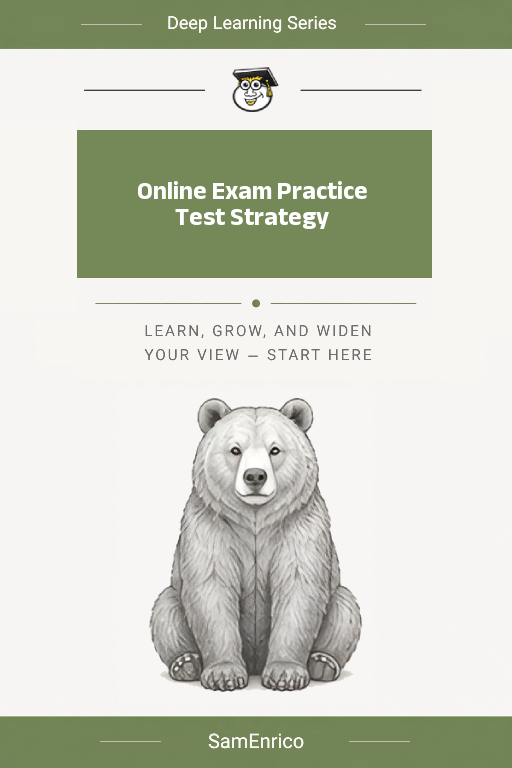
Non-FictionStudent's ShortcutPractice
Online Exam Practice Test Strategy eBook
Take practice proctored exams to familiarize yours
Take practice proctored exams to familiarize yourself with the software and rules.
Formats
Free sample
Here is an in-depth summary of each chapter for the book "Online Exam Practice Test Strategy" (titled The Mock Proctor Method), based on the outline provided.Introduction: Why "Real Practice" Is the Only Practice This opening section establishes the fundamental problem: most test-takers focus exclusively on content (facts, formulas, concepts) while ignoring procedure (how the exam software works, what the rules are, how to behave on camera). The result is that thousands of qualified students fail or receive flagged scores not because they didn't know the material, but because they were unfamiliar with the exam environment. The introduction defines the "Mock Proctor Method"—a requirement of three or more fully simulated practice exams before the real test—and explains how these practice runs reveal hidden vulnerabilities (e.g., unconscious eye movements, environment violations, technical glitches) long before they can cause a real exam failure.Chapter 1: The Hidden Curriculum of Online Proctoring This chapter argues that the rules and software of online proctoring constitute a "hidden curriculum"—a set of unspoken requirements just as important as the official subject matter. It breaks down the three main types of proctoring: live (human watching in real time), recorded (AI-reviewed after submission), and automated (AI-only with real-time flagging). Major platforms (Proctor U, Honorlock, Respondus Monitor, Exam Soft, Proctorio, Talview) are introduced, with emphasis on how each has different rule sets, flagging thresholds, and user interfaces.
The chapter's central insight, drawn from best-selling study guides, is that students must treat proctoring protocols as a separate subject worthy of dedicated study. The cost of ignorance is severe: false cheating accusations, exam termination, academic probation, or permanent record flags.Chapter 2: Building Your Personal Exam Environment Lab This chapter transforms the abstract concept of a "good testing environment" into a concrete, repeatable setup. The six critical components are detailed: desk (clear, stable, appropriate size), lighting (overhead preferred; backlighting triggers flags), background (blank wall or neutral backdrop, no posters or shelves), seating (comfortable but not relaxing), technology (reliable internet, working camera/mic), and room boundaries (closed door, no interruptions). A deep dive on the "clean desk policy" explains exactly what must be removed (phones, watches, notes, external monitors, unapproved calculators) and why each item is prohibited. The one-monitor rule is emphasized because multiple displays are the most common violation.
The chapter concludes with a pre-exam environment audit checklist inspired by The Checklist Manifesto.Chapter 3: Software Simulation – Practice Like a Pilot Drawing an analogy to aviation simulation, this chapter explains why watching tutorials is passive and ineffective, while clicking through mock exams creates active, durable learning. A critical warning is issued: download and install proctoring software days before the exam, not the morning of. The difference between browser lockdown (e.g., Respondus Lock Down Browser) and dedicated applications (e.g., Exam Soft) is explained, including how each affects navigation, copy-paste, and access to other programs. The chapter provides guidance on sourcing or creating simulation exams with identical interface elements (question types, timers, flagging buttons) and stresses the "demo test advantage"—every major platform offers a free practice test, and students who skip it are gambling with their scores. Case studies illustrate students who failed drag-and-drop questions not due to content but because they had never practiced the interface.Chapter 4: The 5-Rule Framework of Every Proctored Exam This chapter organizes all proctoring rules into a memorable five-part framework.
Rule 1: Identity verification covers government ID requirements, name matching, and photo protocols. Rule 2: No talking or vocalizing explains why subvocalizing (mouthing words) triggers AI audio flags even when silent. Rule 3: Eye movement restrictions details how looking off-screen, reading aloud, or excessive blinking can be misread as cheating. Rule 4: Bathroom and break policies states the hard truth: leaving camera view equals an automatic flag, and most exams offer no breaks. Rule 5: Permitted materials clarifies what "closed book" actually means (no calculators, blank paper, phones, or scratch paper unless explicitly approved).
The chapter then teaches readers how to use practice tests to discover their own accidental violations and provides a desensitization protocol for AI red-flag behaviors.Chapter 5: Designing Your Personal Practice Proctored Exam This is the "how-to" chapter for creating high-fidelity simulations without expensive software. A step-by-step protocol is provided: set a timer, clear your environment, start recording, announce the start, complete the exam without pausing, and stop recording. Recommended tools include OBS Studio (free, professional-grade), Zoom self-recording, or even a phone camera propped up to capture screen and face simultaneously. The chapter introduces the "mock proctor"—a friend or a printed checklist that enforces rules (e.g., "Stop talking!" "Eyes forward!"). The room scan simulation is practiced exactly as it happens in real exams: a 360-degree security check showing desk, floor, walls, and ceiling.
Metrics to track include time per question, violations per minute, how many times you restarted or paused, and a self-rated anxiety score before and after.Chapter 6: Stress Inoculation Through Simulated Rules Enforcement This chapter applies the psychological principle of stress inoculation—controlled exposure to stressors to build tolerance—to online exam preparation. It explains why "easy practice" (taking untimed, unproctored practice tests) fails to transfer to high-stakes conditions: the absence of pressure means no anxiety adaptation occurs. The method of progressive overload is introduced: first mock exam has relaxed rules; second mock adds strict time pressure; third mock adds simulated interruptions (noise, internet drops, a "proctor" who interrupts). The anxiety paradox is explained: more rule-familiarity leads to a smaller startle response on exam day. The chapter provides scripts for common stressors (internet drop, power failure, background noise) and teaches "if-then" mental planning to automate responses under pressure.Chapter 7: Analyzing Your Mock Proctored Exam Replay This chapter teaches the skill of video review—watching your own practice exam recording with the critical eye of a proctor.
Specific behaviors to look for include gaze shifts (how often you look away from the screen), hand movements (are they disappearing off-camera?), posture changes (did you slouch out of frame?), and audio disturbances (were you sighing, whispering, or muttering?). Common violations that students miss include touching one's face (interpreted as covering mouth), looking at a watch (potential cheating device), and breathing heavily into the mic (noise flag). The chapter introduces the "violation log"—a running document tracking every rule break across all practice sessions—and the "correction drill," a brief focused practice targeting each repeated error. The 80/20 rule of violations is applied: identify the 20% of behaviors causing 80% of flags, and fix those first.Chapter 8: Handling the Unexpected – Technical and Rule Breaks This chapter is a contingency planning guide for the inevitable surprises that occur during online exams. Real exam interruptions that must be practiced include internet dropping (and steps to reconnect), power failure (and how to resume), browser crash (and whether answers are saved), and ID rejection (and how to appeal).
The difference between platform-specific recovery steps (e.g., Proctor U's reconnection button vs. Honorlock's login again) and universal steps (staying calm, not moving, verbalizing your actions) is explained. A "crash simulation" is described: force an interruption mid-question by closing the browser or disconnecting Wi-Fi, then practice recovering. Scripts for live proctors are provided ("My internet dropped. I am reconnecting now.
My ID was visible before."). The "pause and state" technique teaches students to verbalize their actions for the recording (e.g.…
This is the end of the free sample. Get the eBook to keep going. Buy now
About this book
Details
- Author
- Fortier Shantel
- Publisher
- SamEnrico
- Language
- English
- Genre
- Non-Fiction, Student's Shortcut, Practice
- Released
- 2026-05-29
- Pages (approx.)
- 148
- Available as
- eBook, Audiobook

Read better in the ZLOADR app
Your eBooks on your phone or tablet. Sign in with your SamEnrico account and start reading.
More by Fortier Shantel
 The Mediator Who Stopped FightsFortier Shantel$11.99
 Anger At Child's Political ViewsFortier Shantel$11.99
 Behance Project CompareFortier Shantel$11.99
 Rental Property Appraisal GuideFortier Shantel$11.99
 Parenting Stress From Sibling RivalryFortier Shantel$11.99
 Founder R&D CreditFortier Shantel$11.99Founder R&D CreditFortier Shantel$11.99
 Zinc Supplement GuideFortier Shantel$11.99
 Executive Compensation Tax Planning ManualFortier Shantel$11.99
 The Dubai Data Heist: When an Insider Held a City HostageFortier Shantel$11.99
 Gwernabwy’s Last Stand: The Dragon of Dinas EmrysFortier Shantel$11.99
 How to Produce SuspendersFortier Shantel$11.99
You may also like
 Hong Kong Handover 1997Dunn Johnnie$11.99
 Zumba For Postnatal Recovery CourseNeal Christian$11.99
 Zumba for BeginnersLadner Nikia$11.99
 YouTube Comment Mining GuideHumes Pandora$12.99
 Worry Box MeditationCarlin Rudy$11.99
 Workplace Stress MeditationNguyen Lynn$11.99
 Workplace Stress and Sleep RepairHawley Ivory$11.99
 Workplace Perfectionism CureDelaney Jeffry$11.99
 Workplace Injustice Anger GuideWallen Isabelle$11.99
 Work Addiction and Burnout LinkGreenwood Ester$11.99
 Women in Yoga and WellnessBeattie Galina$11.99
 Women in Stand Up ComedyChun Evangeline$11.99