
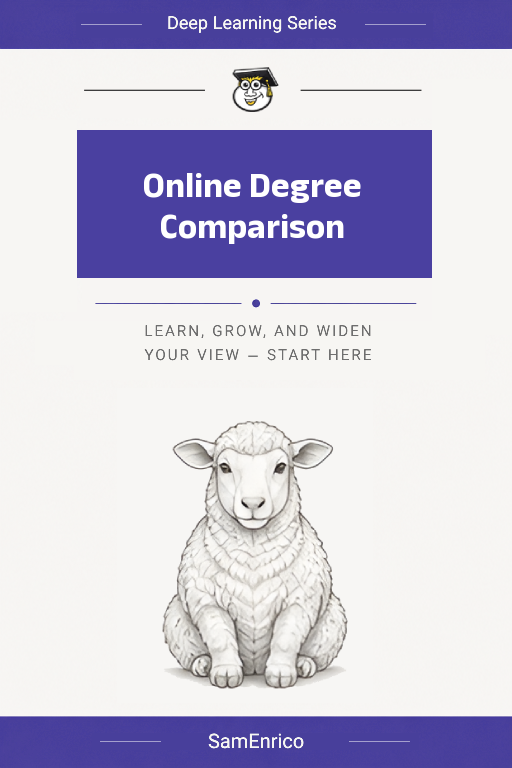
Non-FictionStudent's ShortcutOnline
Online Degree Comparison eBook
Compare UK Open University, US online programs, an
by Bostick Tomi
Compare UK Open University, US online programs, and Australian online degree options globally.
Formats
Free sample
Chapter 1: The Three Engines--–- Maria had done everything right. She had a steady job in São Paulo, a decade of experience in supply chain management, and a burning desire to move into a leadership role at her multinational company. The only problem was the piece of paper she did not have: a bachelor’s degree. Her boss was blunt. “Without it, you hit the glass ceiling in eighteen months.” So Maria began a search that would take her from the Open University’s virtual halls in the United Kingdom to Arizona State University’s digital campus in the United States, and finally to the University of Melbourne’s online portal in Australia.
She was not looking for just any degree. She was looking for the right engine to launch her career across borders.This book begins with that question: what are the engines? Before you can compare tuition fees, before you can weigh accreditation against alumni networks, and before you can decide whether a competency-based degree from the United States fits your life better than an asynchronous structured degree from the United Kingdom, you need a clear map of the three national systems that dominate the global online education market. The United Kingdom, the United States, and Australia are not random choices. They are the three giants because of four distinct advantages: English as the primary language of instruction (which makes degrees globally portable), decades of experience in distance learning (the United Kingdom’s Open University celebrated its fiftieth anniversary long before the pandemic made online education mainstream), aggressive export of higher education as a national industry (Australia earns more than thirty billion Australian dollars annually from international education), and finally, the existence of clear, reliable accreditation frameworks that other countries recognize.
A student in Kenya cannot easily verify the quality of a degree from a small university in the Philippines, but she can verify a degree from a TEQSA-accredited Australian institution. That trust is the currency this entire market trades on.This chapter serves as your foundational primer. We will examine each of the three systems through the lens of the Three Pillars introduced in this book’s Introduction: Cost Architecture (how you pay and what you get), Academic Rigor (how you are taught and assessed), and Career Mobility (where the degree can take you). By the end of this chapter, you will understand not just the names of universities, but the underlying logic of each country’s approach. You will see why the United Kingdom prioritizes tutor-supported independent study, why the United States offers everything from tenured professors to volunteer faculty and competency-based acceleration, and why Australia’s Commonwealth Supported Places can make online degrees shockingly affordable for domestic students and some internationals.
More importantly, you will know which engine aligns with your life, your budget, and your ambitions.The United Kingdom Model: The Gold Standard of Distance Learning When most people think of online degrees, they think of the Open University. Founded in 1969, the Open University was the world’s first successful distance-learning university, and it remains the largest academic institution in the United Kingdom by student enrollment, with over one hundred seventy thousand students, including thirty-five thousand outside the United Kingdom. The Open University’s longevity is not an accident. It holds a Royal Charter, which is the United Kingdom’s equivalent of United States regional accreditation and Australia’s TEQSA registration. A Royal Charter is granted by the monarch on the advice of the Privy Council, and it signals that the institution meets the highest standards of academic governance, financial stability, and public accountability.
When you graduate from the Open University, your degree carries the same legal weight as a degree from Oxford or Cambridge. No employer or graduate school can dismiss it as a diploma mill because the Royal Charter guarantees its legitimacy.But the Open University is not the only player in the United Kingdom market. The University of London, through its online platform, offers degrees from member institutions like the London School of Economics and Political Science and University College London. The University of Edinburgh has robust online master’s programs in data science and artificial intelligence. However, the Open University remains the most accessible and representative model for understanding the United Kingdom system because of three distinctive features: open entry, module-based degrees, and tutor-supported asynchronous learning.Open Entry: The Radical Idea That Anyone Can Learn Unlike most United States and Australian universities, the Open University does not require prior qualifications for many of its undergraduate degrees.
You do not need A-levels, a high school diploma, or standardized test scores. You simply enroll. This open entry policy reflects the Open University’s founding mission: to provide university education to adults who were excluded from the elite campus system. In practice, this means that a student who left school at sixteen can start a bachelor’s degree alongside a student who holds a master’s from another institution. The university’s retention strategy is not to screen students at the gate, but to support them through the journey.
The trade-off is that the first year is intentionally rigorous to identify students who are not yet ready for degree-level work. Dropout rates are higher than at selective campuses, but for motivated learners, the open door is a gift.For international students, open entry removes the most terrifying barrier to higher education: the application gamble. You do not need to pay for transcript evaluation services. You do not need to take the SAT or the ACT. You do not need to write a personal statement that will be judged by an admissions committee.
You simply prove your identity, pay the module fee, and begin. This is liberating, but it also places the burden of self-assessment on you. The Open University will not tell you that you are not ready. You must discover that yourself, usually by struggling through the first assignment.Module-Based Degrees: Building Your Degree One Piece at a Time The Open University does not sell degrees. It sells modules.
A typical bachelor’s degree requires three hundred sixty credits, with each module worth ten, thirty, or sixty credits. Modules last anywhere from a few months to a full academic year. Students register for one or two modules at a time, pay per module, and only commit to the next module after completing the current one. This structure, which falls under the Academic Rigor pillar, has profound implications for Cost Architecture. If life intervenes—a job loss, a family illness, a cross-border move—you can pause after a module without losing tuition for an entire semester.
You are never locked into a multi-year financial commitment.The downside is that the per-module fee structure can be more expensive than flat-rate United States competency-based programs if you take a full course load. For the 2025 to 2026 academic year, undergraduate modules cost approximately three thousand to five thousand pounds each for international students, with a full degree ranging from eighteen thousand to thirty thousand pounds depending on the number of modules and the subject. That places the Open University in the middle of the global market: cheaper than most United States non-profit giants, more expensive…
This is the end of the free sample. Get the eBook to keep going. Buy now
About this book
Details
- Author
- Bostick Tomi
- Publisher
- SamEnrico
- Language
- English
- Genre
- Non-Fiction, Student's Shortcut, Online
- Released
- 2026-06-01
- Pages (approx.)
- 149
- Available as
- eBook, Audiobook

Read better in the ZLOADR app
Your eBooks on your phone or tablet. Sign in with your SamEnrico account and start reading.
More by Bostick Tomi
 Eisenhower For StudentsBostick Tomi$11.99
 Remote Work for PilotsBostick Tomi$11.99
 One Mindfully PracticeBostick Tomi$11.99
 Grief Insomnia ReliefBostick Tomi$11.99
 Validating Shame GuideBostick Tomi$11.99
 The Higher Power Concept GuideBostick Tomi$11.99
 Elizabeth Executions ManagementBostick Tomi$11.99
 Apology NVC MethodBostick Tomi$11.99
 The Leopard of the Limpopo: The 19th-Century Serial Killer Who Terrorized Southern AfricaBostick Tomi$11.99
 The Montreal Masterpiece Heist: How a Mafia Turncoat Exposed the UnderworldBostick Tomi$11.99
 A Collector's Handbook to the Hillman Minx Phase ViiBostick Tomi$11.99
 How to Produce Index CardsBostick Tomi$11.99
You may also like
 Hong Kong Handover 1997Dunn Johnnie$11.99
 Zumba For Postnatal Recovery CourseNeal Christian$11.99
 Zumba for BeginnersLadner Nikia$11.99
 YouTube Comment Mining GuideHumes Pandora$12.99
 Worry Box MeditationCarlin Rudy$11.99
 Workplace Stress MeditationNguyen Lynn$11.99
 Workplace Stress and Sleep RepairHawley Ivory$11.99
 Workplace Perfectionism CureDelaney Jeffry$11.99
 Workplace Injustice Anger GuideWallen Isabelle$11.99
 Work Addiction and Burnout LinkGreenwood Ester$11.99
 Women in Yoga and WellnessBeattie Galina$11.99
 Women in Stand Up ComedyChun Evangeline$11.99