
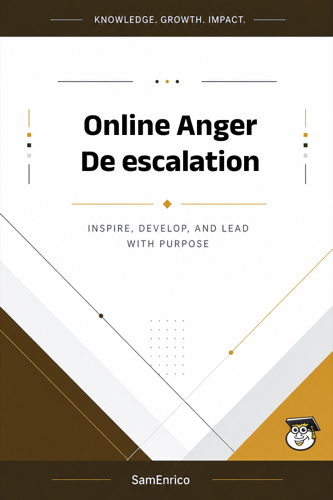
Online Anger De escalation eBook
Pause before posting angry comments and disengage
Pause before posting angry comments and disengage from online arguments gracefully.
Formats
Free sample
Chapter 1: The Dopamine Trap–- It begins with a buzz. A soft, almost friendly vibration against your thigh or a gentle ping from the speaker on your desk. You glance down. Someone has replied to your comment. Or someone has replied to someone else’s reply to your comment.
Or perhaps there is no direct mention of you at all—just a notification that a conversation you are marginally involved in has continued without you. Either way, your heart rate shifts. Your pupils dilate. Your thumb hovers. And without a single conscious decision to do so, you are already typing.This is not a failure of character.
It is not a sign that you are weak-willed or “too online” or secretly enjoy conflict. It is biology. Specifically, it is the hijacking of a neural circuit that evolved hundreds of millions of years ago to keep you alive in a world of predators and scarcity, now being triggered by a piece of curved glass and silicon designed by some of the smartest engineers on the planet. The mismatch between your ancient brain and your modern smartphone is the single most important fact about online anger that no one explains to you. Until now.Every time you see a notification, your brain releases a small pulse of dopamine.
This is not the “pleasure chemical” that pop psychology makes it out to be. Dopamine is not about enjoyment; it is about anticipation. It is the molecule of “maybe something good is about to happen.” In the ancestral environment, that meant maybe there is fruit in that tree, maybe that rustling grass contains prey, maybe that stranger will become an ally. In your pocket, it means maybe someone liked your post, maybe someone agreed with you, maybe someone finally acknowledged how right you were about that one thing. The problem is that the same neural circuitry cannot distinguish between “maybe I will eat” and “maybe I will win an argument.” To your brain, social status is survival.
And there is no faster way to threaten social status than to be publicly, demonstrably wrong.Thus the trap is set. You are not addicted to being right. You are addicted to the anticipation of being right. And social media platforms, which are not in the business of your mental health but rather your attention, have engineered every detail of their interfaces to exploit this addiction. The red notification bubble is not red by accident.
The push notification that says “Someone replied to you” without telling you what they said is not an oversight. The infinite scroll is not a convenience. These are slot machines. You are the gambler. And the jackpot is a fleeting moment of feeling superior to a stranger.This chapter will do three things.
First, it will show you, in vivid physiological detail, exactly what happens inside your brain and body when you encounter an anger-triggering comment online. Second, it will name the core insight that underpins every de-escalation strategy in this book: online arguments are about status, not survival. Third, it will introduce the foundational tool that you will use for the rest of the book—the Tiered Pause Protocol. By the time you finish this chapter, you will no longer be able to say “I don’t know why I lost my temper.” You will know exactly why. And knowing why is the first step to stopping.The Anatomy of a Snap Let us walk through the sequence slowly.
You are scrolling. Maybe it is Twitter, maybe Reddit, maybe a group chat, maybe the comments section of a news article. You see a post or a comment that strikes you as wrong. Not just factually incorrect—though that is part of it—but morally wrong, or stupidly wrong, or confidently wrong in a way that offends your sense of how the world should work. You feel a small clench in your chest.
Your jaw tightens. Your thumbs are already moving before you have finished reading the sentence.What just happened? In less than a second, your brain has done the following: your eyes sent visual data to your thalamus, which routed it to your amygdala. Your amygdala, a pair of almond-shaped clusters deep in your temporal lobes, is the smoke alarm of your brain. It does not think.
It detects threat. And it detected one. Not a physical threat—you are not in danger of being eaten—but a social threat. Someone has challenged your position, your tribe, your identity, or your competence. To your ancient limbic system, that challenge registers the same way a predator would.
Your amygdala then signals your hypothalamus, which activates your sympathetic nervous system. Your adrenal glands release adrenaline and cortisol. Your heart rate increases. Your breathing becomes shallow. Blood flows away from your prefrontal cortex—the rational, planning, impulse-control part of your brain—and toward your large muscles, preparing you to fight.This is the amygdala hijack, a term popularized by emotional intelligence researcher Daniel Goleman.
It is called a hijack because the amygdala responds to the stimulus before the prefrontal cortex has even had a chance to review the data. The rational part of your brain does not get a vote. By the time you are aware of feeling angry, the physiological cascade is already underway. You are already in fight mode. And the only thing that fight mode wants to do is fight.Here is the cruel irony.
In a physical confrontation, the amygdala hijack is useful. It gives you the speed and strength to escape or defend yourself. But in an online argument, there is nothing to fight. There is only a screen. So the energy that would have gone into throwing a punch goes into typing a reply.
And because your prefrontal cortex is currently under-resourced (blood has been redirected away from it), that reply is not going to be thoughtful, measured, or strategic. It is going to be fast, hot, and regret-shaped.The Chemical Loop The amygdala hijack is the ignition. But what keeps the engine running is the reward loop. After you post that angry reply, something surprising happens: you feel good. Not proud, necessarily, and not at peace, but activated.
There is a rush. You hit send and for a moment you feel powerful. That feeling is dopamine, released not in response to the anger itself but in response to the anticipation of a response. You have thrown a stone into the pond. Now you wait for the ripples.
Will they agree? Will they attack back? Will they finally see the error of their ways?This is the same neurological mechanism that keeps people pulling the lever on a slot machine. The machine does not pay out every time. In fact, it pays out unpredictably.
That unpredictability is what makes it addictive. If you knew exactly when the reward would come, the dopamine would stop flowing. But because you do not know—because the reply might come in thirty seconds or thirty minutes, and because it might be an apology or an escalation—the anticipation is endless. You check your phone. You refresh the page.
You check again.Meanwhile, cortisol—the stress hormone—is still elevated. Your body is in a low-grade state of alarm. This is not…
This is the end of the free sample. Get the eBook to keep going. Buy now
About this book
Details
- Author
- Harvey Sophia
- Publisher
- SamEnrico
- Language
- English
- Genre
- Non-Fiction, Self-Help, Digital
- Released
- 2026-06-12
- Pages (approx.)
- 153
- Available as
- eBook, Audiobook

Read better in the ZLOADR app
Your eBooks on your phone or tablet. Sign in with your SamEnrico account and start reading.
More by Harvey Sophia
 Soccer Penalty Kick FocusHarvey Sophia$11.99
 Whistleblower Award CasesHarvey Sophia$11.99
 High Achievers Recovery CourseHarvey Sophia$11.99
 Antwerp Diamond Heist Accomplice TrialHarvey Sophia$11.99
 The Amazon’s Lost Veins: The Obsession to Find the River’s True SourceHarvey Sophia$11.99
 Understanding Diaphragmatic Hernia Exomphalos Corpus Callosum AgenesisHarvey Sophia$17.99
 UK Skilled Worker Visa GuideHarvey Sophia$12.99
 Asia BOI GuideHarvey Sophia$12.99
 AI-Powered Content Scheduling IntelligenceHarvey Sophia$11.99
You may also like
 The Mute Button TherapyMatheny Bettie$11.99
 Name Phone Contact EntryMccaskill Kathyrn$11.99
 MBSR for Digital DetoxBarry Laure$11.99
 Pet Loss Digital MemorialWhatley Delphia$11.99
 Name Recall Practice AppMerriman Daysi$11.99
 Letting Go of Social Media ResentmentReddick Drusilla$11.99
 The Workaholic's Digital DetoxHoffman Tricia$11.99
 Mindfulness for Technology AddictsKingsley Maisie$11.99
 Metta for an Online ConnectionWingate Flo$11.99
 Divorce And Social Media GuideHalcomb Evia$11.99
 Pain Meditation App GuideGreenlee Parker$11.99
 Imposter Syndrome App CompanionPennington Delois$11.99