
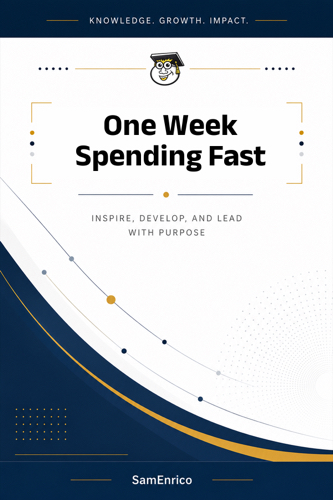
One Week Spending Fast eBook
Survive and thrive during seven days of zero non-e
Survive and thrive during seven days of zero non-essential purchases with daily coaching.
Formats
Free sample
Chapter 1: The Trigger Inventory...--–- The first time I realized I had a spending problem, I was standing in my kitchen, holding a receipt for $47 worth of candles I did not need, did not particularly want, and had bought because I was sad about an email from my boss. The candles were pumpkin-scented. It was March. I do not even like pumpkin.That moment—absurd, embarrassing, and quietly devastating—was the beginning of this book. Not because I stopped spending that day.
I did not. I bought three more candles the following week, this time for $62, because I was stressed about taxes. The pattern continued for years: emotion, click, package, guilt, repeat. I was not buying things. I was buying temporary relief from feelings I did not want to name.This chapter is not about budgeting.
It is not about spreadsheets, debt snowballs, or investment strategies. Those things matter, but they come later. This chapter is about something more fundamental and far more uncomfortable: why you spend money when you do not mean to. Before you can survive seven days of zero non-essential purchases, you must understand what drives you to make those purchases in the first place. Without that understanding, the fast becomes an exercise in pure willpower—and as you will learn, willpower is a terrible long-term strategy.The spending fast is a diagnostic tool.
Think of it as a financial MRI. But an MRI is useless if you do not know what you are looking for. This chapter gives you the map. You will identify the emotional triggers that bypass your rational brain and hijack your wallet. You will build psychological armor that works even when you are tired, stressed, or drunk-texting Amazon at 11 PM.
And you will complete a single, transformative exercise that will change how you see every purchase you make from this day forward.Let us begin with a truth that the personal finance industry does not want you to hear: you are not bad with money. You are human. And humans are not rational creatures. We are feeling creatures who occasionally think, not thinking creatures who occasionally feel. Your spending habits are not a moral failure.
They are a predictable response to predictable emotional states. Once you understand those states, you can intercept them. That is what this chapter teaches.The Myth of Retail Therapy Let us start by dismantling one of the most dangerous lies of modern consumer culture: the idea that shopping can heal emotional wounds. Call it retail therapy. Call it treating yourself.
Call it self-care. Whatever name you use, the underlying promise is the same: if you feel bad, buying something will make you feel better.The science says otherwise.In a 2013 study published in the Journal of Consumer Psychology, researchers found that the mood boost from shopping lasts approximately twenty minutes. That is it. Twenty minutes after you click "buy" or hand over your credit card, you return to your baseline emotional state. If you were sad before shopping, you are sad again twenty minutes later—only now you are also $47 poorer and the owner of three pumpkin candles in March.But here is what the study also found: the anticipation of shopping produces a larger and longer-lasting dopamine hit than the act of shopping itself.
Browsing, adding items to your cart, imagining yourself owning the thing—that fantasy is chemically rewarding. The moment you actually buy it, the dopamine curve crashes. This is why online shopping feels so compelling. The infinite scroll, the saved carts, the "you might also like" algorithms—they are all designed to keep you in the anticipation phase, where your brain is flooded with feel-good chemicals, without ever delivering the disappointing reality of ownership.This is also why you have probably bought things that sat in a box, unopened, for weeks. The fantasy was the product.
The actual object was just the receipt.Retail therapy is not therapy. Therapy is expensive, difficult, and requires vulnerability. Shopping is easy, immediate, and requires only a credit card. That ease is exactly why it does not work. Real emotional healing takes time, discomfort, and often the assistance of a trained professional.
Shopping takes twelve seconds and a Prime membership. You cannot solve a deep problem with a shallow solution.I am not saying this to shame you. I am saying it to free you. Once you accept that shopping cannot fix your feelings, you stop expecting it to. You stop being disappointed when the package arrives and you still feel sad.
You stop the cycle of hope, purchase, disappointment, guilt, and repeat. The myth of retail therapy keeps you trapped. The truth sets you up for a spending fast.The Seven Emotional Spenders Over the past decade of studying spending behavior—both my own and that of thousands of readers, clients, and workshop attendees—I have found that non-essential purchases are almost always driven by one of seven emotional states. I call these the Seven Emotional Spenders. Learn to recognize them, and you learn to recognize the warning signs of an impending impulse purchase.Boredom Boredom is the most dangerous emotional spender because it feels neutral.
You are not sad, not stressed, not angry. You are just... nothing. And nothing, it turns out, is intolerable for the human brain. When we are bored, we crave stimulation.
Shopping provides instant, effortless stimulation. Open an app. Scroll. See something shiny. Buy it.
The whole process takes less than a minute, and for that minute, you are not bored anymore.The problem, of course, is that the boredom returns as soon as the transaction is complete. Now you are bored and poorer. So you scroll again. The cycle repeats.Boredom spending is usually small in individual amounts but devastating in aggregate. Five dollars here, twelve dollars there, a nineteen-dollar subscription you forgot to cancel.
These micro-purchases fly under the radar of your rational brain. They do not trigger the same alarm bells as a $200 shopping spree. But they add up. A 2022 study found that the average American spends $314 per month on impulse purchases driven primarily by boredom. That is nearly $3,800 per year.Stress Stress spending feels different from boredom spending.
It has urgency. You are not casually browsing; you are hunting for relief. Your shoulders are tight, your jaw is clenched, and your brain is screaming for anything that will lower the pressure. Shopping offers a quick hit of control. You cannot control the deadline at work, the argument with your partner, or the medical bill that just arrived.
But you can control the decision to buy a new sweater. For a moment, that feels like agency.Stress spending is the most common trigger I see in my coaching practice. It is also the most rational, in a strange way. Your body is in fight-or-flight mode, and your brain is looking for an escape hatch. Shopping is an escape.
It is not a good one, but it is available, legal, and socially acceptable. The problem is that stress spending does not address the source of the stress. It merely adds financial stress to whatever stress was already there. Now you have two problems instead of one.Hunger This one…
This is the end of the free sample. Get the eBook to keep going. Buy now
About this book
Details
- Author
- Schiller Shenika
- Publisher
- SamEnrico
- Language
- English
- Genre
- Non-Fiction, Self-Help, Fast
- Released
- 2026-06-06
- Pages (approx.)
- 118
- Available as
- eBook, Audiobook

Read better in the ZLOADR app
Your eBooks on your phone or tablet. Sign in with your SamEnrico account and start reading.
More by Schiller Shenika
 Flash Sales InflationSchiller Shenika$11.99
 Physical Touch Stress GuideSchiller Shenika$11.99
 Memory Palace Technique for StudentsSchiller Shenika$11.99
 Name Memory Palace GuideSchiller Shenika$11.99
 Resignation ConversationSchiller Shenika$11.99
 The 3D Printer for SchoolsSchiller Shenika$11.99
 SMART Goals for WritersSchiller Shenika$11.99
 The Ballad of the Wandering Composer: The Lost Symphony of Gustav MahlerSchiller Shenika$11.99
 The Lost Art of the Gilded Age: How America's First Billionaires Built a Legacy of ExcessSchiller Shenika$11.99
 Service Providers Guide to Music InstructionSchiller Shenika$11.99
 A Collector's Handbook to the Lagonda 3-litre Drophead CoupeSchiller Shenika$11.99
 How to Start a Cocks for Industrial Use Business (Beginners Guide)Schiller Shenika$11.99
You may also like
 Hong Kong Handover 1997Dunn Johnnie$11.99
 Zumba For Postnatal Recovery CourseNeal Christian$11.99
 Zumba for BeginnersLadner Nikia$11.99
 YouTube Comment Mining GuideHumes Pandora$12.99
 Worry Box MeditationCarlin Rudy$11.99
 Workplace Stress MeditationNguyen Lynn$11.99
 Workplace Stress and Sleep RepairHawley Ivory$11.99
 Workplace Perfectionism CureDelaney Jeffry$11.99
 Workplace Injustice Anger GuideWallen Isabelle$11.99
 Work Addiction and Burnout LinkGreenwood Ester$11.99
 Women in Yoga and WellnessBeattie Galina$11.99
 Women in Stand Up ComedyChun Evangeline$11.99