
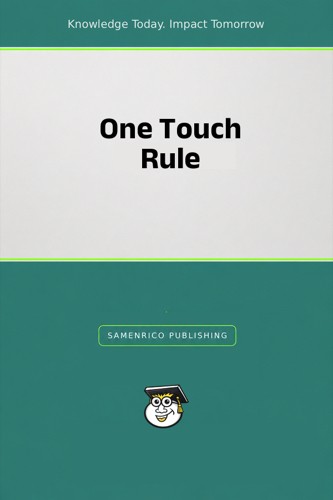
Non-FictionSelf-HelpProductivity
One Touch Rule eBook
Handle mail and tasks immediately to avoid piles.
Handle mail and tasks immediately to avoid piles.
Formats
Free sample
Chapter 1: The 11-Hour Ghost--–- The first time I realized I had a problem, I was standing in my kitchen at 11:47 PM, eating cold pizza over the sink, while my unread email count ticked past 47,000. My three-year-old daughter had been asleep for hours. My wife had gone to bed without saying goodnight. And I was re-reading an email from my boss that I had already opened fourteen times over the previous nineteen days.I knew what the email said. I had known since day one.
It was a simple request: “Can you send me the Q3 numbers by Thursday?” That was it. Nineteen words. A task that would take, at most, four minutes to complete. Pull the report, attach it, type “Here you go,” send. Four minutes.
But for nineteen days—nearly three full weeks—I had opened that email, read those nineteen words, felt a small spike of anxiety, and closed it again.Fourteen times.I wasn’t lazy. I was a senior director at a mid-sized tech company. I worked sixty-hour weeks. I answered emails at midnight and on Sundays. I was exhausted, perpetually behind, and secretly ashamed that I couldn’t seem to do the one thing my job required: keep up.
The pile on my desk had grown to six inches high. The pile on my kitchen counter was worse. And the pile in my head—the constant buzzing list of things I had not done, should have done, needed to remember—was deafening.That night, eating cold pizza alone, I asked myself a question I had been avoiding for years: Why can’t I just do the thing?The answer, it turned out, was not that I was lazy, disorganized, or stupid. The answer was that I had never learned how to decide.This book is the result of what I learned next. Over the following two years, I read every productivity book I could find—Getting Things Done, Atomic Habits, Essentialism, The Organized Mind, and more than a dozen others.
I tested their systems. I failed at most of them. And then, slowly, I distilled what worked into a single principle: Touch things once.The One Touch Rule changed my life. It cut my email processing time from two hours per day to twenty minutes. It cleared my desk, my counter, and most importantly, my mind.
It saved my marriage—not because my wife cared about my inbox, but because I stopped being distracted and started being present. And it can do the same for you.But before we get to the solution, we have to diagnose the problem. And the problem starts with a lie we all believe: that putting something aside “for later” is harmless.It is not harmless. It is the most expensive habit you have.The Myth of Later Let me be direct with you: “Later” does not exist.Later is not a time on the clock. Later is not a day on the calendar.
Later is a feeling—the vague, warm illusion that you will have more energy, more focus, and more willpower at some imaginary future moment. Later is a ghost. You cannot schedule a meeting with Later. You cannot put Later on your to-do list. Later is the name we give to the act of not deciding.Here is what actually happens when you put something aside for later: you do not save time.
You create a new task called “remembering to do the thing later.” And that new task—the remembering—is often more expensive than the original task would have been.Consider the email I mentioned earlier. Nineteen words. Four minutes of execution time. But over nineteen days, I touched that email fourteen times. Each touch cost me about ninety seconds of re-reading, re-deciding, and self-recrimination.
That is twenty-one minutes of pure friction—five times the execution time—before I had done a single second of actual work.That is the hidden cost of “later.” It is not a delay. It is a multiplication.I call this the Re-Touch Tax. Every time you touch an item—an email, a piece of mail, a task, a conversation—without completing it, you pay a tax. You pay in attention. You pay in mental energy.
You pay in the quiet, grinding anxiety of a task that will not leave you alone. And you pay again the next time you touch it, and the time after that.The average professional, according to research compiled by the Mc Kinsey Global Institute, spends 28 percent of their workweek reading and responding to email alone. But here is the number that should terrify you: nearly 40 percent of that time is spent re-reading emails they have already seen. Not answering. Not acting.
Re-reading.That is the Re-Touch Tax in action. You are not busy. You are re-busy.The Zeigarnik Effect: Why Your Brain Betrays You To understand why we pile, we have to understand something strange about how your brain works. In the 1920s, a Lithuanian psychologist named Bluma Zeigarnik made a discovery that would shape our understanding of motivation for the next century. She noticed that waiters in Vienna cafes could remember complex drink orders with astonishing accuracy—but only until the order was delivered.
Once the customer paid and left, the waiter’s memory of that order vanished almost immediately.Zeigarnik was intrigued. She designed a series of experiments in which participants were given simple tasks (puzzles, math problems, manual tasks) but were interrupted halfway through on some of them. Later, when asked to recall the tasks, participants remembered the interrupted tasks nearly twice as well as the completed ones.This is now called the Zeigarnik Effect: your brain holds unfinished tasks in a privileged memory slot. It flags them as “important” not because they matter, but because they are incomplete. The open loop demands attention.This is why you lie in bed at 2:00 AM remembering that you forgot to reply to your aunt’s email.
It is not a good email. It is not an urgent email. But your brain, following its ancient programming, treats “incomplete” as “dangerous.” The open loop is a cognitive alarm that will not stop ringing until you close it.Every pile on your desk, every unread email in your inbox, every task you deferred to “later” is an open loop. And your brain is ringing that alarm constantly, quietly, in the background of every moment of your life. You are not anxious because you have too much to do.
You are anxious because you have too much that is not done.The Zeigarnik Effect explains why “later” is so expensive. When you put something down instead of putting it away, you do not remove the task from your mental load. You convert it from active work into background noise. And background noise is exhausting because you cannot turn it off.The Data: What the Re-Touch Tax Costs You Let me give you three numbers that changed my life.Number one: 11 hours per week. According to a study by the productivity software company Wrike, the average professional spends 11 hours each week—more than a full workday—re-reading emails, re-opening documents, and re-deciding what to do with tasks they have already…
This is the end of the free sample. Get the eBook to keep going. Buy now
About this book
Details
- Author
- Gaddy Celinda
- Publisher
- SamEnrico
- Language
- English
- Genre
- Non-Fiction, Self-Help, Productivity
- Released
- 2026-06-06
- Pages (approx.)
- 129
- Available as
- eBook, Audiobook

Read better in the ZLOADR app
Your eBooks on your phone or tablet. Sign in with your SamEnrico account and start reading.
More by Gaddy Celinda
 Reverse Brainstorming Group GuideGaddy Celinda$11.99
 Student Networking DubaiGaddy Celinda$11.99
 Weightlifting Hypnosis WorkbookGaddy Celinda$11.99
 Dental Evidence in CourtGaddy Celinda$11.99
 Self Hypnosis for Climate AnxietyGaddy Celinda$11.99
 Acupuncture for Women's HealthGaddy Celinda$11.99
 Massage For HeadachesGaddy Celinda$11.99
 The Mathematicians of Timbuktu: Unveiling Africa's Forgotten GeniusesGaddy Celinda$11.99
 The Lion and the Eagle: Henry V and the Forge of EnglandGaddy Celinda$11.99
 One Page Marketing Playbook for MoversGaddy Celinda$12.99
 Filipino Content Writing GuideGaddy Celinda$12.99
 Seahorses: Unique FishGaddy Celinda$11.99
You may also like
 Hong Kong Handover 1997Dunn Johnnie$11.99
 Zumba For Postnatal Recovery CourseNeal Christian$11.99
 Zumba for BeginnersLadner Nikia$11.99
 YouTube Comment Mining GuideHumes Pandora$12.99
 Worry Box MeditationCarlin Rudy$11.99
 Workplace Stress MeditationNguyen Lynn$11.99
 Workplace Stress and Sleep RepairHawley Ivory$11.99
 Workplace Perfectionism CureDelaney Jeffry$11.99
 Workplace Injustice Anger GuideWallen Isabelle$11.99
 Work Addiction and Burnout LinkGreenwood Ester$11.99
 Women in Yoga and WellnessBeattie Galina$11.99
 Women in Stand Up ComedyChun Evangeline$11.99