
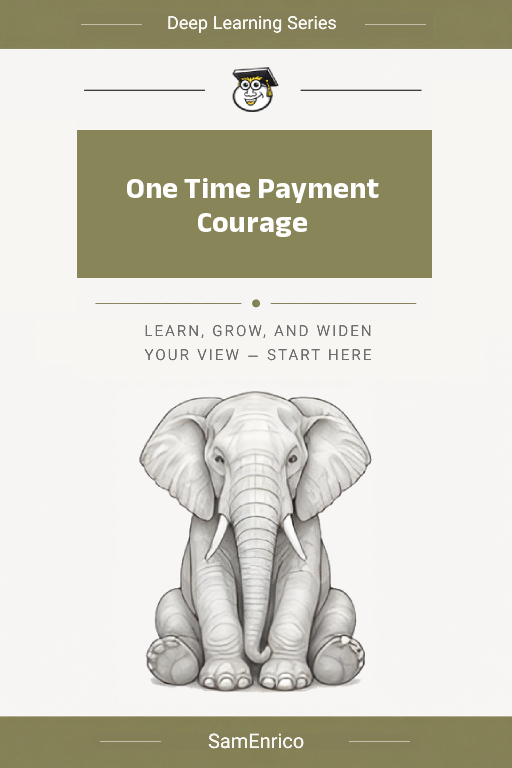
One Time Payment Courage eBook
Charge high one time fees confidently by emphasizi
by Cobb Vincent
Charge high one time fees confidently by emphasizing lifetime value and ownership benefits.
Formats
Free sample
Chapter 1: The Subscription Funeral--The funeral was for a $47 monthly fee.I know that sounds absurd. But there I was, sitting in a coffee shop across from a potential client—let’s call her Sarah—who had just pulled up her bank statement on a laptop. She wasn’t crying, but she was close. For the last forty-seven months, she had been paying $47 for a piece of software she hadn’t opened in thirty-nine of those months. Do the math.
Nearly two thousand dollars. For nothing. She didn’t even remember signing up. The software had long since stopped being useful. Its features had been surpassed by free tools.
But the charge kept coming. Every month. Like a ghost in the machine.Sarah wasn’t poor. She ran a mid-sized marketing agency with seven figures in annual revenue. The 47wasn’tgoingtobreakher.Whatbrokeherwastherealizationthatshehadbeenbleedingsmallamountsofmoneyforyearswithoutnoticing.When Iaskedhertototalallheractivesubscriptionsacrosspersonalandbusinessaccounts,herfacewentpale.47 wasn’t going to break her.
What broke her was the realization that she had been bleeding small amounts of money for years without noticing. When I asked her to total all her active subscriptions across personal and business accounts, her face went pale. 47wasn’tgoingtobreakher.Whatbrokeherwastherealizationthatshehadbeenbleedingsmallamountsofmoneyforyearswithoutnoticing.When Iaskedhertototalallheractivesubscriptionsacrosspersonalandbusinessaccounts,herfacewentpale.1,247 per month. Over 15,000peryear.Nearly15,000 per year. Nearly 15,000peryear.Nearly100,000 over the last six years.
And that was just the subscriptions she could remember. The ones she had actually forgotten—the ghosts—added another $200 per month.“I feel like an idiot,” she said.I told her she wasn’t an idiot. She was just a normal person living in a subscription economy. And that economy is designed to make you forget.This book is not about Sarah’s subscriptions. This book is about what happened next.
Because when I asked Sarah why she didn’t just buy permanent versions of the tools she actually used, she looked at me like I had suggested she move into a cave. “No one sells permanent versions anymore,” she said. “Everything is monthly.”She was almost right. Almost.Hidden beneath the avalanche of recurring fees, a different kind of business is thriving. A business that offers the one thing subscription companies cannot: an ending.
A final payment. A moment when the client writes a single, large check and then never thinks about that expense again. These businesses charge three, five, even ten times more than their subscription competitors for the exact same outcome. And their clients love them for it.This chapter is the funeral for the assumption that subscriptions are inevitable. It is the eulogy for the myth that buyers prefer renting over owning.
And it is the invitation to bury your fear of the one-time payment forever.The Great Subscription Migration Let’s rewind twenty years. The year is 2004. Most software comes in a box. You go to a store—yes, a physical store—buy a CD-ROM, install it on your computer, and own it forever. If you want an upgrade, you buy another box a year or two later.
Microsoft Office cost 399forapermanentlicense.Adobe Photoshopcost399 for a permanent license. Adobe Photoshop cost 399forapermanentlicense.Adobe Photoshopcost649. You paid once, you owned it. The relationship between buyer and seller ended at the cash register, except for the occasional support call.Then something shifted.In 2010, Adobe announced it would no longer sell Creative Suite as a one-time purchase. Instead, customers would pay $49.99 per month for access.
The backlash was immediate and vicious. Designers called it extortion. Bloggers predicted Adobe’s demise. A Change.org petition demanding the return of perpetual licenses gathered tens of thousands of signatures. But Adobe held firm.
And within three years, their revenue had nearly doubled.The rest of the business world took notes. Microsoft launched Office 365 as a subscription. Amazon turned Prime from a shipping perk into a bundled subscription empire. Netflix transformed from a DVD-by-mail service into the streaming giant that trained a generation to pay monthly for content they would never own. Spotify did the same for music.
Peloton for fitness. Blue Apron for food. Dollar Shave Club for razors. Every industry, from razors to razors, went recurring.On the surface, this made perfect sense. For sellers, subscriptions create predictable, recurring revenue.
Investors love recurring revenue. A company with 10millioninmonthlyrecurringrevenueisvaluedhigherthanacompanywith10 million in monthly recurring revenue is valued higher than a company with 10millioninmonthlyrecurringrevenueisvaluedhigherthanacompanywith120 million in annual one-time sales, even though the numbers are identical. Why? Certainty. Subscriptions smooth out the peaks and valleys of one-time purchases.
They turn customers into annuity streams. They make financial forecasting feel like science rather than art.For buyers, subscriptions offered low entry points. Instead of paying 649for Photoshop,youcouldpay649 for Photoshop, you could pay 649for Photoshop,youcouldpay20 for a month, use it for a project, and cancel. Instead of buying a 15,000pieceofgymequipment,youcouldpay15,000 piece of gym equipment, you could pay 15,000pieceofgymequipment,youcouldpay39 per month for a Peloton and see if you actually used it. Subscriptions lowered the risk of commitment.
They made expensive things feel cheap.But something happened on the way to the subscription utopia. Something the economists and Saa S founders did not predict.The Psychology of Death by a Thousand Cuts Here is what the subscription industry understood: humans are terrible at multiplication.We are wired to evaluate costs in the moment, not over time. A 15monthlyfeefeelslike15 monthly fee feels like 15monthlyfeefeelslike15. It does not feel like 180peryear.Itdefinitelydoesnotfeellike180 per year. It definitely does not feel like 180peryear.Itdefinitelydoesnotfeellike1,800 over a decade.
Our brains process the immediate expense and file it under “small” without projecting it forward. Subscription companies exploit this cognitive blind spot ruthlessly.But here is what the subscription industry missed: humans eventually learn.After the fifth forgotten subscription, after the twelfth monthly charge for a service you barely use, after the annual ritual of scrolling through your bank statement and muttering “what is THIS one,” the math crystalizes. You realize you have spent thousands of dollars on things you do not own. You realize there is no end. The payments will continue until you actively stop them, and even then, the companies make cancellation a labyrinth of dark patterns and retention offers.This is called subscription fatigue.
And it is everywhere.A 2023 survey of 2,500 consumers found that the average person underestimates their monthly subscription spending by 200%. People think they spend 80permonthonsubscriptions.Theyactuallyspend80 per month on subscriptions. They actually spend 80permonthonsubscriptions.Theyactuallyspend240. The same study found that 42% of people have forgotten they were paying for a subscription for six months or longer. That is not a marketplace.
That is a tax on inattention.In the business-to-business world, the numbers are even more staggering. The average small business carries 3,500permonthin Saa Ssubscriptions.Theaveragemid−sizedbusinesscarries3,500 per month in Saa S subscriptions. The average mid-sized business carries 3,500permonthin Saa Ssubscriptions.Theaveragemid−sizedbusinesscarries12,000 per month. And according to subscription management platform Cledara, 30% of those subscriptions are completely unused. Businesses are paying tens of thousands of dollars annually for software their employees installed once, used twice, and forgot forever.I interviewed a CFO of a manufacturing company who discovered his team was paying for seventeen different project management tools.
Seventeen. The company had seventy-three employees. When he gathered everyone in a room and asked which tool they actually used, three tools covered 90% of the work. The…
This is the end of the free sample. Get the eBook to keep going. Buy now
About this book
Details
- Author
- Cobb Vincent
- Publisher
- SamEnrico
- Language
- English
- Genre
- Non-Fiction, First 30 Days, One Time
- Released
- 2026-05-30
- Pages (approx.)
- 139
- Available as
- eBook, Audiobook

Read better in the ZLOADR app
Your eBooks on your phone or tablet. Sign in with your SamEnrico account and start reading.
More by Cobb Vincent
 Child Loss And Phone NumberCobb Vincent$11.99
 Self Hypnosis for SupplementCobb Vincent$11.99
 Coroner Death Investigation StressCobb Vincent$11.99
 Self Hypnosis for Fear of CommitmentCobb Vincent$11.99
 The DBT Emotion JournalCobb Vincent$11.99
 Herd Immunity Explained WorkbookCobb Vincent$11.99
 Script Writing for HypnosisCobb Vincent$11.99
 Alcohol Recovery for LawyersCobb Vincent$11.99
 The Timbuktu Codebreakers: Cracking the Cosmos with NumbersCobb Vincent$11.99
 The Unseen War: How a Tiny Swiss Town Took Over the Global Watch IndustryCobb Vincent$11.99
 Sealyham Terrier: Rare TerrierCobb Vincent$11.99
 How to Produce Security and Protection ProductsCobb Vincent$11.99