
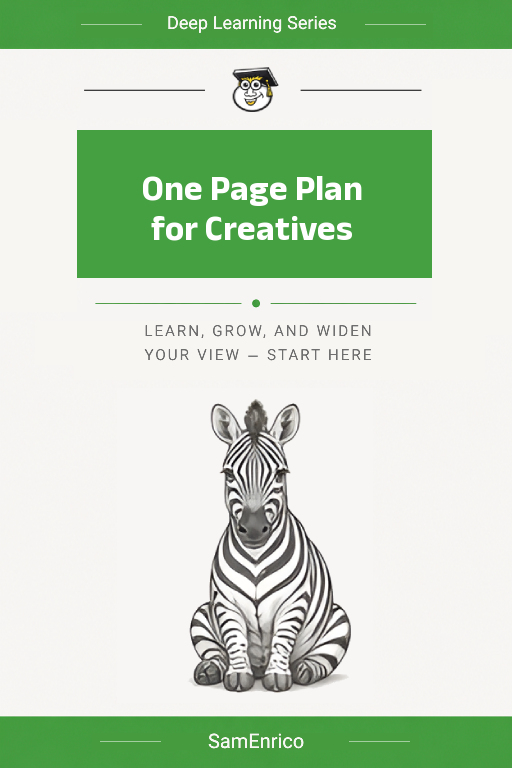
Non-FictionFirst 30 DaysLean Planning
One Page Plan for Creatives eBook
Create lean plan for artists, designers, and maker
Create lean plan for artists, designers, and makers. Portfolio, commissions, and sales channels.
Formats
Free sample
Chapter 1: The CEO Mirror--Every time you call yourself a “starving artist,” you are making a prophecy, not a statement of fact.That single phrase—hungry, desperate, waiting to be discovered—has destroyed more creative careers than bad reviews, economic recessions, or algorithmic changes combined. It is not a badge of honor. It is not proof of authenticity. It is a permission slip to neglect the boring, unsexy, utterly essential work of running a business. And the cruelest irony is this: the very artists who wear “starving” as a crown are often the most technically gifted.
They pour thousands of hours into their craft while refusing to spend ten minutes learning how to price a commission. They build elaborate studios while letting their invoices go unpaid. They dream of gallery shows while treating their own email list like spam.This book exists because that pattern is not romantic. It is tragic. And it is entirely optional.The central argument of The One Page Plan for Creatives is simple: you do not have to choose between being an artist and being a businessperson.
That dichotomy is a lie invented by people who benefit from your underearning—galleries that take 50% commissions, clients who sense your desperation, and a culture that has somehow convinced you that poverty purifies creativity. The most successful creatives you admire are not the ones who suffered the most. They are the ones who learned to separate their identity from their output, to build systems that protect their studio time, and to treat their creative practice as a legitimate, thriving enterprise.This chapter is not about spreadsheets or profit margins. Those come later. This chapter is about looking in the mirror and deciding that you are allowed to want both: the work and the wage, the art and the abundance, the making and the money.The Creative’s False Choice Let us name the lie explicitly.
Nearly every creative entrepreneur has heard some version of the following internal monologue:“If I spend time on marketing, I am not making art.”“If I charge what I am worth, I will lose the clients I love.”“If I think about money, I am selling out.”“If I treat this like a business, I will kill the magic.”These statements feel true because they have been repeated so often. But feel is not the same as is. Let us examine each one with the cold light of logic.First: “If I spend time on marketing, I am not making art.” This assumes that making art is the only legitimate use of your time. But making art that nobody sees, that nobody buys, that sits in a drawer or a hard drive forever—is that truly more noble than spending an hour writing an email to people who actively want to support you? The ceramicist who spends forty hours a week at the wheel and two hours on packaging, pricing, and posting is not a pure artist.
She is a bad business owner. And bad business owners eventually cannot afford clay.Second: “If I charge what I am worth, I will lose the clients I love.” This confuses correlation with causation. The clients who love you—who truly value your vision, your skill, your unique perspective—will not leave because you raised your prices. They will celebrate your growth. The clients who leave were never clients; they were bargain hunters.
And bargain hunters do not sustain creative careers. They exhaust them.Third: “If I think about money, I am selling out.” Selling out means compromising your artistic integrity for commercial gain. Thinking about money is not the same as compromising your integrity. Money is simply a tool. It pays for studio rent, better materials, health insurance, and the ability to say no to projects that do not serve you.
The artists who never think about money are not pure; they are privileged. They have a partner, an inheritance, or a trust fund that allows them to ignore the math. For the rest of us, thinking about money is survival.Fourth: “If I treat this like a business, I will kill the magic.” This is the most seductive lie of all. It suggests that structure and spontaneity are enemies. But consider the evidence: the most innovative, surprising, boundary-pushing artists in history—from Mozart to Murakami, from Frida Kahlo to Frank Gehry—worked within rigorous systems.
They had schedules. They had habits. They had contracts. They treated their craft with professional discipline precisely because they wanted to protect the magic from the chaos of the world. Structure does not kill creativity; chaos does.The Lean Canvas for Creatives Now that we have cleared the psychological debris, we can build something new.
The traditional business plan—with its forty-page projections, its dense market analyses, its five-year forecasts—was designed for venture capitalists and bankers, not for painters and potters. It assumes linear growth, predictable customers, and a world that stands still. Your creative business is none of those things.What you need instead is a Lean Canvas. This is a one-page visual framework that captures everything essential about your creative practice without the corporate jargon. It was adapted from the lean startup methodology, but it has been refined over years of working with artists, designers, and makers who needed something they could fill out in under an hour and actually use the next day.The Lean Canvas for Creatives has nine boxes.
You will fill them out as you read through this book, but for now, let us simply name them:The Problem You Solve (What pain point does your art address for buyers?)Your Unique Visual Style (What makes your work unmistakably yours?)Ideal Buyers (Who needs your work most desperately?)Current Alternatives (What do buyers do if they cannot buy from you?)Your Solution (How does your work solve the problem better than alternatives?)Revenue Streams (Commissions? Prints? Originals? Licensing? Teaching?)Cost Structure (What does it cost you to make, market, and deliver?)Key Sales Channels (Where will you find your buyers?)Your Freedom Number (We will get to this in a moment—it is the most important box.)Do not try to fill out all nine boxes right now.
This chapter focuses on the psychological foundation and the Freedom Number. The other boxes will be built in subsequent chapters.The Freedom Number: Your North Star Here is the single most practical thing you will read in this entire book: You cannot plan a business until you know exactly how much money you need to live the life you want.Not survive. Not scrape by. Not “make enough to buy more clay.” Thrive. Sleep through the night without worrying about rent.
Replace your laptop when it breaks. Take a vacation. Save for retirement. Buy health insurance. Hire help when you are overwhelmed.
Say no to a project that feels wrong because you do not need the money desperately.Most creative business advice tells you to start with your prices or your products or your portfolio. That is backward. You start with your life. What does your life cost? What would it cost for you to wake up every morning excited to work, unafraid of the bills…
This is the end of the free sample. Get the eBook to keep going. Buy now
About this book
Details
- Author
- Bartels Trish
- Publisher
- SamEnrico
- Language
- English
- Genre
- Non-Fiction, First 30 Days, Lean Planning
- Released
- 2026-06-01
- Pages (approx.)
- 125
- Available as
- eBook, Audiobook

Read better in the ZLOADR app
Your eBooks on your phone or tablet. Sign in with your SamEnrico account and start reading.
More by Bartels Trish
 Road Rage In Parking LotsBartels Trish$11.99
 Metta For Grief RecoveryBartels Trish$11.99
 Student Anger for TeachersBartels Trish$11.99
 Swift Transport Exit PlaybookBartels Trish$11.99
 The Postpartum Mental Health GuideBartels Trish$11.99
 The Ballad of the First Country Legend: The Untold Story of James DickersonBartels Trish$11.99
 Digital Payment Provider MapBartels Trish$12.99
 The Delphi Murders: Small Town MysteryBartels Trish$11.99
 A Beginners Guide to Fast Pitch (Volume 1)Bartels Trish$11.99
You may also like
 Hong Kong Handover 1997Dunn Johnnie$11.99
 Zumba For Postnatal Recovery CourseNeal Christian$11.99
 Zumba for BeginnersLadner Nikia$11.99
 YouTube Comment Mining GuideHumes Pandora$12.99
 Worry Box MeditationCarlin Rudy$11.99
 Workplace Stress MeditationNguyen Lynn$11.99
 Workplace Stress and Sleep RepairHawley Ivory$11.99
 Workplace Perfectionism CureDelaney Jeffry$11.99
 Workplace Injustice Anger GuideWallen Isabelle$11.99
 Work Addiction and Burnout LinkGreenwood Ester$11.99
 Women in Yoga and WellnessBeattie Galina$11.99
 Women in Stand Up ComedyChun Evangeline$11.99