
Non-FictionBusiness BriefRemote Work
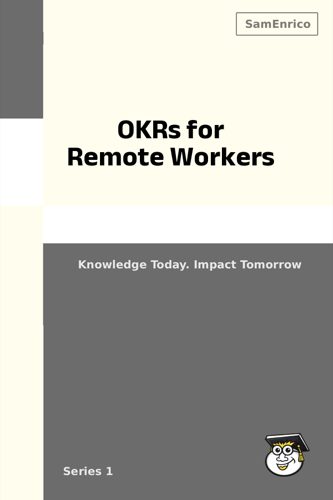
OKRs for Remote Workers eBook
Maintain visibility and accountability without dai
by Fry Codi
Maintain visibility and accountability without daily supervision.
Formats
Free sample
Chapter 1: The Visibility Trap--–- The call came in at 10:47 AM on a Tuesday. Sarah, a marketing director at a fast-growing Saa S company, was staring at her laptop, refreshing Slack for the third time in ten minutes. Her best remote designer, Marcus, had been "away" for two hours. No status update. No message.
No response to her polite ping. Her heart rate was climbing. Was he working? Was he sick? Was he interviewing elsewhere?
She was about to call his personal phone when Marcus finally messaged back: "Sorry, was in a deep work session redesigning the landing page. Got it done. Conversion rate jumped 12% in A/B testing."Sarah felt relief, then shame. She had spent two hours spiraling over a green status light while Marcus had been delivering the best work of his career. She wasn't alone.
Across the world, millions of managers were doing the same thing—confusing the illusion of presence with the reality of productivity.The Myth of the Visible Worker The industrial revolution trained us to manage what we can see. Factory foremen walked the floor, watching hands move, counting units per hour, observing posture and pace. If a worker was at their station, they were producing. If they weren't, they weren't. Simple.
Effective. Wrong for knowledge work.That mental model has survived for over a century, and it has found new life in the remote work era through surveillance software, activity trackers, and the desperate hope that a green Slack dot means something. But here is the uncomfortable truth that this chapter will prove with data, stories, and hard logic: there is zero correlation between visible presence and productive output in knowledge work.Zero.Let that land.The most prolific coder you have ever managed might work in four-hour bursts with long walks in between. The best writer on your team might do their deepest thinking lying on a couch with their eyes closed. The account executive who closes million-dollar deals might take a two-hour lunch every day and finish at 3 PM.
Conversely, the person who responds to every Slack message within thirty seconds, who has their camera on for every meeting, who never shows as "away"—that person might be delivering mediocre work while performing the theater of busyness.The visibility trap is the cognitive bias that assumes what you can see is what matters, and what you cannot see does not exist. In remote work, this bias becomes a management disaster.The Anatomy of the Trap Let us dissect exactly how the visibility trap works, because understanding its mechanisms is the first step to escaping it.Step One: Anxiety triggers observation. You are a manager. You cannot see your team. That feels wrong.
In the office, you could glance over a cubicle wall. Now, there is a void. Your brain, wired for a world of physical cues, interprets the void as danger. Something might be wrong. Someone might be slacking.
You might be losing control.Step Two: Observation seeks proxies. Since you cannot see actual output in real time, you grasp for whatever is visible. Slack status. Last active time. Cursor movement in shared documents.
Response latency. Calendar openness. Video camera on/off. These become your false beacons.Step Three: Proxies become targets. You start to reward the proxies.
You feel good about the person who replies fast. You feel anxious about the person who is often "away." Without realizing it, you begin to manage to the proxies. "Can you just keep me updated more?" you ask, which really means "Can you perform visibility for me?"Step Four: Performative work replaces real work. Your team learns what you reward. They start logging in early and staying late—not to work, but to be seen.
They send trivial Slack messages to show activity. They keep their cameras on even when they are not paying attention. They generate busyness. They stop generating value. The visibility trap has sprung.The Data That Should Terrify You In 2022, a large-scale study of over 5,000 remote workers across fifty companies found something that should be printed on posters in every management office: there was no statistical difference in productivity between workers who maintained "high presence" (always online, fast replies, frequent updates) and those who maintained "low presence" (offline for hours, delayed replies, minimal updates).None.What did predict productivity?
Two things. First, clarity of goals. Workers who could state their top priority in one sentence were 40% more productive than those who could not. Second, autonomy over schedule. Workers who controlled their own hours—including long uninterrupted blocks—were 35% more productive.In other words, the visibility trap does not just waste your time as a manager.
It actively destroys the conditions that create productivity. By demanding presence, you remove autonomy. By removing autonomy, you kill the deep focus that produces results.A separate study of 1,200 managers found that those who reported "high anxiety" about remote work were three times more likely to use activity tracking software. Those same managers reported the lowest team performance scores. Anxiety drove surveillance, and surveillance drove underperformance.
The visibility trap is a self-fulfilling prophecy.Asynchronous Accountability: The Escape The solution to the visibility trap is not more visibility. It is a complete reconceptualization of what "visibility" means. This book will introduce the concept of Asynchronous Accountability—the idea that work becomes visible through its results, not through real-time observation of the worker.Think of it this way. A lighthouse does not follow ships. It does not check on them every hour to see if they are still moving.
A lighthouse stands still, shines a consistent beam, and lets captains navigate themselves. The lighthouse provides a fixed point of reference—a clear destination and a warning of danger. That is it. That is all accountability should be.Bad managers act like tugboats. They circle the ship, push and pull, try to steer every turn.
They exhaust themselves and annoy the captain. Good remote managers act like lighthouses. They set a clear Objective (the beam), define measurable Key Results (the distance markers), and trust the worker to navigate.Asynchronous accountability has three pillars:Pillar One: Outcome metrics over activity metrics. Activity metrics are emails sent, hours logged, keystrokes, cursor movements, meetings attended. Outcome metrics are bugs fixed, revenue generated, customers retained, features shipped.
Activity metrics are easy to measure and mean nothing. Outcome metrics are harder to define and mean everything. The rest of this book will show you how to define outcome metrics with surgical precision.Pillar Two: Written over verbal. Verbal updates (meetings, calls, quick "check-ins") are synchronous. They interrupt flow.
They prioritize the speaker's availability over the listener's focus. Written updates (documents, async check-ins, recorded videos) are asynchronous. They create a permanent record. They allow the receiver to consume information on their own schedule. They scale across time zones.
They force clarity because writing is thinking.Pillar Three: Scheduled over spontaneous. Spontaneous check-ins ("Hey, got a minute?") are the enemy of deep work. They train workers to stay in a state of shallow, interruptible readiness. Scheduled accountability (weekly written updates, quarterly OKR reviews, monthly retrospectives) creates predictable rhythms. Workers know when accountability happens.
They can plan their deep work around it. They are not constantly waiting for the next ping.Why Your Anxiety Is…
This is the end of the free sample. Get the eBook to keep going. Buy now
About this book
Details
- Author
- Fry Codi
- Publisher
- SamEnrico
- Language
- English
- Genre
- Non-Fiction, Business Brief, Remote Work
- Released
- 2026-06-11
- Pages (approx.)
- 145
- Available as
- eBook, Audiobook

Read better in the ZLOADR app
Your eBooks on your phone or tablet. Sign in with your SamEnrico account and start reading.
More by Fry Codi
 Operation Car Wash Frozen AssetsFry Codi$11.99
 US 179D Energy DeductionFry Codi$11.99
 Family Acceptance Self EsteemFry Codi$11.99
 Alcohol Withdrawal Safety and Self CareFry Codi$11.99
 The Silent Revolution: How a 19th-Century Inventor Outsmarted the WorldFry Codi$11.99
 Classroom Voice Analytics GuideFry Codi$12.99
 US AI Executive Order WorkbookFry Codi$12.99
 Ultimate Handbook Guide to Tokyo : (Japan) Travel GuideFry Codi$11.99
 Playing Team SportsFry Codi$11.99
 Understanding Idaho SyndromeFry Codi$17.99
You may also like
 Hong Kong Handover 1997Dunn Johnnie$11.99
 Zumba For Postnatal Recovery CourseNeal Christian$11.99
 Zumba for BeginnersLadner Nikia$11.99
 YouTube Comment Mining GuideHumes Pandora$12.99
 Worry Box MeditationCarlin Rudy$11.99
 Workplace Stress MeditationNguyen Lynn$11.99
 Workplace Stress and Sleep RepairHawley Ivory$11.99
 Workplace Perfectionism CureDelaney Jeffry$11.99
 Workplace Injustice Anger GuideWallen Isabelle$11.99
 Work Addiction and Burnout LinkGreenwood Ester$11.99
 Women in Yoga and WellnessBeattie Galina$11.99
 Women in Stand Up ComedyChun Evangeline$11.99