
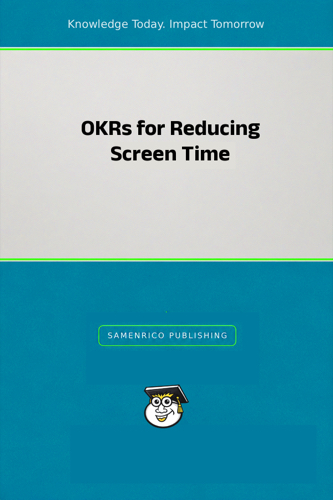
Non-FictionBusiness BriefDigital Wellness
OKRs for Reducing Screen Time eBook
Set daily phone pickups, social media minutes, and
by Hickey Tad
Set daily phone pickups, social media minutes, and app limits.
Formats
Free sample
Chapter 1: The Fourteen-Year Sentence--–- The average smartphone user will spend over fourteen cumulative years of their life staring at a screen. Not sleeping, not working, not eating—just staring. Fourteen years is enough time to earn three bachelor’s degrees, write a dozen novels, raise a child to high school, or learn three languages fluently. Instead, it disappears into a glowing rectangle.Let that number sit with you for a moment.Fourteen years is not a typo. It is not an exaggeration cooked up by alarmist researchers.
It is the mathematical reality of the average person’s screen habits in the early twenty-first century. If you are thirty years old today and you continue using your phone at the average rate, you will look back on your eightieth birthday and realize that the equivalent of nearly a decade and a half of your waking life was spent scrolling, tapping, swiping, and staring.This chapter exists to make that number feel real.Because until you feel it—not just understand it intellectually but feel it in your gut—you will not change. The data alone will not save you. The logic alone will not save you. You need to be confronted with the sheer, staggering weight of what you are losing.Let us begin with a simple question: What would you do with fourteen extra years of life?The Calculation That Changes Everything Before we go any further, take out your phone.
Open your Screen Time settings if you use an i Phone, or Digital Wellbeing if you use Android. Look at your seven-day average. Write that number down right now.Do not estimate. Do not guess. Look at the actual number.The global average is approximately four hours and thirty-seven minutes per day.
That is not a small number. That is not “a few minutes here and there.” That is nearly one-third of your waking hours dedicated to a device that did not exist twenty years ago.Now do the math. And pay close attention here, because this book will distinguish between two very different numbers, a distinction most other books ignore.First, calculate your total screen time lifetime. Use this formula:(Average daily screen minutes × 365 days × 80 years) ÷ 60 minutes ÷ 24 hours If your average is four and a half hours per day, the math looks like this: 270 minutes × 365 × 80 = 7,884,000 minutes. Divide by 60 = 131,400 hours.
Divide by 24 = 5,475 days. Divide by 365 = 15 years.Fifteen years.That number includes everything: work emails, navigation maps, banking apps, weather checks, messaging family, reading the news, and every moment of social media, gaming, and streaming. It is your total screen time footprint.But here is the crucial clarification that almost every digital wellness book gets wrong, and that this book will return to in Chapter 12 when you write your Cognitive Surplus Pledge. You are not going to eliminate all screen time. You should not.
Work requires screens. Communication requires screens. Navigation, banking, healthcare, and countless other essential activities require screens. The goal of this book is not to turn you into a Luddite living in a cabin without electricity.The goal is to reclaim the discretionary portion.So let us calculate the number that actually matters for this book: your discretionary screen time lifetime. This means social media, gaming, You Tube, news browsing, shopping apps, and any other scrolling you do purely for entertainment or distraction—not for work or essential communication.(Daily discretionary minutes × 365 × 50 remaining years) ÷ 60 ÷ 24For the average person, discretionary time is about two to three hours per day.
Let us use two and a half hours as our example: 150 minutes × 365 × 50 = 2,737,500 minutes. Divide by 60 = 45,625 hours. Divide by 24 = 1,901 days. Divide by 365 = 5.2 years.Five years.That is five years of your life that you could spend on anything else. Learning an instrument.
Traveling. Reading. Sleeping. Playing with your children. Building a business.
Falling in love. Simply being bored enough to have a creative thought.One reader of this book’s early draft wrote in the margin next to this calculation: “I just did this and I feel sick. I’ve already spent two full years of my life on Tik Tok. I don’t even like Tik Tok.”That feeling—that slight nausea, that tightening in the chest—is not an overreaction. It is the appropriate emotional response to realizing you have been robbed.
The question is: who robbed you?The Architects of Distraction Your phone was not designed to serve you. It was designed to capture you.This is not a conspiracy theory. It is not hyperbole. It is the public testimony of the very people who built the most addictive features of modern technology.In 2017, a former Google design ethicist named Tristan Harris testified before the United States Senate. He told them that the smartphone was not a neutral tool.
He explained that the infinite scroll—the feature that allows you to swipe down endlessly through content without ever reaching a natural stopping point—was deliberately engineered to exploit a vulnerability in human psychology called the “intermittent reward loop.”Let us unpack what that means, because understanding this mechanism is the first step toward defeating it.The intermittent reward loop was discovered in the 1950s by psychologist B.F. Skinner. Skinner placed a hungry rat in a box with a lever. When the rat pressed the lever, a food pellet dropped every single time. The rat learned to press the lever when it wanted food, but it did not obsess over the lever.
It pressed, it ate, it moved on.Then Skinner changed the experiment. He programmed the lever to deliver a food pellet randomly—sometimes after one press, sometimes after ten, sometimes after fifty. The rat went insane. It pressed the lever compulsively. It refused to sleep.
It ignored other rats. It stood by the lever and pressed, pressed, pressed, hoping that the next press might be the one that produced a pellet.That is your phone.Every time you open Instagram, you do not know if you will see something boring, something interesting, something hilarious, or something heartbreaking. That unpredictability—the variable reward—is what keeps you coming back. If every scroll produced a mediocre post, you would stop. If every scroll produced a brilliant post, you would eventually get bored.
But the randomness? The possibility that the next scroll might be the one that makes you laugh or informs you or connects you with someone you love? That possibility is neurologically irresistible.Your brain releases dopamine not when you receive a reward, but when you anticipate one. The slot machine does not make you happy when you win. It makes you excited when you pull the lever, because the outcome is unknown.
Your phone is a slot machine that you carry in your pocket. Every notification is a pull of the lever. Every refresh is a pull of the lever. Every time you unlock the screen, you are gambling with your attention.And the house always wins.The Phantom Buzz There is a name for the sensation of feeling your phone vibrate in your pocket, reaching for it, and finding nothing there. It is called the “phantom buzz” or “phantom vibration syndrome,” and approximately eighty-nine percent of smartphone users report experiencing it at least once per…
This is the end of the free sample. Get the eBook to keep going. Buy now
About this book
Details
- Author
- Hickey Tad
- Publisher
- SamEnrico
- Language
- English
- Genre
- Non-Fiction, Business Brief, Digital Wellness
- Released
- 2026-06-06
- Pages (approx.)
- 132
- Available as
- eBook, Audiobook

Read better in the ZLOADR app
Your eBooks on your phone or tablet. Sign in with your SamEnrico account and start reading.
More by Hickey Tad
 Mountain Retreat Sleep GuideHickey Tad$11.99
 Assertiveness Skills HandbookHickey Tad$11.99
 Pornography and Self EsteemHickey Tad$11.99
 Journaling Prompts for Recovery MilestonesHickey Tad$11.99
 The Stone Poets: Visionaries of the Gothic CathedralsHickey Tad$11.99
 How to Start a Mounted Piezo-electric Crystals Business (Beginners Guide)Hickey Tad$11.99
 Understanding Idiopathic Thrombocytopenic PurpuraHickey Tad$17.99
 Sale Day DriverHickey Tad$11.99
 JPMorgan Chase BaaS Compliance GuideHickey Tad$12.99
 Cellular Agriculture GuideHickey Tad$12.99
You may also like
 Hong Kong Handover 1997Dunn Johnnie$11.99
 Zumba For Postnatal Recovery CourseNeal Christian$11.99
 Zumba for BeginnersLadner Nikia$11.99
 YouTube Comment Mining GuideHumes Pandora$12.99
 Worry Box MeditationCarlin Rudy$11.99
 Workplace Stress MeditationNguyen Lynn$11.99
 Workplace Stress and Sleep RepairHawley Ivory$11.99
 Workplace Perfectionism CureDelaney Jeffry$11.99
 Workplace Injustice Anger GuideWallen Isabelle$11.99
 Work Addiction and Burnout LinkGreenwood Ester$11.99
 Women in Yoga and WellnessBeattie Galina$11.99
 Women in Stand Up ComedyChun Evangeline$11.99