
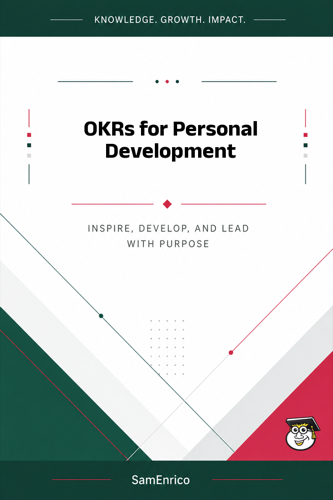
OKRs for Personal Development eBook
Sets learning and growth objectives.
by Light Marilu
Sets learning and growth objectives.
Formats
Free sample
Chapter 1: The Resolution Graveyard--Every year, approximately 1.4 billion New Year's resolutions are made around the world. By February 1st, roughly 1.3 billion of them are dead. They do not die dramatic deaths. They are not murdered by tragedy or bad luck. They die quietly, in the dark, suffocated by the very thing their makers thought would save them: willpower.I have been there.
You have been there. We have all stood in the graveyard of our own good intentions, staring at the tombstone of a goal we swore would be different this time. "Lose twenty pounds." "Write a book." "Learn Spanish." "Start a business." "Meditate daily." The words on the stone are not wrong. They are noble, even beautiful. But noble words do not lift weights.
Beautiful aspirations do not turn pages. And willpower, as it turns out, is a terrible architect.This book is not about trying harder. It is about building better.Let me tell you about Sarah. I met Sarah at a conference three years ago. She was a marketing manager in her early thirties, smart, driven, and utterly exhausted.
She showed me her journal—not a diary, but a graveyard. Page after page of resolutions, goals, and quarter plans, each one abandoned somewhere between week three and week eight. "I don't understand," she said, her voice cracking. "I want these things. I really want them.
Why can't I just make myself do them?"I asked her to show me her last resolution. She flipped to January of that year. "Learn data analytics to qualify for a promotion," she read aloud. Beautiful. Noble.
Completely doomed."Why did you stop?" I asked.She thought for a long moment. "I don't know. Life got busy. I missed a week of studying, then two, then I just... stopped."Sarah is not lazy.
Sarah is not weak. Sarah is not lacking in desire or discipline. Sarah is suffering from what I call the Architecture Gap—the chasm between what we want to achieve and the systems we build to achieve it. She was trying to build a skyscraper with a hammer and hope. And then she blamed herself when it collapsed.This chapter is an autopsy.
We are going to dig up the corpses of your failed resolutions and ask not "What is wrong with you?" but "What was wrong with the plan?" We are going to discover that your resolutions did not die because you lacked character. They died because they lacked structure. And then we are going to learn the first principles of a different way—a way that replaces hope-based goal setting with architecture-based execution.Welcome to the Resolution Graveyard. Grab a shovel.The 92% Lie The statistic appears everywhere in January: 92% of people abandon their New Year's resolutions by February. But this number, as startling as it is, actually conceals a more uncomfortable truth.
The 8% who succeed are not morally superior. They are not gifted with superhuman willpower. They do not want success more desperately than the rest of us.What the 8% have is better architecture.Researchers at the University of Scranton studied the resolution habits of hundreds of people over several years. Their findings, published in the Journal of Clinical Psychology, revealed something counterintuitive: the most significant predictor of resolution success was not how badly someone wanted to change, nor how specific their goal was, nor even how much social support they had. The most significant predictor was whether the person had broken their goal down into measurable, time-bound actions.In other words, the people who succeeded were not the ones who said "I want to lose weight." They were the ones who said "I will walk for thirty minutes every day after work for the next ninety days." The former is a wish.
The latter is an architecture.This distinction is everything. A wish is a feeling dressed in language. An architecture is a system disguised as a plan. Wishes float. Architectures stand on the ground.
And when life gets hard—when the alarm doesn't go off, when the meeting runs long, when the kids get sick—the wish evaporates while the architecture holds.Think about the difference between a to-do list and a blueprint. A to-do list says "buy milk, call mom, go to gym, finish report." It is a collection of activities, each one urgent or familiar or nagging. A blueprint says "by December 31st, the foundation will be poured, the frame will be standing, and the roof will be sealed." It is a collection of outcomes, each one building toward something larger. A to-do list is infinite. A blueprint is finite.
A to-do list makes you feel busy. A blueprint makes you effective.The 92% are working from to-do lists. The 8% are working from blueprints. And the difference is not effort. It is design.The False God of Willpower We have been sold a story.
The story goes like this: success belongs to those who want it badly enough. If you fail, it is because you did not want it enough. Try harder. Dig deeper. Push through.
The story is seductive because it places everything in your control. You are the hero. You are the villain. You are the only variable.The story is also wrong.Decades of research in behavioral psychology have dismantled the myth of willpower as a limitless resource. Roy Baumeister's famous "cookie and radish" experiments at Case Western Reserve University demonstrated that willpower is more like a muscle than a magic wand—it fatigues with use, recovers with rest, and cannot be called upon indefinitely.
Participants who resisted eating fresh-baked cookies (using willpower) gave up on a subsequent puzzle task twice as fast as participants who were allowed to eat the cookies. The act of resisting depleted them.Here is what the willpower myth gets dangerously wrong: it assumes that failure is always a failure of wanting. But what if you wanted something desperately and still failed? What then? The myth offers only one answer: you did not want it enough.
This is not a diagnosis. It is a judgment. And judgment, unlike architecture, never helped anyone build anything.I have worked with hundreds of people who wanted things desperately. They wanted to leave toxic relationships. They wanted to start businesses that would free them from soul-crushing jobs.
They wanted to be present for their children instead of distracted by their phones. Their wanting was not the problem. Their wanting was volcanic. But wanting, by itself, does not create a schedule. Wanting does not block out time on a calendar.
Wanting does not tell you what to do on Tuesday at 4 PM when the craving hits.What wanting does is create the motivation to build architecture. But motivation is the spark, not the firewood. And sparks, no matter how bright, burn out.The 92% are not suffering from a deficit of desire. They are suffering from a deficit of design. They are trying to run a marathon on motivation alone, expecting their feelings to carry them across the finish line.
But feelings are fickle. Feelings are weather. And no marathon runner waits for perfect weather. They train in the rain. They run when they are tired.
They have a plan that does not depend on how they feel.That is architecture. That is what the 8% have.…
This is the end of the free sample. Get the eBook to keep going. Buy now
About this book
Details
- Author
- Light Marilu
- Publisher
- SamEnrico
- Language
- English
- Genre
- Non-Fiction, Self-Help, Growth
- Released
- 2026-06-05
- Pages (approx.)
- 138
- Available as
- eBook, Audiobook

Read better in the ZLOADR app
Your eBooks on your phone or tablet. Sign in with your SamEnrico account and start reading.
More by Light Marilu
 Cocaine Heart Attack RisksLight Marilu$11.99
 Parental Favoritism RepairLight Marilu$11.99
 Workplace Comparison TrapLight Marilu$11.99
 Sleep Learning for Memory ConsolidationLight Marilu$11.99
 Name Meaning ResearchLight Marilu$11.99
 Difficult Family TalksLight Marilu$11.99
 Compulsive Spending Workbook For CouplesLight Marilu$11.99
 The Phantom Hacker: The First Digital Heist That Shook the WorldLight Marilu$11.99
 The Bone Setters of the Renaissance: Ambroise Paré and the Birth of Modern SurgeryLight Marilu$11.99
 How to Produce UPS AccessoriesLight Marilu$11.99
 How to Produce Key CapsLight Marilu$11.99
 Two Week Notion Template LaunchLight Marilu$12.99
You may also like
 Hong Kong Handover 1997Dunn Johnnie$11.99
 Zumba For Postnatal Recovery CourseNeal Christian$11.99
 Zumba for BeginnersLadner Nikia$11.99
 YouTube Comment Mining GuideHumes Pandora$12.99
 Worry Box MeditationCarlin Rudy$11.99
 Workplace Stress MeditationNguyen Lynn$11.99
 Workplace Stress and Sleep RepairHawley Ivory$11.99
 Workplace Perfectionism CureDelaney Jeffry$11.99
 Workplace Injustice Anger GuideWallen Isabelle$11.99
 Work Addiction and Burnout LinkGreenwood Ester$11.99
 Women in Yoga and WellnessBeattie Galina$11.99
 Women in Stand Up ComedyChun Evangeline$11.99