
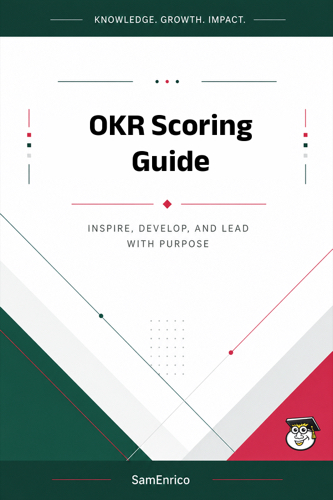
OKR Scoring Guide eBook
Grade progress from zero point zero to one point z
by Swan Mitchel
Grade progress from zero point zero to one point zero.
Formats
Free sample
Chapter 1: The Scoring Blindspot--Most organizations are addicted to goal-setting and allergic to grading. Walk into almost any company today, and you will find beautifully crafted Objectives and Key Results (OKRs) displayed on dashboards, printed on posters, or embedded into quarterly review decks. Teams spend days, sometimes weeks, arguing over the perfect wording of an Objective. Consultants are flown in. Workshops are held.
Coffee mugs are printed. And then, almost nothing happens. The quarter ends, the scores are either never calculated or hastily fudged into a sea of 1.0s, and everyone moves on to the next quarter’s ritual of performative planning. The goal was a wish. The score was a lie.
And the organization learned nothing.This book exists because of a single, uncomfortable truth: Setting a goal is easy. Scoring it honestly is hard. And the organizations that master the hard part—the weekly, uncomfortable, data-driven discipline of grading progress from 0.0 to 1.0—are the ones that consistently outperform their peers. The rest drown in what I call the "Scoring Blindspot": the mistaken belief that writing an OKR is the same as achieving it.The Great Illusion of Goal Setting Let us begin with a story. In the late 1970s, Andy Grove, the legendary CEO of Intel, watched his engineers chase ambitious technical goals with tremendous energy but no clear way to measure whether they were actually winning.
They would emerge from a quarter exhausted, having shipped code and built features, only to realize that the market had not moved. They had confused outputs (the things they produced) with outcomes (the change they created). Grove’s insight was revolutionary: a goal without a numerical score is not a goal; it is a hallucination.This insight became the foundation of what we now call OKRs. But somewhere between Grove’s Intel and the modern corporate world, the scoring part got lost. Why?
Because scoring is vulnerable. When you assign a number to progress, you expose yourself. A score of 0.4 says, "We tried hard and still fell short." A score of 0.0 says, "We failed completely." In most corporate cultures, those numbers feel like confessions of incompetence. So teams cheat. They set easy targets.
They change definitions mid-quarter. They score 1.0 on everything and call it success.This book calls that what it is: the scoring blindspot. And it is the single largest reason OKRs fail.Why This Chapter Exists (And What You Will Learn)Before we dive into the mechanics of scoring, we must agree on why scoring matters more than the goal itself. This chapter serves as the philosophical foundation for everything that follows. You will learn:The critical difference between outputs and outcomes, and why most teams track the wrong thing.Why the absence of a scoring ritual guarantees the failure of any goal-setting system.The four fatal assumptions that cause organizations to skip or fake scoring.A simple self-assessment to determine whether your team suffers from the scoring blindspot.A preview of the weekly scoring discipline that will transform how you manage.By the end of this chapter, you will never look at an OKR dashboard the same way again.
You will see the empty spaces where scores should be. You will hear the silence where hard conversations should happen. And you will be ready to build a scoring culture—not a goal-setting theater.The Output vs. Outcome Trap The most common mistake in all of goal management is confusing what you do with what you achieve. Let me give you a concrete example.A software team sets an OKR with the Key Result: "Launch the new checkout feature by October 15." They work nights and weekends.
They ship the code on October 14. They score a 1.0. The celebration is loud. Then the data comes in. The new feature is so confusing that cart abandonment increases by 40%.
Customers are calling support in fury. The team achieved the output (launching code) but failed the outcome (improving checkout success). They scored a 1.0 on a meaningless metric.This is the output vs. outcome trap. Outputs are activities, tasks, or deliverables: "Write the report," "Hold the training," "Deploy the software." Outcomes are changes in behavior, revenue, satisfaction, or efficiency: "Reduce customer churn from 5% to 3%," "Increase net promoter score from 40 to 55," "Decrease average handle time from 8 minutes to 5 minutes."Here is the brutal truth: Outputs are easy to score.
Outcomes are hard. And that is precisely why most organizations default to outputs. They want the comfort of a 1.0, even if that 1.0 means nothing.Consider two different Key Results for the same Objective ("Improve customer support quality"):Output KR: "Train all support agents on the new protocol by end of quarter." Score: 1.0 if training happens. Meaningless if behavior does not change.Outcome KR: "Reduce average first response time from 6 hours to 2 hours." Score: [actual improvement] / [target improvement]. Harder to achieve.
But if you move the needle, you actually improved support.Throughout this book, every scoring method, every ritual, and every retrospective will be built around outcome-based Key Results. If you are still tracking outputs, stop reading. Go back to your OKRs and rewrite them. This book cannot help you until you commit to measuring what actually matters.The Four Fatal Assumptions That Kill Scoring Why do smart, well-intentioned teams avoid honest scoring? Over a decade of research and practice, I have observed four fatal assumptions that create the scoring blindspot.
Read each one carefully. I guarantee you have made at least one of them.Assumption 1: "We will know progress when we see it."This is the assumption of the vague. Teams that skip numerical targets convince themselves that they have a "gut feel" for progress. They do not. The human brain is terrible at estimating progress without a baseline and a target.
Research in behavioral economics shows that without a numerical anchor, people systematically overestimate their progress by 40-60%. The result: you feel great until the quarter ends, then realize you achieved nothing.Assumption 2: "The final score is all that matters."This is the assumption of the quarterly surprise. Teams that only score at the end of the quarter believe they are saving time by not scoring weekly. In reality, they are ensuring that when the final score is bad, it is too late to fix it. Scoring is not a grade; it is a steering wheel.
If you only check your speed when you arrive at your destination, you are going to crash.Assumption 3: "A low score means failure."This is the assumption of the punishment culture. In schools, a 60% is an F. In OKRs, a 0.6 can be a tremendous success if the goal was appropriately stretch. But most managers were raised in grading systems that punish anything below 90%. They bring that trauma to the workplace.
As a result, teams sandbag (set low targets to guarantee 1.0) rather than stretch. The entire purpose of OKRs—to push beyond what is comfortable—is destroyed.Assumption 4: "Scores are private."This is the assumption of the hidden scorecard. When teams keep their scores in a private spreadsheet or a locked dashboard, inflation runs rampant. No one wants to be the only team reporting a 0.4 while everyone else claims 1.0. Transparency is the only antidote to grade inflation.
When scores are public, the social pressure to be honest outweighs the fear of looking bad.These four assumptions are not…
This is the end of the free sample. Get the eBook to keep going. Buy now
About this book
Details
- Author
- Swan Mitchel
- Publisher
- SamEnrico
- Language
- English
- Genre
- Non-Fiction, Self-Help, Scoring Systems
- Released
- 2026-06-12
- Pages (approx.)
- 150
- Available as
- eBook, Audiobook

Read better in the ZLOADR app
Your eBooks on your phone or tablet. Sign in with your SamEnrico account and start reading.
More by Swan Mitchel
 Driving Anxiety Relief GuideSwan Mitchel$11.99
 Hoffa Body Rumors Cadaver Dog SearchesSwan Mitchel$11.99
 Shame Of Mental IllnessSwan Mitchel$11.99
 Job Loss for ImmigrantsSwan Mitchel$11.99
 Pinterest Perfect Life IllusionSwan Mitchel$11.99
 Money and Marriage StressSwan Mitchel$11.99
 Chicago Seven Defendant MemoirSwan Mitchel$11.99
 The Kremlin's Shadow: Russia's Untouchable Oligarchs and the Billion-Dollar HeistSwan Mitchel$11.99
 The Flames of Freedom: Greece Rises Against the OttomansSwan Mitchel$11.99
 How to Produce Plastic Product Making Machinery PartsSwan Mitchel$11.99
 How to Produce MuffinsSwan Mitchel$11.99
 Coping Strategies for Burnout GuideSwan Mitchel$12.99