
Non-FictionBusiness BriefRetrospectives
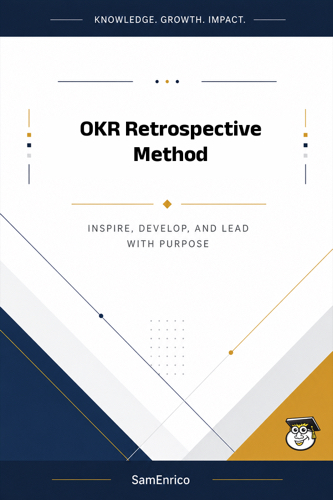
OKR Retrospective Method eBook
Review quarter's results to set better objectives
by Zook Gonzalo
Review quarter's results to set better objectives next cycle.
Formats
Free sample
Chapter 1: The 90-Day Reckoning--–- In the spring of 2019, a mid-sized Saa S company called Lighthouse Analytics did everything right. They set ambitious OKRs in January: increase annual recurring revenue by 40%, reduce customer churn to 3%, and launch three major features. Leadership cascaded these objectives to every department. Teams held kickoff meetings. Spreadsheets were color-coded.
Morale was high.Then February happened. A competitor dropped a pricing bomb. Two key engineers left. The sales team discovered that their target market had shifted overnight. By March, the CEO was distracted by an acquisition offer.
The OKR spreadsheet—once a proud artifact of strategic planning—was last opened on January 31st. At the quarter's end, leadership gathered to review results. The numbers were grim: revenue up only 8%, churn at 5.5%, one feature launched (buggy). The CEO asked a question that no one could answer: "What did we learn?"Silence.Not because the team was incompetent. Because they had never stopped to ask that question during the ninety days.
They had set goals, executed furiously, and discovered only at the finish line that they had been solving the wrong problems for the last two months. The annual performance review system—designed for an era when markets moved at the speed of postal mail—had taught them to treat strategy as a once-a-year event. And it had failed them.This book exists because that story is not an exception. It is the rule.The Annual Review Is a Relic of Another Century Let us be direct: the traditional annual performance review is not merely ineffective. It is a business liability.
In markets that shift every ninety days, waiting twelve months to pivot guarantees obsolescence. Yet most organizations still structure their goal-setting around a calendar invented for agrarian societies and industrialized by General Electric in the 1950s.Consider the math. A typical company sets annual goals in December or January. By March, external conditions have changed. By June, the original assumptions are laughable.
By September, everyone has quietly abandoned the annual plan but no one has admitted it aloud. Then December arrives, and leadership reviews a year of drift, produces a post-mortem full of excuses, and repeats the cycle. This is not strategic management. This is a ritual.John Doerr, in his seminal work Measure What Matters, documented this phenomenon across hundreds of organizations. His data revealed a startling pattern: OKR failure is rarely due to bad initial planning.
Teams are actually quite good at setting reasonable goals. The failure occurs in the execution phase—specifically, the absence of structured reflection during the execution window. Teams set goals, then ignore them for ninety days, only to discover at quarter's end that they drifted off course. Doerr calls this the "set and forget" trap, and it is the single greatest predictor of OKR abandonment.The solution is not better goal-setting software. It is not stricter metrics.
It is not hiring a consultant to run a two-day workshop. The solution is a fundamental reorientation of how organizations relate to time. You must abandon the annual cycle and embrace the quarterly reckoning.The 90-Day Natural Rhythm Why ninety days? The number is not arbitrary. Human attention spans, financial reporting cycles, seasonal business patterns, and even cognitive science all converge on a twelve-week horizon.First, the neuroscience: research into goal gradients shows that human motivation follows a curvilinear pattern.
At the start of a goal cycle, energy is high. It dips in the middle. It spikes again near the deadline. With a twelve-month cycle, the middle dip lasts six to eight months—long enough for teams to lose all momentum. With a ninety-day cycle, the dip lasts only a few weeks, and the deadline spike arrives before disengagement becomes permanent.Second, the business cycle: public companies report earnings quarterly for a reason.
Ninety days is long enough to achieve something meaningful—launch a product, acquire a cohort of customers, run a meaningful experiment—but short enough that market conditions are unlikely to change completely. A year is an eternity in software, e-commerce, or any technology-adjacent field. A quarter is a sprint.Third, the learning loop: research on high-performing teams (Google's Project Aristotle, DARPA's Red Team studies) consistently finds that the optimal feedback frequency for complex adaptive work is every sixty to ninety days. Longer than that, and the feedback arrives too late to correct course. Shorter than that, and teams cannot generate enough data to draw meaningful conclusions.
The quarterly retrospective sits in the sweet spot.Consider how this plays out in practice. A team operating on annual cycles runs one learning loop per year. If they fail, they waste twelve months. If they succeed, they have only one data point to explain why. A team operating on quarterly cycles runs four learning loops per year.
Each loop produces insights that feed into the next. The annual team learns once. The quarterly team learns four times. Over three years, the quarterly team has twelve learning cycles while the annual team has three. The gap in adaptive capacity is not linear—it is exponential.
The quarterly team outruns the annual team not because they work harder but because they learn faster.The High Cost of "Set and Forget"Let us examine the anatomy of a typical quarter. Week one: high energy, clear goals, everyone aligned. Weeks two through four: execution begins. Progress is visible. The OKR tracker shows green.
Weeks five through eight: the first signs of drift appear. A key result is behind schedule. A market assumption proves shaky. But no one calls a retro because the quarterly review is weeks away. Weeks nine through eleven: the drift accelerates.
Teams invent their own workarounds. The OKR tracker is updated sporadically. Week twelve: panic. The team scrambles to produce a report. The retro is scheduled for the last Friday at 4 PM.
Half the team skips it. The other half presents slides that nobody reads.This is the "set and forget" trap. It has four distinct costs:Cost One: Strategic Drift. When teams do not reflect mid-quarter, they continue executing on assumptions that may have been invalidated weeks ago. A sales team that set a goal of "acquire 50 enterprise customers" might discover in week three that their ideal customer profile has shifted to mid-market.
But without a structured retro, they keep calling enterprise leads for another seven weeks. The cost is not just wasted time—it is the opportunity cost of not pursuing the correct market.Cost Two: Morale Erosion. Nothing demoralizes a team like working hard on the wrong thing. The "set and forget" trap produces a specific psychological pattern: confusion (weeks four to six), frustration (weeks seven to nine), and resignation (weeks ten to twelve). By the time the quarter ends, high performers have already updated their resumes.
The retro becomes a performance review in the worst sense—a ritual of blame rather than a tool for improvement.Cost Three: Knowledge Waste. Every team generates insights during execution. A marketer learns which channels actually convert. An engineer learns which architecture fails at scale. A salesperson learns which objection kills the deal.
In a "set and forget" culture, these insights are never captured. They live in individual brains, then walk out the door…
This is the end of the free sample. Get the eBook to keep going. Buy now
About this book
Details
- Author
- Zook Gonzalo
- Publisher
- SamEnrico
- Language
- English
- Genre
- Non-Fiction, Business Brief, Retrospectives
- Released
- 2026-06-06
- Pages (approx.)
- 118
- Available as
- eBook, Audiobook

Read better in the ZLOADR app
Your eBooks on your phone or tablet. Sign in with your SamEnrico account and start reading.
More by Zook Gonzalo
 Cocaine Relapse Home Environment GuideZook Gonzalo$11.99
 US Energy Efficient Home CreditZook Gonzalo$11.99
 Sleep Meditation For VeteransZook Gonzalo$11.99
 Mindfulness Drills for Craving ControlZook Gonzalo$11.99
 The Thunderbird's Sky Palace: A Haida Legend of the Celestial StrongholdZook Gonzalo$11.99
 Understanding Ichthyosis, Netherton SyndromeZook Gonzalo$17.99
 Ultimate Handbook Guide to The Hague : (Netherlands) Travel GuideZook Gonzalo$11.99
 EU AI Act Compliance Guide 2025Zook Gonzalo$12.99
 Open Educational Resource AIZook Gonzalo$12.99
 Playing MusicZook Gonzalo$11.99
You may also like
 Hong Kong Handover 1997Dunn Johnnie$11.99
 Zumba For Postnatal Recovery CourseNeal Christian$11.99
 Zumba for BeginnersLadner Nikia$11.99
 YouTube Comment Mining GuideHumes Pandora$12.99
 Worry Box MeditationCarlin Rudy$11.99
 Workplace Stress MeditationNguyen Lynn$11.99
 Workplace Stress and Sleep RepairHawley Ivory$11.99
 Workplace Perfectionism CureDelaney Jeffry$11.99
 Workplace Injustice Anger GuideWallen Isabelle$11.99
 Work Addiction and Burnout LinkGreenwood Ester$11.99
 Women in Yoga and WellnessBeattie Galina$11.99
 Women in Stand Up ComedyChun Evangeline$11.99