
Non-FictionProfessional's Cheat SheetStartupSelf-Help
OKR for Startups Guide Audiobook
Implement lightweight OKRs for early-stage startup
Set ambitious goals for high growth companies with this practical workbook.
Formats
Free sample
Chapter 1: The Corporate Lie--Most founders discover OKRs the same way they discover most things in startups: a well-meaning investor or a more experienced founder says, "You should really read Measure What Matters." So you do. You underline passages. You feel inspired. You roll out OKRs with the best intentions. And then, six weeks later, your team hates you, nothing has improved, and you have quietly abandoned the whole experiment.If this has happened to you, you are not alone.
In fact, you are in the overwhelming majority.The dirty secret of the startup world is that most founders have tried OKRs and hated them. They blame themselves. They assume they lacked the discipline, the leadership, or the team to make it work. They conclude "OKRs don't work for startups" and move on, never realizing that the problem wasn't them. The problem was the advice.This book exists because that conclusion is wrong.
OKRs do work for startups. But the version of OKRs that works for a startup looks almost nothing like the version that works for Google, Intel, or a five-thousand-person enterprise. The corporate OKR industrial complex has sold you a system designed for stability, hierarchy, and predictability. You have none of those things. No wonder it failed.The Dirty Secret That No One Tells You Let me be direct: the standard OKR framework popularized by John Doerr's Measure What Matters was designed for a very specific context.
That context is a mature organization with stable teams, predictable markets, a clear hierarchy, and the luxury of three-month planning cycles. Andy Grove developed the original system at Intel in the 1970s—a semiconductor manufacturer with long product cycles and massive capital investments. Google adopted it in the late 1990s, already a company with hundreds of employees and a clear business model.Neither Intel nor Google was a pre-product-market-fit startup trying to figure out who their customer was while running out of cash.The core problem is simple: traditional OKR frameworks require three-month planning cycles. But startups hunting for Product-Market Fit often pivot every few weeks. A three-month OKR set in January is irrelevant by February.
Worse, cascading OKRs from the CEO down to "teams of one" creates artificial bureaucracy and anxiety. When you have five people and everyone already knows what everyone else is doing, cascading OKRs is not alignment—it is theater.The startup reality is brutal: you cannot plan for three…
This is the end of the free sample. Get the Audiobook to keep going. Buy now
About this book
Details
- Author
- Bounds Blaine
- Publisher
- SamEnrico
- Language
- English
- Genre
- Non-Fiction, Professional's Cheat Sheet, Startup, Self-Help, Startup OKRs
- Released
- 2026-05-30
- Pages (approx.)
- 129
- Available as
- eBook, Audiobook

Listen in the VoxFlicks app
Audiobooks and audio dramas wherever you go. Sign in with your SamEnrico account and press play.
More by Bounds Blaine
 My Real Name Is Still MineBounds Blaine$11.99
 Macro Ratio Calculator GuideBounds Blaine$11.99
 Customer Retention Outbreak ManualBounds Blaine$11.99
 Riding the Wave of EmotionBounds Blaine$11.99
 Daily Goal ExecutionBounds Blaine$11.99
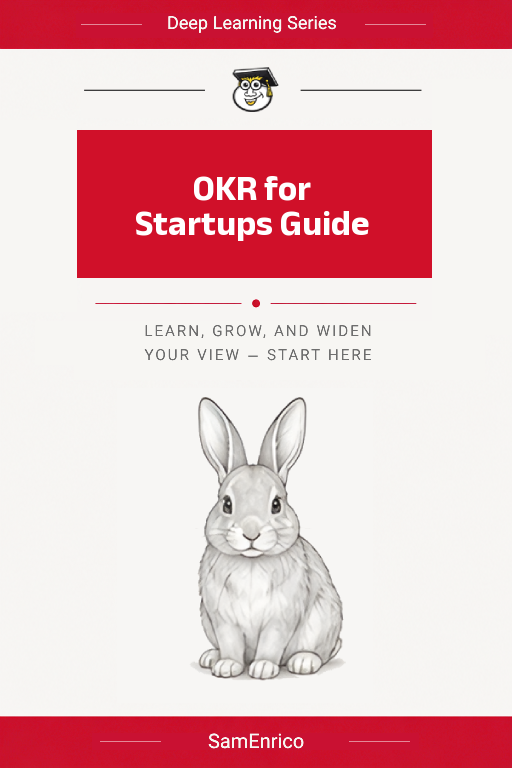 OKR for Startups GuideBounds Blaine$12.99
 Holding Plank for CoreBounds Blaine$11.99
 Spouse Memorial Service PlanningBounds Blaine$11.99
 Nobel Prize for the Greenhouse EffectBounds Blaine$11.99
 The Ponzi Prince of Playgrounds: How a Fraudster's Empire Collapsed with a Child's LifeBounds Blaine$11.99
 Raven’s Gambit: The Hidden War of the NornsBounds Blaine$11.99
 A Collector's Handbook to the Morris IvBounds Blaine$11.99
You may also like
 Hong Kong Handover 1997Dunn Johnnie$11.99
 Zumba For Postnatal Recovery CourseNeal Christian$11.99
 Zumba for BeginnersLadner Nikia$11.99
 YouTube Comment Mining GuideHumes Pandora$12.99
 Worry Box MeditationCarlin Rudy$11.99
 Workplace Stress MeditationNguyen Lynn$11.99
 Workplace Stress and Sleep RepairHawley Ivory$11.99
 Workplace Perfectionism CureDelaney Jeffry$11.99
 Workplace Injustice Anger GuideWallen Isabelle$11.99
 Work Addiction and Burnout LinkGreenwood Ester$11.99
 Women in Yoga and WellnessBeattie Galina$11.99
 Women in Stand Up ComedyChun Evangeline$11.99