
Non-FictionProfessional's Cheat SheetStartupSelf-Help
OKR for Startups Guide eBook
Set ambitious goals for high growth companies with
Set ambitious goals for high growth companies with this practical workbook.
Formats
Free sample
Chapter 1: The Motion Trap--You are moving too fast, and it is killing your startup.Not the kind of fast that ships products, closes customers, or finds product-market fit. The other kind of fast. The frantic, scattered, everything-is-urgent kind of fast that leaves your team exhausted and your metrics flat. The kind of fast where you wake up on a Tuesday, check your calendar, and realize you have seventeen half-finished initiatives, three competing priorities, and no idea what actually worked last month.This is the Motion Trap. And every founder falls into it eventually.The Motion Trap feels like progress.
Your Slack channels are buzzing. Your engineers are pulling late nights. Your sales team is sending out proposals. Your product manager is running user interviews. Everyone is busy.
Everyone is tired. Everyone is convinced that the breakthrough is just one more sprint away.But the breakthrough never comes. Because the Motion Trap has a cruel property: activity without alignment is just noise. And noise, no matter how loud, does not move your metrics.I have watched hundreds of startups fall into this trap. The founders are brilliant.
The teams are talented. The ideas are plausible. But they are spinning in circles because they have confused motion with progress. They are working harder and harder while staying exactly where they are.This chapter will give you the single most important distinction in this entire book: the difference between Activity OKRs and Impact OKRs. It will teach you how to identify the real bottleneck in your startup.
And it will give you a diagnostic that will change how you think about progress forever.By the time you finish this chapter, you will never confuse being busy with being effective again.The Founder Who Did Everything Right Let me tell you about Maria. She was a second-time founder, which meant she knew all the startup clichés and believed none of them. Her first company had failed because she built a product nobody wanted. She was not going to make that mistake again.Her new startup, called Beacon, was a analytics tool for e-commerce brands. She had raised $2 million from a respectable seed fund.
She had hired eight talented people. She had a waitlist of fifty stores eager to try her product.Maria did everything the playbook said to do. She talked to customers constantly. She shipped new features every two weeks. She tracked every metric in a beautiful dashboard.
She held weekly all-hands where everyone shared their wins.Six months later, Beacon was dying.Revenue had flatlined at $12,000 per month. Churn was running at 11% per month, which meant she was losing customers faster than she could add them. The engineering team was burning out. The sales team was fighting with product over what to build. And Maria was waking up at 3 AM every night staring at the ceiling, trying to figure out where she had gone wrong.Here is what her dashboard looked like at the time:Blog posts published: 24Customer interviews conducted: 67Features shipped: 31Sales calls completed: 142Support tickets resolved: 503Lines of code written: 47,000Every number was going up.
Every activity was happening. And yet the business was failing.Maria had fallen into the Motion Trap. She was measuring what she was doing instead of what she was achieving. Her dashboard was a monument to activity. It told her nothing about impact.The Two Kinds of OKRs Objectives and Key Results, in their purest form, are supposed to solve this problem.
But most startups use OKRs wrong. They write Objectives that are vague and Key Results that are just to-do lists with numbers attached. They measure inputs instead of outcomes. And then they wonder why nothing changes.Let me show you the difference.An Activity OKR answers the question: "What will we do?"An Impact OKR answers the question: "What will change?"These seem similar. They are not.
They are fundamentally different ways of thinking about work, accountability, and success.Activity OKRs feel safe. You can control them. You can check them off. You can feel good about completing them, even if the business doesn't move. They are the comfort food of goal-setting.Impact OKRs feel terrifying.
You cannot control them completely. They depend on customer behavior, market conditions, and a thousand variables outside your control. They might fail even if you work hard. They force you to confront the possibility that your strategy is wrong.This is why most startups default to Activity OKRs. Not because they are lazy, but because they are afraid.
Afraid to set a real goal. Afraid to fail in public. Afraid to discover that their brilliant idea is actually not working.Here is what Activity OKRs look like in the wild. I have seen thousands of these from early-stage startups, and they all share the same tragic DNA:Write 12 blog posts Conduct 50 customer interviews Build the mobile app Launch the marketing campaign Fix the payment integration bug Hire three engineers Redesign the pricing page These are not Key Results. These are to-do lists with a number attached.
They measure inputs. And inputs are seductive because they feel productive. You can check off "write 12 blog posts" and feel a dopamine hit of accomplishment. But did those blog posts increase trial signups? You do not know, because you did not measure that.Now contrast with Impact OKRs:Increase trial-to-paid conversion from 8% to 15%Reduce first-week churn from 40% to 20%Decrease average time to value from 14 days to 3 days Grow net dollar retention from 85% to 110%Shorten sales cycle from 60 days to 30 days Increase activation rate from 22% to 40%These KRs measure what actually matters.
They force you to confront whether your activities are working. You cannot cheat an Impact KR by being busy. You can only move it by changing customer behavior.Maria, from our story, had thirty-one Impact KRs? No. She had zero.
She had thirty-one Activity KRs disguised as features. She shipped code, wrote content, and made sales calls. But she never asked the question that mattered: "Did any of this change customer behavior?"The Activity Trap in Action Let me walk you through a typical quarter in a startup that has fallen into the Motion Trap. You will recognize this if you have lived it.Day 1 of the quarter. The founder gathers the team.
There is whiteboarding. There is excitement. There is a shared sense that this quarter will be different. The team writes down ten things they want to accomplish. Everyone agrees.
The founder posts the list in Slack. High fives all around.Day 15. The first check-in. The engineering team has started building feature A. The marketing team has outlined the campaign for feature B.
The sales team is asking customers about feature C. Progress is being made. The founder feels good.Day 30. The second check-in. Feature A is half-built.
Feature B has been deprioritized because a big customer asked for something else. Feature C is waiting on engineering. The marketing team is confused about what to promote. The sales team is frustrated because the product doesn't do what they promised.Day 45. The third check-in.
Feature A is finished but has bugs. The big customer's request is now feature D, which is taking all of engineering's time. Feature…
This is the end of the free sample. Get the eBook to keep going. Buy now
About this book
Details
- Author
- Bounds Blaine
- Publisher
- SamEnrico
- Language
- English
- Genre
- Non-Fiction, Professional's Cheat Sheet, Startup, Self-Help, Startup OKRs
- Released
- 2026-06-06
- Pages (approx.)
- 141
- Available as
- eBook, Audiobook

Read better in the ZLOADR app
Your eBooks on your phone or tablet. Sign in with your SamEnrico account and start reading.
More by Bounds Blaine
 My Real Name Is Still MineBounds Blaine$11.99
 Macro Ratio Calculator GuideBounds Blaine$11.99
 Customer Retention Outbreak ManualBounds Blaine$11.99
 Riding the Wave of EmotionBounds Blaine$11.99
 Daily Goal ExecutionBounds Blaine$11.99
 Holding Plank for CoreBounds Blaine$11.99
 Spouse Memorial Service PlanningBounds Blaine$11.99
 Nobel Prize for the Greenhouse EffectBounds Blaine$11.99
 The Ponzi Prince of Playgrounds: How a Fraudster's Empire Collapsed with a Child's LifeBounds Blaine$11.99
 Raven’s Gambit: The Hidden War of the NornsBounds Blaine$11.99
 A Collector's Handbook to the Morris IvBounds Blaine$11.99
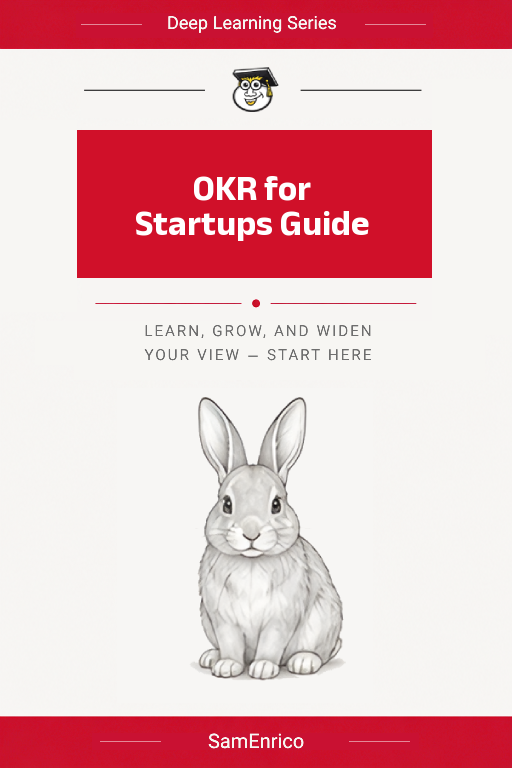 OKR for Startups GuideBounds Blaine$12.99
You may also like
 Hong Kong Handover 1997Dunn Johnnie$11.99
 Zumba For Postnatal Recovery CourseNeal Christian$11.99
 Zumba for BeginnersLadner Nikia$11.99
 YouTube Comment Mining GuideHumes Pandora$12.99
 Worry Box MeditationCarlin Rudy$11.99
 Workplace Stress MeditationNguyen Lynn$11.99
 Workplace Stress and Sleep RepairHawley Ivory$11.99
 Workplace Perfectionism CureDelaney Jeffry$11.99
 Workplace Injustice Anger GuideWallen Isabelle$11.99
 Work Addiction and Burnout LinkGreenwood Ester$11.99
 Women in Yoga and WellnessBeattie Galina$11.99
 Women in Stand Up ComedyChun Evangeline$11.99