
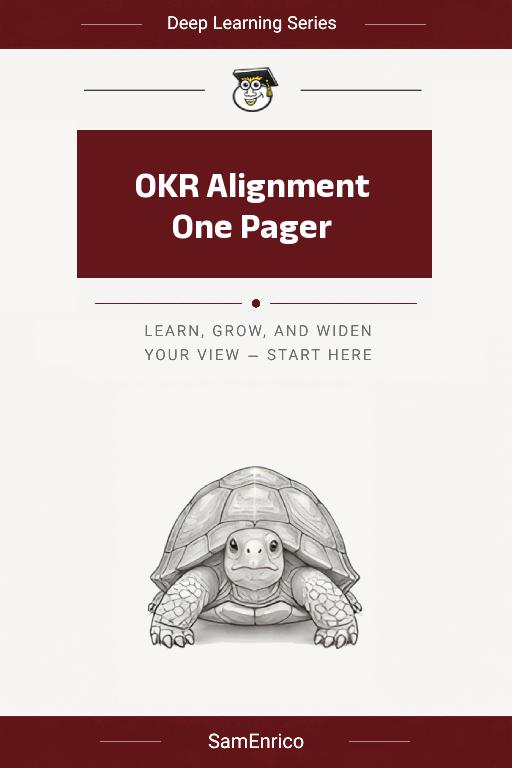
OKR Alignment One Pager eBook
Connect your one-page business plan to quarterly O
by Page Duane
Connect your one-page business plan to quarterly OKRs for execution tracking.
Formats
Free sample
Chapter 1: The 50-Page Lie--–- In twenty years of leading teams, I have written exactly forty-seven strategic plans. Forty-seven carefully crafted documents, each one representing weeks of executive offsites, heated debates over formatting, late-night Power Point sessions, and the kind of collaborative suffering that leaders mistake for progress. Of those forty-seven plans, exactly three were executed. The remaining forty-four sit in a Google Drive folder I have nervously titled “Old Strategy – Archive.” I have not opened that folder in six years. I am afraid of what I might find.This is not a confession of personal failure.
It is an indictment of a system that nearly every organization on earth has accepted as normal. We spend fortunes on strategy consultants. We fly leadership teams to offsite locations with whiteboards and catered lunches. We produce documents that run fifty, sixty, even one hundred pages, complete with executive summaries, market analyses, SWOT matrices, Porter’s Five Forces, and carefully formatted financial projections. Then we return to the office, email the PDF to the company, and wait for magic to happen.
The magic never comes.Instead, something quieter and more destructive takes hold. It is called Strategic Drift, and it is the slow, almost invisible process by which quarterly goals drift away from annual plans, weekly tasks drift away from quarterly goals, and daily firefighting drifts away from everything that matters. By the time anyone notices, the company is moving fast—often very fast—but in twelve different directions simultaneously. Speed without alignment is not progress. It is chaos with a budget.This chapter is an autopsy of that failure.
It will show you why fifty-page plans are not just ineffective but actively dangerous. It will introduce you to a Saa S company that hit one hundred percent of its quarterly OKRs and nearly went bankrupt as a result. And it will establish the single most important truth of this book: you cannot execute a fifty-page plan. You can only execute a one-page plan that everyone has memorized.The Graveyard of Good Intentions Let us begin with a thought experiment. Imagine you are the CEO of a mid-sized B2B software company.
Your leadership team has just completed a three-day strategic offsite. The facilitator was excellent. The food was surprisingly good for hotel catering. The group reached consensus on a bold new direction: you will pivot from serving small businesses to targeting enterprise customers. The logic is sound.
Enterprise contracts are larger, retention is higher, and your product has features that smaller customers rarely use. The offsite concludes with handshakes and a shared sense of purpose.You return to the office on Monday morning. Your head of sales pulls you aside. “Great offsite,” she says. “But we have a Q2 number to hit.
My team is focused on small business deals because that is what the forecast says. When do we switch?”Your head of product has a different question. “We heard the enterprise pivot loud and clear,” he says. “But our roadmap for the next quarter is already locked. We committed to three feature releases for our existing small business customers.
Do we cancel those?”Your head of marketing sends an email: “Love the new direction. Can you share the updated messaging framework? I need to rewrite the website and the pitch deck by Friday.”And just like that, the beautiful strategic plan collides with the ugly reality of quarterly commitments, locked roadmaps, and human bandwidth. The plan does not die in a dramatic boardroom explosion. It dies in a thousand small compromises, each one perfectly reasonable in isolation and catastrophically destructive in aggregate.This is the graveyard of good intentions.
Every organization has one.The $2.3 Trillion Problem The scale of this problem is almost impossible to comprehend, so let us start with a number: two point three trillion dollars. That is the annual cost of poor strategy execution, according to research published in the Harvard Business Review. To put that number in perspective, it is larger than the GDP of Canada, larger than the entire global box office industry, and roughly equivalent to the combined market capitalization of Amazon, Meta, and Netflix. Two point three trillion dollars lost every single year, not because leaders lack good ideas, but because they cannot translate those ideas into action.The same research reveals an even more unsettling statistic: sixty-seven percent of well-formulated strategies fail due to poor execution. Not because the strategy was wrong.
Not because the market shifted. Not because competitors were smarter. Because the organization could not convert the plan into daily work. Leaders are spending millions of dollars developing strategies that have a two-thirds chance of dying before they ever reach the customer.Why does this happen? The answer is surprisingly simple and deeply uncomfortable.
Most organizations confuse planning with alignment. A fifty-page strategic plan is an extraordinary planning document. It captures nuance. It acknowledges trade-offs. It anticipates risks and proposes mitigations.
But a fifty-page plan cannot be aligned because no human being can hold fifty pages of information in working memory. Alignment requires shared mental models. Shared mental models require simplicity. Simplicity requires ruthless editing.The Saa S Startup That Did Everything Right—And Almost Died Let me tell you about a company I will call Swift Cloud. Swift Cloud was a B2B Saa S startup that provided workflow automation for mid-sized manufacturing companies.
The business had raised twenty million dollars in Series B funding, employed one hundred and twenty people, and was growing at an impressive thirty percent year over year. By any reasonable metric, Swift Cloud was a success story.In the second quarter of their fiscal year, Swift Cloud’s leadership team set three company-wide OKRs. The first OKR was to ship five new product features, including a long-promised integration with SAP. The second OKR was to improve average page load time by twenty percent, addressing a growing complaint from customers about performance. The third OKR was to increase net promoter score from forty-two to fifty, a stretch goal that would put them in the top tier of B2B software companies.The team executed brilliantly.
Engineering shipped all five features, including the SAP integration, two weeks ahead of schedule. The performance team reduced page load time by twenty-two percent, exceeding their target. The customer success team ran a series of initiatives that pushed NPS to forty-eight—short of fifty, but close enough to celebrate. When the quarter ended, Swift Cloud’s OKR attainment rate was one hundred percent. The leadership team congratulated themselves on a job well done.Then the quarterly financial results came in.
Revenue had grown by just four percent, far below the fifteen percent target. New customer acquisition had flatlined. Existing customers were churning at a rate the company had not seen in three years. Despite hitting every single OKR, Swift Cloud was in crisis.What happened? The answer reveals the fundamental flaw in how most organizations use OKRs.
Swift Cloud’s OKRs measured activity—shipping features, improving speed, raising survey scores—while the company’s strategic plan required adoption. The business model depended on customers actually using the new features, not just having them available. The SAP integration was technically flawless, but manufacturing customers needed…
This is the end of the free sample. Get the eBook to keep going. Buy now
About this book
Details
- Author
- Page Duane
- Publisher
- SamEnrico
- Language
- English
- Genre
- Non-Fiction, First 30 Days, OKR
- Released
- 2026-06-01
- Pages (approx.)
- 150
- Available as
- eBook, Audiobook

Read better in the ZLOADR app
Your eBooks on your phone or tablet. Sign in with your SamEnrico account and start reading.
More by Page Duane
 Mindfulness Meditation for Creativity BlockPage Duane$11.99
 Benzodiazepine Taper SleepPage Duane$11.99
 Gratitude Meditation Nightly PracticePage Duane$11.99
 Bipolar Support Group GuidePage Duane$11.99
 TM for Better Sleep QualityPage Duane$11.99
 Bulgaria Remote Tax GuidePage Duane$11.99
 Programming Syntax PegsPage Duane$11.99
 Neuropathic Pain ChecklistPage Duane$11.99
 The Quantum Leap: How Richard Feynman’s Crazy Idea Changed the WorldPage Duane$11.99
 The Last Broadcast: The Day the Beatles Broke UpPage Duane$11.99
 The Last Breath: The Miraculous Survival of the S.S. Central AmericaPage Duane$11.99
 Growing EritrichiumPage Duane$11.99
You may also like
 Hong Kong Handover 1997Dunn Johnnie$11.99
 Zumba For Postnatal Recovery CourseNeal Christian$11.99
 Zumba for BeginnersLadner Nikia$11.99
 YouTube Comment Mining GuideHumes Pandora$12.99
 Worry Box MeditationCarlin Rudy$11.99
 Workplace Stress MeditationNguyen Lynn$11.99
 Workplace Stress and Sleep RepairHawley Ivory$11.99
 Workplace Perfectionism CureDelaney Jeffry$11.99
 Workplace Injustice Anger GuideWallen Isabelle$11.99
 Work Addiction and Burnout LinkGreenwood Ester$11.99
 Women in Yoga and WellnessBeattie Galina$11.99
 Women in Stand Up ComedyChun Evangeline$11.99