
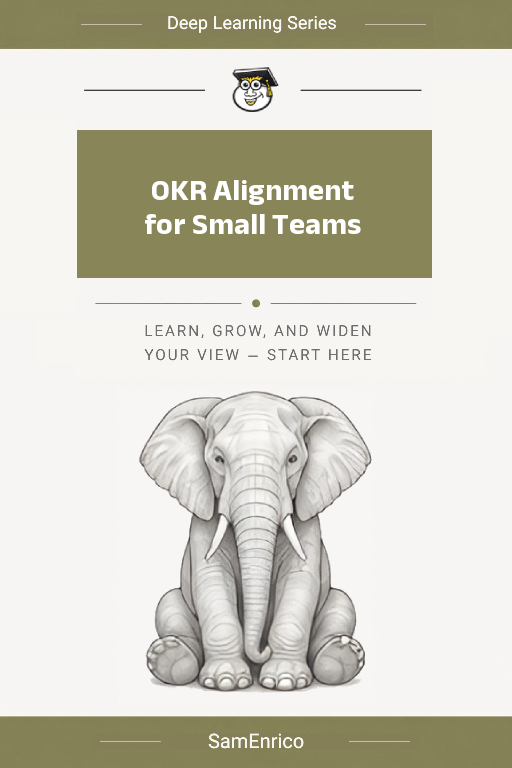
Non-FictionProfessional's Cheat SheetGoal Setting
OKR Alignment for Small Teams eBook
Align individual OKRs to team and company goals. C
Align individual OKRs to team and company goals. Cascade effectively without bureaucracy.
Formats
Free sample
Chapter 1: The Alignment Illusion--–- The Tuesday morning meeting was only eleven minutes old when Alex realized his team was drowning in data but starving for direction. His marketing lead had just presented a spreadsheet showing a 40% increase in social media impressions. His product manager followed with a demo of three new features shipped that week. His customer success manager reported closing fifty support tickets. The team applauded each update.
Alex nodded along. Then someone asked the question that stopped the room cold: "Are we actually winning?"No one could answer.The social media impressions were up, but trial sign-ups were flat. The three new features were elegant, but usage data showed that customers weren't touching two of them. The fifty closed support tickets sounded heroic until someone noted that twenty-four of them were the same recurring bug that had been reported three months earlier. The team was busy.
The team was productive by every traditional measure. But the team was not aligned, and nobody knew it until that single question exposed the gap between activity and impact.This chapter diagnoses the three specific ways small teams derail their strategy despite having good intentions, talented people, and urgent goals. You will learn why the metrics you celebrate might be lying to you, why copying Google's OKR system will suffocate your seven-person team, and why the research on alignment only works when you remove handoffs instead of adding meetings. By the end of this chapter, you will take a diagnostic quiz that will tell you, with brutal honesty, whether your team is aligned or just busy. And you will understand why the answer to that question is the single biggest predictor of whether your small team will outgrow its competitors or burn out trying.The Proxy Metric Trap: When Numbers Lie to Nice People Alex's team fell into the most common trap in small-team strategy: they confused activity with impact.
They measured what was easy to count instead of what mattered. This is the Proxy Metric Trap, and it is the silent killer of small teams because it feels like progress.A proxy metric is a measurement that stands in for something you actually care about but cannot measure directly or do not want to measure because the real metric is harder, scarier, or slower to move. Every team uses proxies. The problem is not using proxies; the problem is forgetting that they are proxies. When you start treating "social media impressions" as if they are the goal rather than a possible indicator of the goal, you have entered the trap.Consider the difference between a true outcome and a hollow proxy.
A true outcome changes customer behavior in a way that directly advances your business. "Reduce the time it takes a new user to complete their first successful task from eight minutes to three minutes" is a true outcome. If you achieve that, you know with certainty that you have made your product easier to use. A proxy metric would be "number of onboarding emails sent" or "pages of documentation written" or "hours spent redesigning the welcome screen." Each of these activities might contribute to the true outcome, but none of them guarantees it. You could send a hundred onboarding emails and still have confused users.
You could write fifty pages of documentation and still have customers churning because they cannot find the button.The Proxy Metric Trap has a predictable psychology. It rewards visibility over value. When a team member announces "I shipped twelve features this quarter," the room applauds because the statement is concrete, verifiable, and impressive. When a team member announces "I reduced customer confusion by an ambiguous amount," the room is less sure how to respond. So teams drift toward celebrating what can be counted rather than what should be changed.
The problem is not laziness or incompetence. The problem is that the easy metrics are right there, updating in real time on your dashboard, while the meaningful metrics require work to define, track, and interpret.Here is a simple test to spot whether you are in the Proxy Metric Trap. Take the last three things your team celebrated. For each one, ask: "If we achieved this but nothing else changed about our customers' behavior or our business results, would we still consider the quarter a success?" If the answer is yes, you are celebrating a proxy. If the answer is no, you are celebrating an outcome.
Alex's team celebrated fifty closed support tickets. But when they asked the question, they realized that closing fifty tickets while the same bug kept coming back was not a win. It was a treadmill.The Bureaucracy Trap: Why Small Teams Should Not Act Like Google The second trap is the Bureaucracy Trap, and it is the most ironic failure mode in the OKR world. Small teams hear about OKRs from successful companies like Google, Intel, and Linked In. They read the books.
They attend the workshops. And then they implement the exact same processes that those companies use for fifty thousand employees. The result is not alignment. The result is suffocation.The Bureaucracy Trap works like this. A five-person team decides to implement OKRs.
Someone reads that Google cascades objectives from the CEO down to individual contributors through multiple layers of review. So the small team creates a similar cascade. The founder writes company OKRs. Each department head writes team OKRs. Each individual writes personal OKRs.
Then the team schedules weekly alignment meetings, monthly review meetings, and quarterly grading sessions. They build spreadsheets with formulas and color coding. They spend hours writing, revising, and presenting their OKRs to each other.Within one quarter, the five-person team is spending four hours per week in alignment meetings. That is twenty person-hours per week, or the equivalent of half a full-time employee, dedicated not to doing the work but to talking about the work. The team is now more aligned on paper and less effective in reality.
They have mistaken process for progress.The Bureaucracy Trap exists because small teams have a structural advantage that large companies would kill for: low coordination overhead. When you have five people in a room, you do not need three layers of approval loops. You do not need formal sign-offs. You do not need monthly review meetings with slide decks. You need a shared understanding of the goal and the freedom to adjust in real time.
Every layer of process you add to a small team is not a feature. It is a tax.Consider the difference between a waterfall cascade and the lightweight alternative that this book will teach you. A waterfall cascade moves objectives from top to bottom in a straight line. The CEO sets a goal. The VP translates it into department goals.
The manager translates those into team goals. The individual translates those into personal goals. Information flows one way, slowly, and never returns. The problem is that the person closest to the customer—the individual contributor—has no mechanism to tell the CEO that the goal is wrong. The person who discovers a better path mid-quarter has no way to adjust without asking for permission from three layers of management.The alternative, which you…
This is the end of the free sample. Get the eBook to keep going. Buy now
About this book
Details
- Author
- Colley Bronwyn
- Publisher
- SamEnrico
- Language
- English
- Genre
- Non-Fiction, Professional's Cheat Sheet, Goal Setting
- Released
- 2026-05-29
- Pages (approx.)
- 130
- Available as
- eBook, Audiobook

Read better in the ZLOADR app
Your eBooks on your phone or tablet. Sign in with your SamEnrico account and start reading.
More by Colley Bronwyn
 Emotional Regulation For CancerColley Bronwyn$11.99
 Stress Exercise Prescription GuideColley Bronwyn$11.99
 Mongolian Restaurant OwnerColley Bronwyn$11.99
 Sexual Addiction Recovery for WomenColley Bronwyn$11.99
 The Djinn of the Oud: A Melody from the SandsColley Bronwyn$11.99
 How to Start a Needleloom Carpet Business (Beginners Guide)Colley Bronwyn$11.99
 Learn to Play the Tenor GuitarColley Bronwyn$11.99
 Local Retail Store BusinessColley Bronwyn$11.99
You may also like
 Hong Kong Handover 1997Dunn Johnnie$11.99
 Zumba For Postnatal Recovery CourseNeal Christian$11.99
 Zumba for BeginnersLadner Nikia$11.99
 YouTube Comment Mining GuideHumes Pandora$12.99
 Worry Box MeditationCarlin Rudy$11.99
 Workplace Stress MeditationNguyen Lynn$11.99
 Workplace Stress and Sleep RepairHawley Ivory$11.99
 Workplace Perfectionism CureDelaney Jeffry$11.99
 Workplace Injustice Anger GuideWallen Isabelle$11.99
 Work Addiction and Burnout LinkGreenwood Ester$11.99
 Women in Yoga and WellnessBeattie Galina$11.99
 Women in Stand Up ComedyChun Evangeline$11.99