
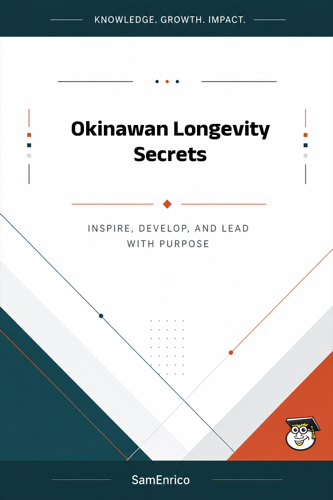
Non-FictionHealth & WellnessBlue Zones
Okinawan Longevity Secrets eBook
Eat sweet potatoes, practice moai, and find your i
Eat sweet potatoes, practice moai, and find your ikigai daily.
Formats
Free sample
Chapter 1: The Scarcity Paradox--In the spring of 1945, as American bombs fell on the island of Okinawa with a ferocity that would ultimately claim over a quarter of the civilian population, an eighty-seven-year-old farmer named Ushi stood in her sweet potato field and watched her village burn. She had no running water, no electricity, no medicine, and no hope of rescue. By every metric of modern longevity—wealth, infrastructure, medical access—Ushi should have died within the year. She lived another thirty-two years, dying peacefully at one hundred and nineteen, surrounded by four generations of her family.This is not an outlier. This is the pattern.The Okinawa Centenarian Study, a twenty-five-year longitudinal research project conducted by Drs.
Bradley Willcox, Craig Willcox, and Makoto Suzuki, tracked over nine hundred Okinawan centenarians and discovered a paradox that upends everything Western medicine believes about aging. The people who lived the longest were not the richest. They were not the most educated. They did not have the best access to healthcare. In fact, many of them had spent decades in poverty, survived war and famine, and never visited a doctor until they were already centenarians.Okinawa today has sixty-eight centenarians per one hundred thousand people.
The United States has approximately ten. The United Kingdom has fifteen. Even mainland Japan, which boasts some of the highest longevity statistics in the developed world, has only thirty-five per one hundred thousand—roughly half of Okinawa's rate.The question is not whether Okinawans live longer. They do. The question is why.And the answer, as this book will demonstrate across twelve chapters and a twelve-week protocol, is not what you think.
It is not the sweet potato alone, though that purple root is a biochemical marvel. It is not the Moai, though that contractual community is the most powerful social technology ever devised. It is not the Ikigai, though finding purpose in small daily actions is the difference between surviving and thriving.The answer is something much more uncomfortable, much more counterintuitive, and much more actionable than any of those individual components.The answer is scarcity.The Great Lie of Affluent Longevity We have been sold a story. The story goes like this: if you earn enough money, buy the right supplements, join the correct gym, and get annual physicals, you will live a long and healthy life. This story is seductive because it places control in your hands.
It says that longevity is a product of accumulation—of wealth, of knowledge, of resources.The data does not support this story.The Okinawa Centenarian Study found that the majority of centenarians had lived through what economists call "negative economic shocks" — periods of profound scarcity. The 1945 Battle of Okinawa killed approximately one hundred twenty thousand civilians, destroyed nearly every building on the island, and left survivors with nothing but the clothes on their backs and whatever food they could grow or steal. The post-war American occupation brought processed foods, sugar, and sedentary lifestyles to the island for the first time. By the 1960s, Okinawa was beginning to look like a miniature version of the American suburbs, complete with cars, television, and packaged snacks.And yet, the generation that had survived the war—the people who had eaten nothing but sweet potatoes and seaweed for years—went on to become the longest-lived humans in recorded history. The generation that grew up in the relative affluence of the post-war era?
They developed diabetes, heart disease, and obesity at rates approaching those of mainland Japan and the West.This is the scarcity paradox: the people who had the least lived the longest. The people who had more died younger.The Mechanism: Why Scarcity Triggers Longevity Before you close this book and accuse me of romanticizing poverty, let me be clear. Starvation is not a longevity strategy. Malnutrition is not a goal. The Okinawans were not healthy because they suffered.
They were healthy because their suffering forced them into behaviors that, by accident, activated the body's most powerful longevity pathways.Let me explain the biology.When the human body experiences caloric restriction—not starvation, but consistent, mild underfeeding—it activates a genetic pathway called the mechanistic target of rapamycin, or m TOR. Think of m TOR as a master switch. When it is fully activated (which happens when you eat to satiety or beyond), your body is in "growth mode." It builds cells, stores fat, and prioritizes reproduction over repair. This is useful when food is abundant. It is disastrous for long-term health because growth mode accelerates aging.
It promotes inflammation, increases cancer risk, and shortens telomeres (the protective caps on your chromosomes).When m TOR is partially inhibited (which happens when you stop eating at eighty percent full, a practice the Okinawans call hara hachi bu), your body flips into "repair mode." It activates autophagy—a process of cellular cleanup that removes damaged proteins, dysfunctional mitochondria, and even senescent "zombie" cells that contribute to aging. Your body stops building and starts repairing.The sweet potato, which was the only food available to many Okinawans during and after the war, is uniquely suited to support this repair mode. Unlike the refined carbohydrates that dominate Western diets (bread, pasta, rice, sugar), the Okinawan purple sweet potato releases glucose slowly into the bloodstream because of its high resistant starch and fiber content. This prevents the insulin spikes that keep m TOR activated and allows the body to remain in a low-grade repair state for most of the day.But here is the crucial insight that every other book on Okinawan longevity misses: the sweet potato alone does nothing. You could eat purple sweet potatoes at every meal while continuing to overeat, while eating them alongside sugar and dairy, while scrolling through social media in isolation, and you would see no longevity benefit whatsoever.The sweet potato works because it was embedded in a system of scarcity.
That system had three components, and they are the three pillars of this book.Pillar One: Caloric Scarcity (Hara Hachi Bu)The Okinawan practice of eating until eighty percent full is not a diet. It is not calorie counting. It is not portion control in the Western sense, which typically involves measuring, weighing, and feeling deprived. Hara Hachi Bu is a mindset shift: you stop eating when you are no longer hungry, not when you are full.The Confucian proverb that gave this practice its name translates roughly to "eat until you are eight parts full." The Okinawan elders did not calculate this number. They simply ate slowly, paid attention to their bodies, and stopped when they felt "comfortably incomplete" — a sensation that most Westerners have never experienced because they eat until they feel stuffed, then eat a little more.The science here is robust.
Studies of caloric restriction in humans and animals consistently show that reducing caloric intake by twenty to thirty percent extends lifespan, reduces inflammation, lowers cancer risk, and delays the onset of age-related diseases. The effect size is enormous: caloric restriction is the single most replicable longevity intervention in the history of biomedical research, outperforming every drug, every supplement, and every exercise protocol ever studied.But there is a catch. Caloric restriction only works if you…
This is the end of the free sample. Get the eBook to keep going. Buy now
About this book
Details
- Author
- Meyer Candace
- Publisher
- SamEnrico
- Language
- English
- Genre
- Non-Fiction, Health & Wellness, Blue Zones
- Released
- 2026-06-06
- Pages (approx.)
- 143
- Available as
- eBook, Audiobook

Read better in the ZLOADR app
Your eBooks on your phone or tablet. Sign in with your SamEnrico account and start reading.
More by Meyer Candace
 Morning Mindset Reframe GuideMeyer Candace$11.99
 Logical Creativity HandbookMeyer Candace$11.99
 Relationship Anger RestructuringMeyer Candace$11.99
 The Sherman Alexie StoryMeyer Candace$11.99
 Time Restricted EatingMeyer Candace$11.99
 Gut Brain Immune TriangleMeyer Candace$11.99
 Affirmations For AgingMeyer Candace$11.99
 Pegasus and the Parthenon: Horses of Ancient AthensMeyer Candace$11.99
 The Last Supper: Australia's Death Row Meals and the Final Hours of the CondemnedMeyer Candace$11.99
 The Essential Guide to Contemporary FolkMeyer Candace$11.99
 B2B Sales for Maritime SectorMeyer Candace$12.99
 ROI Calculator for PromotionMeyer Candace$12.99
You may also like
 Hong Kong Handover 1997Dunn Johnnie$11.99
 Zumba For Postnatal Recovery CourseNeal Christian$11.99
 Zumba for BeginnersLadner Nikia$11.99
 YouTube Comment Mining GuideHumes Pandora$12.99
 Worry Box MeditationCarlin Rudy$11.99
 Workplace Stress MeditationNguyen Lynn$11.99
 Workplace Stress and Sleep RepairHawley Ivory$11.99
 Workplace Perfectionism CureDelaney Jeffry$11.99
 Workplace Injustice Anger GuideWallen Isabelle$11.99
 Work Addiction and Burnout LinkGreenwood Ester$11.99
 Women in Yoga and WellnessBeattie Galina$11.99
 Women in Stand Up ComedyChun Evangeline$11.99