
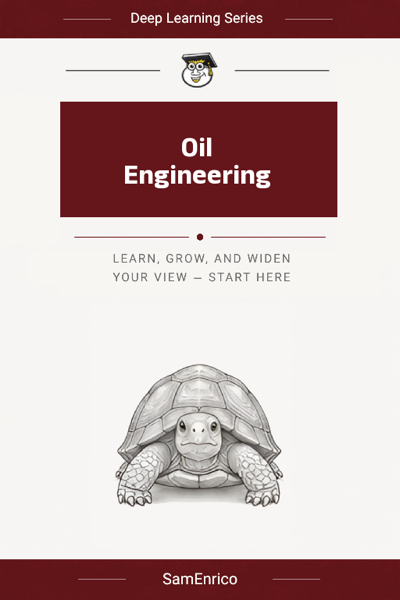
Oil Engineering eBook
A Coursebook on Oil Engineering
by Key Tanisha
A Coursebook on Oil Engineering
Formats
Free sample
Chapter 1: The Invisible Harvest--–- The phone rang at 2:17 AM. On the other end was a field superintendent with a voice that shifted from casual to clipped in the space of a single sentence. "The separator is sanding out," he said. "We've lost half our capacity, and the backpressure is climbing toward the relief valve setting." In that moment, a young production engineer—only eighteen months out of university—faced a decision that would affect dozens of workers, millions of dollars in deferred oil, and the environmental integrity of a facility the size of a city block. She had three hours before the next shift change, no clear procedure for this exact failure, and a control room full of operators waiting for guidance.
This is not an unusual story. This is Tuesday in oil engineering.Oil engineering is not a discipline of pristine whiteboards and elegant equations solved in quiet offices. It is the art and science of finding, extracting, and delivering hydrocarbons from deep beneath the Earth's surface to the tanks, pipelines, and refineries that feed modern civilization. It is a field defined by uncertainty—geological uncertainty about what lies thousands of meters below the rig floor, mechanical uncertainty about equipment pushed to the limits of temperature and pressure, and economic uncertainty about a commodity whose price can halve in six months. The engineer who succeeds in this world is not merely a technician applying formulas.
She is a decision-maker under pressure, a safety advocate, an environmental steward, and—increasingly—a key player in the energy transition.This chapter establishes the foundation upon which the entire book is built. It answers the most fundamental question: what exactly is oil engineering, and why should anyone spend a career doing it? We will explore the three sectors of the industry, the life cycle of any oilfield from discovery to abandonment, the economics that drive every decision, and finally—honestly—the future of petroleum in a world that is simultaneously addicted to fossil fuels and desperate to move beyond them. By the end of this chapter, you will understand not only the structure of this book but also the structure of an industry that employs millions, moves billions of barrels annually, and touches nearly every aspect of modern life.The Three Sectors: Upstream, Midstream, Downstream Before diving into reservoirs and rigs, we must map the terrain. The oil and gas industry is conventionally divided into three sectors, each with its own engineering challenges, economic drivers, and career paths.
Understanding these divisions helps the engineer see where her work fits into the larger system—and, crucially, where her decisions ripple outward.Upstream: Finding and Producing The upstream sector—often called exploration and production (E&P)—is where oil engineering begins. This is the world of seismic crews shooting sound waves across deserts and oceans, of geologists debating the meaning of a subtle fault on a 3D seismic cube, of drilling rigs that cost half a million dollars per day to operate, of production platforms that look like small cities floating in the North Sea. Upstream engineers find the oil and bring it to the surface.Within upstream, there are distinct sub-disciplines that will form the backbone of this book. Reservoir engineers use material balance equations and numerical simulators to predict how much oil is present and how it will flow. Drilling engineers design the well path, select the bits and muds, and ensure that the hole reaches its target safely.
Production engineers manage the well once it is completed, optimizing artificial lift and troubleshooting problems like sand production, scale, or wax deposition. Facilities engineers design the surface processing equipment that separates oil, gas, and water. Upstream ends at the custody transfer point—usually the inlet flange of a pipeline or the manifold of an export terminal.Midstream: Transporting and Storing The midstream sector bridges the gap between production and refining. It is often overlooked by newcomers, but it accounts for a massive portion of industry infrastructure and investment. Midstream includes pipelines (on land and under the sea), pumping stations, compressor stations, storage tanks, liquefied natural gas (LNG) plants, and marine terminals.
Midstream engineers worry about different problems than their upstream colleagues: flow assurance (keeping the product moving without forming hydrates or wax), corrosion control, leak detection, and pressure management across hundreds or thousands of kilometers.A curious feature of midstream is that it is often regulated as a natural monopoly—you cannot easily build competing pipelines to the same refinery. This regulatory reality shapes the economics and financing of midstream projects. For the engineer, midstream offers long-term operational roles and challenging problems in multiphase flow, materials science, and automation.Downstream: Refining and Marketing The downstream sector takes crude oil and natural gas and transforms them into products people actually buy: gasoline, diesel, jet fuel, heating oil, lubricants, asphalt, plastics, fertilizers, and thousands of petrochemical derivatives. Downstream engineering is chemical engineering at enormous scale. Refineries are complex networks of distillation columns, catalytic crackers, hydrotreaters, reformers, and alkylation units.
They operate at high temperatures and pressures, with inventories of flammable and toxic substances that require rigorous process safety management.Downstream engineers focus on yield optimization (getting more high-value products from each barrel of crude), energy efficiency, emissions reduction, and reliability. While this book focuses primarily on upstream and midstream, the downstream context matters because the quality of crude oil (its API gravity, sulfur content, acidity) determines its market value and refining cost. An upstream engineer who understands what refiners want can make better development decisions.Why the Boundaries Are Blurring The clean division between upstream, midstream, and downstream is a useful teaching tool, but modern oil companies increasingly operate across these boundaries. Integrated majors like Exxon Mobil, Shell, and BP own assets in all three sectors. Shale operators in the Permian Basin have built their own midstream gathering systems because third-party pipelines could not keep pace with production growth.
And the rise of "molecules to electrons" strategies—where natural gas is produced, transported, and ultimately burned for power generation—blurs the line between energy production and utility operations.For the aspiring oil engineer, this means you should understand all three sectors even if you work in only one. A drilling engineer who does not understand the value of the crude her well will produce may drill unnecessarily expensive wells. A production engineer who ignores midstream constraints may choke back a well that could flow harder. The best engineers think across boundaries.The Oilfield Life Cycle: From Seismic to Abandonment Every oilfield follows a predictable sequence of phases, from the first inkling of a prospect to the final plugged well and removed platform. This life cycle frames the entire book, and each subsequent chapter addresses the engineering challenges of one or more phases.
Understanding the sequence helps the engineer anticipate what comes next and make decisions that consider the full life cycle, not just the immediate task.Exploration: The Search for Traps Exploration is the phase of highest risk and highest potential reward. The explorationist's job is to identify geological structures that might contain oil or gas—and then to drill a well to test that hypothesis. Success rates vary dramatically. In a mature basin like the Gulf…
This is the end of the free sample. Get the eBook to keep going. Buy now
About this book
Details
- Author
- Key Tanisha
- Publisher
- SamEnrico
- Language
- English
- Genre
- Non-Fiction, Informative, Educational
- Released
- 2026-05-04
- Pages (approx.)
- 150
- Available as
- eBook, Audiobook

Read better in the ZLOADR app
Your eBooks on your phone or tablet. Sign in with your SamEnrico account and start reading.
More by Key Tanisha
 Emotional Eating WorkbookKey Tanisha$11.99
 Self Hypnosis Strength TrainingKey Tanisha$11.99
 Shift Work Cognitive PerformanceKey Tanisha$11.99
 The Trade Show CollectorKey Tanisha$11.99
 Self Esteem and Silent TreatmentKey Tanisha$11.99
 The Last Broadcast: The 1996 TWA Flight 800 Conspiracy FilesKey Tanisha$11.99
 Excalibur’s Lost Daughter: The Forgotten Heir of AvalonKey Tanisha$11.99
 P Card Program GuideKey Tanisha$12.99
 Executive Summary Quick Reference for Daily UseKey Tanisha$12.99
 Understanding Exostoses, Multiple, Type 2Key Tanisha$17.99
 How to Become a Mold StamperKey Tanisha$11.99