
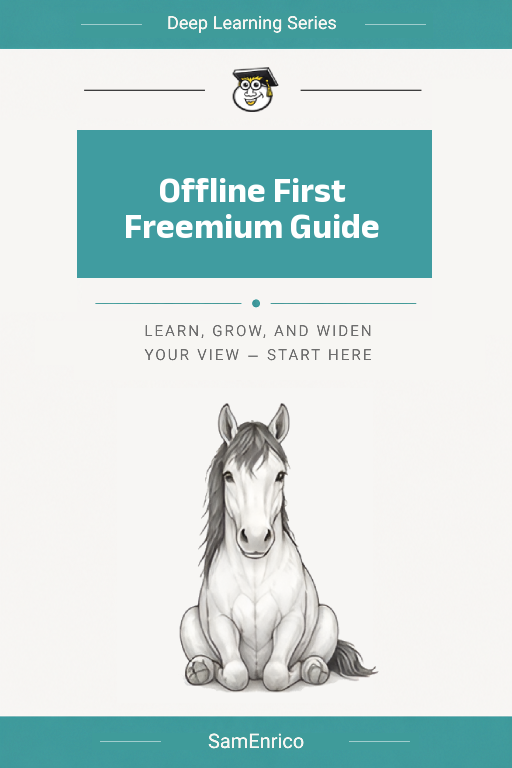
Offline First Freemium Guide eBook
Design freemium apps that work without constant in
Design freemium apps that work without constant internet for rural users in low broadband regions across Africa and Asia.
Formats
Free sample
Chapter 1: The Spinning Coffin...--–- The screen freezes. A white wheel appears. It spins. And spins. And spins.
You have seen this wheel before. It is the universal symbol of modern failure: the infinite spinner, the spinning wheel of death, the frozen loader that mocks you with its motion while delivering nothing.For most developers reading this book, that spinner is an annoyance. A minor frustration when the subway goes into a tunnel. A brief pause when the elevator loses signal. You wait five seconds, maybe ten, and the world returns.
The spinner disappears. Life continues.But for the next billion users, that spinner is not an annoyance. It is the end of the transaction. The loss of a day's wages. A missed market price that costs a farmer his entire harvest margin.
A health record that never syncs. A child's vaccination date that gets forgotten because the app demanded a connection that does not exist.The spinner is a coffin. And it is burying your product before it ever reaches the people who need it most.This book is about digging that product out of the grave.The Geography of Disconnection Let us start with a number: 3.8 billion.That is how many people on this planet still lack reliable internet access. Not "no access" in the sense of living in a cave without electricity. Many of these people have smartphones.
Many have data plans. But "reliable" is the word that matters. The International Telecommunication Union estimates that while 95% of the world's population lives within range of a mobile signal, only 55% actually use the internet regularly. The gap between coverage and usage is the gap between having a signal bar and having usable connectivity.Consider a rural trader in northern Nigeria. Her name is Amina.
She wakes at 5:00 AM to walk to the nearest town where she sells vegetables. She owns a smartphone—a Tecno Spark from 2019 with 1GB of RAM and 16GB of storage. She has a data plan: 500MB for the week, which costs her 500 Naira. That is roughly $0.60 USD. It is also the price of her breakfast for two days.Amina's phone shows three bars of signal when she stands outside her house.
But those bars mean nothing. When she tries to check market prices for tomatoes on a trading app, the spinner appears. She waits. The spinner continues. She waits longer.
Eventually, the app gives her an error: "No internet connection. Please try again."But she has a connection. The bars are there. The phone says "4G." Yet the data cannot travel the distance from the tower to her phone because the tower is overloaded, the backhaul is satellite, and the latency is 800 milliseconds. The app's timeout is set to 10 seconds.
It fails. She gives up.This is not a story about infrastructure. This is a story about assumptions. Every app Amina has ever downloaded was built in Lagos, Nairobi, or Bangalore by developers sitting on fiber connections. Those developers never tested their apps at 2G speeds.
They never ran their sync protocols over a connection that drops every 47 seconds. They never considered that a user might close the app while a background queue is still processing because they need to save battery for an emergency call.The assumption was always: the internet is there. The internet is fast. The internet is cheap.The assumption is wrong.The $100 Billion Blind Spot Let me make this personal for you, the reader. You are probably building something.
Maybe it is a health app for community workers. Maybe it is an agricultural marketplace. Maybe it is an educational platform for students who cannot afford textbooks. Whatever it is, you have competitors. And your competitors are almost certainly building for the connected world.Big Tech has abandoned this market.
Not because they are evil, but because their business models depend on tracking, on real-time engagement, on advertising that requires constant connectivity. Google and Meta fight over the last 100 million users in wealthy countries while the next billion sit in the dark, offline, ignored.That is your opportunity.The offline-first market is a $100 billion blind spot.Consider these numbers:Mobile money transactions in Africa reached $1.4 trillion in 2023. That is trillion with a T. And most of those transactions happen over USSD codes, not smartphone apps, because the apps fail when connectivity drops.Agricultural technology could increase farm yields by 30% in emerging markets, but adoption hovers below 10% because weather apps require data to fetch forecasts.Telemedicine could save 2 million lives per year in rural Asia and Africa, but most health apps crash when community workers enter areas with no signal.Every single one of these failures is a design failure. The technology exists.
The demand exists. The money exists. What does not exist is the willingness to build for the actual conditions on the ground.This book is that willingness.The Cost of a Meal Let us talk about money, because money is the hidden variable in every connectivity calculation.In the United States or Europe, the cost of 1GB of mobile data is roughly 1% of daily minimum wage. In Nigeria, 1GB costs about 20% of daily minimum wage. In the Democratic Republic of Congo, it is closer to 40%.
In Indonesia, 15%.Think about what that means. Every time your app syncs a 5MB JSON payload, you are asking a user to spend money they could have spent on food. Every background refresh that runs automatically is a background tax on poverty.This is not hyperbole. I have watched users in rural Kenya disable automatic app updates on their phones. I have watched them turn off push notifications.
I have watched them delete apps that consumed too much data in the background. They are not being paranoid. They are being rational economic actors with limited resources.If your app requires constant connectivity, you are not building for these users. You are building for yourself.The first rule of offline-first design: Treat every byte of data as if it costs the user a penny. Because in many cases, it does.Who Is the Next Billion?Before we go further, we need to get specific about who we are building for.
The phrase "next billion users" has become a marketing cliché. Tech companies love to talk about bringing the unconnected online. But they rarely describe who those users actually are.Let me give you a detailed portrait. It is a composite drawn from field research across twelve countries in Africa and Asia, from rural Uganda to the Philippines, from the highlands of Papua New Guinea to the villages of Rajasthan.Profile: The Next Billion User Age: Between 16 and 35. The next billion is young.
Very young. The median age in sub-Saharan Africa is 19. In India, it is 28. These are digital natives in the sense that they have grown up with mobile phones, but not with home internet.Income: 2to2 to 2to10 per day. This is the working poor.
They have jobs. They have aspirations. They have families. But every dollar is accounted for. There is no discretionary spending.Device: A smartphone costing 50to50 to 50to150.
Usually an Android. Often a refurbished model. Screen size: 4 to 5.5 inches. RAM: 1GB to 3GB. Storage: 16GB to 32GB…
This is the end of the free sample. Get the eBook to keep going. Buy now
About this book
Details
- Author
- Mansfield Trula
- Publisher
- SamEnrico
- Language
- English
- Genre
- Non-Fiction, Business Brief, Offline SaaS
- Released
- 2026-06-01
- Pages (approx.)
- 127
- Available as
- eBook, Audiobook

Read better in the ZLOADR app
Your eBooks on your phone or tablet. Sign in with your SamEnrico account and start reading.
More by Mansfield Trula
 Self Love Affirmations GuideMansfield Trula$11.99
 The Emotional Regulation for ShameMansfield Trula$11.99
 Learning Weekly ReviewMansfield Trula$11.99
 Business Credit Card StrategyMansfield Trula$11.99
 Metabolic Adaptation RD GuideMansfield Trula$11.99
 Habit Formation for TeachersMansfield Trula$11.99
 Evening Commute RageMansfield Trula$11.99
 Pocahontas Diplomatic BridgeMansfield Trula$11.99
 The Veles Conspiracy: A Spy Among the DeadMansfield Trula$11.99
 The Great White North Conspiracy: Canada's Insurance Fraud Panic of the 2000sMansfield Trula$11.99
 How to Start a Noodle Business (Beginners Guide)Mansfield Trula$11.99
 How to Produce LaTeX Interior PaintMansfield Trula$11.99