
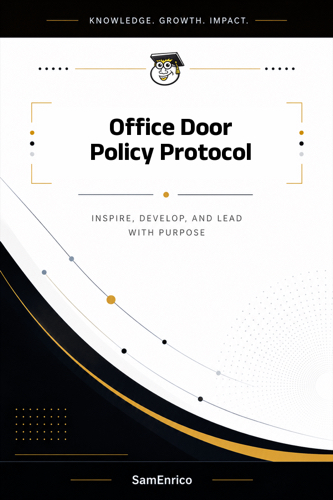
Non-FictionSelf-HelpOffice Dynamics
Office Door Policy Protocol eBook
Set physical workspace boundaries to prevent inter
by Becnel Adria
Set physical workspace boundaries to prevent interruptions using this practical office management guide.
Formats
Free sample
Chapter 1: The 23-Minute Theft--–- The first time it happened today, you were typing an email. The second time, you were finally diving into that spreadsheet. The third time, you had just found your flow state—that rare, precious window where the words came easily and the numbers made sense. Then came the knock. Or worse, no knock at all—just a head appearing around the doorframe, attached to a voice saying three words that have quietly become the most expensive phrase in modern work: “Got a second?”You don’t have a second.
But you’ll give one anyway. Because that’s what good colleagues do. That’s what team players do. That’s what someone with an “open door policy” does.And that single second will cost you twenty-three minutes.Not ten. Not fifteen.
Twenty-three. That’s the average time required to fully recover cognitive focus after a one-minute interruption, according to research compiled by Gloria Mark at the University of California, Irvine. Her team studied information workers in their natural environments and found that the switching cost—the mental overhead of disengaging from one task, shifting attention to another, and then reorienting back to the original task—averages just over twenty-three minutes per interruption. Some interruptions cost more; some cost less. But the median hovers around that devastating number.Let’s do the math together, because numbers have a way of cutting through politeness.Assume you are a knowledge worker—a manager, an analyst, a designer, an engineer, a writer, a lawyer, an accountant, or anyone whose primary output is thinking.
Assume you receive just five interruptions per day that require you to fully disengage from what you were doing. (If you work in an open-plan office or near a high-traffic hallway, five is a conservative estimate. Many professionals report ten or more.) That’s five minutes of direct interruption time. Multiply by the twenty-three-minute recovery cost, and you lose 115 minutes per day—nearly two hours—not to the interruptions themselves, but to the aftermath.Over a five-day work week: 575 minutes. That’s 9.6 hours.
More than a full workday lost to recovery.Over a forty-eight-week working year (accounting for vacation and holidays): 27,600 minutes. That’s 460 hours. That’s nineteen full days.Nineteen days per year. Per employee.On a team of ten people, that’s one hundred and ninety days of collective cognitive capacity—gone. Not spent on actual work.
Spent on the neurological equivalent of catching your breath after someone shoved you off balance.Now consider what you’re actually being interrupted for. In the vast majority of cases, the interruption is not an emergency. It is not a client crisis. It is not a regulatory deadline. It is not a fire, flood, or physical threat.
It is a question that could have been emailed. A piece of information that could have been looked up. A status update that could have waited until the standing meeting. An observation that could have been shared during designated office hours. A thought that occurred to someone and felt urgent only because it occurred to them right then.In other words, you are losing nineteen days per year to the convenience of other people.And here is the cruelest irony: the very culture that produces these interruptions—the celebrated “open door policy”—was designed to do the opposite.
It was supposed to make teams more collaborative, more agile, more trusting. Instead, it has made them fractured, exhausted, and secretly resentful. The open door has become a trap disguised as a virtue.The Origins of a Well-Intentioned Disaster To understand why the open door policy fails so spectacularly, we have to go back to where it began: post-World War II American management philosophy. In the 1940s and 1950s, organizations were hierarchical, rigid, and siloed. Workers reported to supervisors who reported to managers who reported to executives, and the chain of command was enforced with almost military precision.
If a frontline employee had an idea or a concern, it traveled upward through layers of approval, often arriving at the top weeks later—filtered, diluted, or dead on arrival.Into this environment stepped a generation of management thinkers who argued that accessibility was the antidote to bureaucracy. If leaders made themselves available—really available, without layers of gatekeepers and appointment secretaries—then information would flow faster, trust would increase, and problems would be solved before they festered. The “open door policy” was born as a philosophy of psychological accessibility: the idea that any employee could bring any concern directly to any leader, without fear of reprisal or bureaucratic delay.For a time, it worked. Or at least, it appeared to work. Executives who left their office doors literally open were perceived as more approachable.
Employees who walked through those doors felt heard. The policy became a signal of organizational health, a marker of a culture that valued transparency over hierarchy.But somewhere along the way, the philosophy became architecture. The metaphorical open door became a literal one. And that’s when the trouble began.Because psychological availability—the willingness to listen, to empathize, to respond—is not the same as physical accessibility. A leader can be emotionally present without being constantly interruptible.
In fact, emotional presence requires cognitive presence, which requires uninterrupted focus. You cannot truly listen to an employee’s concern if you are still mentally recovering from the previous interruption. You cannot solve a complex problem if your attention has been shattered into fragments.The original open door policy was about invitation. The modern open door policy has become about default. And a default-open door is not an invitation; it is an absence of boundaries.The Hidden Math of Interruption (Why Your Brain Can’t Just “Get Back to It”)Let’s go deeper into that twenty-three-minute figure, because understanding the why is essential to understanding the how of fixing the problem.
The twenty-three minutes is not the time you spend talking to the person at your door. That’s one minute, maybe two, maybe five if the conversation drifts. The twenty-three minutes is the recovery time after they leave.Here’s what happens inside your brain during that recovery window.When you are engaged in a complex cognitive task—writing a proposal, analyzing data, debugging code, designing a presentation—your brain constructs what psychologists call an “attention scaffold.” Think of it as a mental workspace where relevant information is held active, irrelevant information is suppressed, and a sequence of next steps is queued up and ready to execute. This scaffold is fragile. It requires working memory, which is limited to roughly four discrete items at any given time.
It requires executive function, which is the brain’s air traffic control system for prioritizing tasks and suppressing distractions.When an interruption occurs, that scaffold collapses. Not partially. Not gradually. Collapses. The brain, being a remarkably efficient organ, immediately begins to reallocate cognitive resources to the new stimulus—the person at the door, the question they’re asking, the social cues you need to read to respond appropriately.
The active information in your working memory is flushed. The queued sequence of next steps is discarded. The suppressed distractions come flooding back.When the…
This is the end of the free sample. Get the eBook to keep going. Buy now
About this book
Details
- Author
- Becnel Adria
- Publisher
- SamEnrico
- Language
- English
- Genre
- Non-Fiction, Self-Help, Office Dynamics
- Released
- 2026-06-07
- Pages (approx.)
- 157
- Available as
- eBook, Audiobook

Read better in the ZLOADR app
Your eBooks on your phone or tablet. Sign in with your SamEnrico account and start reading.
More by Becnel Adria
 Fibromyalgia Sleep HypnosisBecnel Adria$11.99
 Binge Eating Maintenance WorkbookBecnel Adria$11.99
 Personal Ing For Success AssessmentBecnel Adria$11.99
 Adrenal Fatigue and Low LibidoBecnel Adria$11.99
 The Night the British Empire Almost Fell: The 1975 Cabinet CrisisBecnel Adria$11.99
 Whispers of the Vanishing: The Last Dance of the KakapoBecnel Adria$11.99
 How to Become a Quiller OperatorBecnel Adria$11.99
 North America Logistics DirectoryBecnel Adria$12.99
 Xero Bookkeeping GuideBecnel Adria$12.99
 Understanding Ectropion Inferior Cleft Lip and Or PalateBecnel Adria$17.99
 ElectronicsBecnel Adria$11.99
You may also like
 Hong Kong Handover 1997Dunn Johnnie$11.99
 Zumba For Postnatal Recovery CourseNeal Christian$11.99
 Zumba for BeginnersLadner Nikia$11.99
 YouTube Comment Mining GuideHumes Pandora$12.99
 Worry Box MeditationCarlin Rudy$11.99
 Workplace Stress MeditationNguyen Lynn$11.99
 Workplace Stress and Sleep RepairHawley Ivory$11.99
 Workplace Perfectionism CureDelaney Jeffry$11.99
 Workplace Injustice Anger GuideWallen Isabelle$11.99
 Work Addiction and Burnout LinkGreenwood Ester$11.99
 Women in Yoga and WellnessBeattie Galina$11.99
 Women in Stand Up ComedyChun Evangeline$11.99