
Non-FictionSelf-HelpWorkplace Wellness
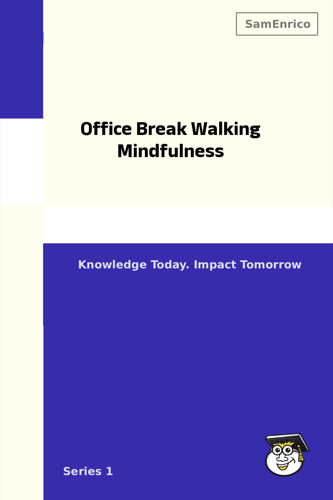
Office Break Walking Mindfulness
Walk a short indoor path during work breaks, reset
Walk a short indoor path during work breaks, resetting attention and reducing stress.
Formats
About this book
Free sample
Chapter 1: The Sitting Corpse...--–- At 3:17 PM on a Tuesday, you will die. Not a literal death—no ambulance, no flatline, no coworkers gathering around your cubicle with teary eyes. A different kind of death. The death of your attention span. The death of your ability to care about the spreadsheet you have been staring at for forty-five minutes without reading a single cell.
The death of the patience you need to not snap at your colleague who just asked “a quick question.” This is the hour when your brain, exhausted from six hours of continuous sitting and screen-staring, stops pretending to function. You are, for all practical purposes, a sitting corpse. And the cruelest part? You will spend the next two hours pretending otherwise.This is not a failure of willpower. It is not a character flaw.
It is biology. And biology, unlike your email inbox, follows predictable rules.The Hidden Epidemic No One Is Measuring Every year, corporations spend billions of dollars on productivity software, time management training, and “wellness initiatives” that include free fruit on Tuesdays and a meditation app subscription that nobody uses past January 15th. Yet the same problem persists: by mid-afternoon, the average office worker is operating at approximately forty percent of their morning cognitive capacity. They are present in body but absent in mind. They answer emails that don't need answering.
They click between tabs without remembering why. They read the same paragraph four times.We call this “being busy.” It is not busy. It is brain fog. And it has a scientific name.Directed Attention Fatigue (DAF) was first described by psychologist William James in the 1890s, but it took another century for researchers to understand its mechanics. Here is what we now know: your brain has a limited supply of inhibitory attention—the neural fuel that allows you to ignore distractions, stay on task, and filter out irrelevant information.
Every email notification you resist checking, every Slack ping you ignore, every moment you force yourself to focus on a boring spreadsheet when you would rather be anywhere else—all of it…
This is the end of the free sample. Get the eBook to keep going. Buy now
Contents
- Chapter 1
- Chapter 2
- Chapter 3
- Chapter 4
- Chapter 5
- Chapter 6
- Chapter 7
- Chapter 8
- Chapter 9
- Chapter 10
- Chapter 11
- Chapter 12
Details
- Author
- Coker Lakeisha
- Publisher
- SamEnrico
- Language
- English
- Genre
- Non-Fiction, Self-Help, Workplace Wellness
- Released
- 2026-06-10
- Pages (approx.)
- 131
- Available as
- eBook, Audiobook

Read better in the ZLOADR app
Your eBooks on your phone or tablet. Sign in with your SamEnrico account and start reading.
More by Coker Lakeisha
 Condescension Anger Triggers GuideCoker Lakeisha$11.99
 SACCO Member Registration GuideCoker Lakeisha$11.99
 Pomodoro Habit Formation GuideCoker Lakeisha$11.99
 Saying No Without Guilt GuideCoker Lakeisha$11.99
 The Djinn Architect of Baghdad’s Forgotten SpireCoker Lakeisha$11.99
 Farm ManagerCoker Lakeisha$11.99
 Insulet SWOT GuideCoker Lakeisha$12.99
 Asana Remote Internship GuideCoker Lakeisha$12.99
 Understanding Ombrophobia[citation Needed]Coker Lakeisha$17.99
 A Beginners Guide to Four square (Volume 1)Coker Lakeisha$11.99
You may also like
 Hong Kong Handover 1997Dunn Johnnie$11.99
 Zumba For Postnatal Recovery CourseNeal Christian$11.99
 Zumba for BeginnersLadner Nikia$11.99
 YouTube Comment Mining GuideHumes Pandora$12.99
 Worry Box MeditationCarlin Rudy$11.99
 Workplace Stress MeditationNguyen Lynn$11.99
 Workplace Stress and Sleep RepairHawley Ivory$11.99
 Workplace Perfectionism CureDelaney Jeffry$11.99
 Workplace Injustice Anger GuideWallen Isabelle$11.99
 Work Addiction and Burnout LinkGreenwood Ester$11.99
 Women in Yoga and WellnessBeattie Galina$11.99
 Women in Stand Up ComedyChun Evangeline$11.99