
Non-FictionHealth & WellnessPsychopharmacology
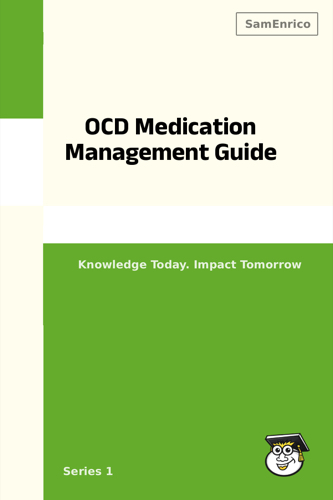
OCD Medication Management Guide eBook
High dose SSRIs and augmentation strategies for tr
High dose SSRIs and augmentation strategies for treatment resistant obsessive compulsive disorder.
Formats
Free sample
Chapter 1: The Serotonin Ceiling--–- The first time Sarah washed her hands until they bled, she was seven years old. The first time her psychiatrist prescribed fluoxetine 20mg, she was twenty-two. The first time a clinician told her she was "treatment-resistant," she was twenty-four—after exactly eight weeks on that standard dose, with no follow-up titration, no discussion of augmentation, and no mention that her brain might simply require more serotonin blockade than a depressed patient's ever would. Sarah's case is not exceptional. It is, in fact, the rule.This chapter dismantles the single most pervasive error in OCD pharmacotherapy: the assumption that what works for major depression should work for obsessive-compulsive disorder at the same dose, for the same duration, with the same expectations of response.
That assumption has failed millions of patients. It has produced the statistic that haunts this field: forty to sixty percent of OCD patients do not achieve remission on first-line monotherapy. But the fault is not in the medications. The fault is in the ceiling we have imposed upon them.We begin with a fundamental question that will echo through every subsequent chapter: Why does OCD demand more serotonin than depression? The answer lies in the unique neurocircuitry of this disorder—a circuit that does not merely regulate mood but governs the error-detection and habit-formation systems of the brain.
To quiet that circuit, standard SERT occupancy of eighty percent is insufficient. OCD often requires occupancy exceeding eighty-five percent, a threshold that standard dosing rarely reaches. This is the serotonin ceiling, and breaking through it is the first and most essential act of precision pharmacology in treatment-resistant OCD.This chapter will establish the neurobiological rationale for high-dose SSRIs, contrast the pathophysiology of OCD with that of major depression, review the FDA-approved agents and their dose-response curves, introduce the concept of supratherapeutic dosing, and provide the foundation for everything that follows: augmentation, switching, and the management of refractory illness. By the end of this chapter, the reader will understand why Sarah needed more—and why your patients will too.The Great Misunderstanding: OCD Is Not Depressed For three decades, the psychopharmacology of OCD has been shackled to the pharmacology of depression. This is not a conspiracy.
It is a historical accident born of convenience. When the SSRIs were first developed and tested, depression was the primary indication. OCD was an afterthought, a secondary approval obtained through smaller trials that often used identical dosing protocols. The result was a one-size-fits-all dosing paradigm that never fit.Consider the numbers. The standard starting dose of fluoxetine for depression is 20mg daily.
The maximum FDA-approved dose is 80mg. For OCD, the same numbers appear on the label: 20mg starting, 80mg maximum. But the clinical reality is radically different. A depressed patient who achieves forty percent reduction in Hamilton Depression Rating Scale scores at 20mg is considered a responder. An OCD patient who achieves a forty percent reduction in Y-BOCS scores at 20mg is a partial responder at best—and will likely relapse within months because the underlying circuit has not been sufficiently silenced.Why?
Because depression and OCD are not the same illness. Depression is a disorder of limbic regulation—the amygdala, the subgenual cingulate, the prefrontal cortex's ability to modulate emotional responses. The circuitry is diffuse, bilateral, and relatively forgiving. OCD is a disorder of cortico-striato-thalamo-cortical (CSTC) loops—a closed circuit that runs from the orbitofrontal cortex to the striatum to the thalamus and back to the cortex. This circuit is tight, reverberatory, and pathologically self-sustaining.
It generates the "error signal"—the feeling that something is wrong, that the hands are still contaminated, that the door is still unlocked—and it does not turn off easily.The serotonin system modulates this circuit, but it does not control it. Serotonin acts as a brake on the thalamus, reducing the volume of the error signal. But the brake is weak at standard occupancy. At eighty percent SERT occupancy, the brake is applied but the circuit continues to spin. At eighty-five to ninety percent occupancy, the brake begins to hold.
This is the serotonin ceiling—the occupancy threshold above which OCD symptoms meaningfully improve and below which patients experience only partial, fleeting, or nonexistent response.The High-Dose Paradox: More Is Different The high-dose paradox can be stated simply: In depression, dose escalation beyond the standard range produces diminishing returns. In OCD, dose escalation into the supratherapeutic range produces linear or near-linear gains up to a point, and only then plateaus. This paradox has been demonstrated in multiple meta-analyses and head-to-head trials, yet it remains underappreciated in clinical practice.A 2019 meta-analysis by Bloch and colleagues examined dose-response relationships across six SSRIs and clomipramine for OCD. The finding was striking: for every increase in SSRI dose equivalent to 20mg of fluoxetine, Y-BOCS scores dropped by an additional 2.5 points on average, up to doses equivalent to 80mg of fluoxetine. Beyond that, gains continued but at a slower rate.
There was no ceiling effect at standard maximum doses. In contrast, depression trials have consistently shown that doses above 40mg of fluoxetine produce minimal additional benefit while increasing side effect burden.What explains this difference? Neuroimaging provides the answer. PET studies of SERT occupancy have demonstrated that at 20mg of fluoxetine, mean occipital SERT occupancy is approximately seventy-six percent. At 40mg, occupancy rises to approximately eighty-one percent.
At 60mg, it reaches eighty-five percent. At 80mg, it approaches ninety percent. In depression, symptom improvement correlates with occupancy up to about eighty percent, after which the curve flattens. In OCD, the correlation continues well into the eighty-five to ninety percent range. The therapeutic ceiling for OCD is higher because the circuit demands more silencing.This has profound practical implications.
A patient who fails 20mg of fluoxetine after eight weeks has not failed fluoxetine. She has failed a low-dose trial of fluoxetine. Similarly, a patient who achieves a thirty percent reduction in Y-BOCS at 40mg of sertraline is not a partial responder. She is a suboptimal responder who likely requires dose escalation, not augmentation or switching. The serotonin ceiling is not a wall.
It is a floor that most patients have never been permitted to stand upon.The Neuroanatomy of Compulsion: Why the CSTC Loop Matters To understand why OCD demands high-dose SSRI therapy, one must first understand the circuit that generates obsessions and compulsions. The CSTC loop is not a metaphor. It is a well-defined anatomical pathway with specific nuclei, specific neurotransmitter systems, and specific patterns of dysregulation in OCD.The loop begins in the orbitofrontal cortex (OFC), a region of the prefrontal cortex that integrates sensory, emotional, and cognitive information to guide decision-making. In OCD, the OFC is hyperactive at rest and becomes more hyperactive when patients are exposed to symptom-provoking stimuli. This hyperactivity generates the "error signal"—the subjective experience that something is wrong, that the hands are not clean, that the stove is still on, that the thought is morally unacceptable.From the OFC, the signal travels to the striatum, specifically the caudate nucleus and putamen.
In a healthy brain, the striatum filters this signal, allowing only salient information to pass through to the thalamus. In OCD, striatal filtering is impaired. The error signal passes through…
This is the end of the free sample. Get the eBook to keep going. Buy now
About this book
Details
- Author
- Landrum Nohemi
- Publisher
- SamEnrico
- Language
- English
- Genre
- Non-Fiction, Health & Wellness, Psychopharmacology
- Released
- 2026-06-06
- Pages (approx.)
- 155
- Available as
- eBook, Audiobook

Read better in the ZLOADR app
Your eBooks on your phone or tablet. Sign in with your SamEnrico account and start reading.
More by Landrum Nohemi
 Survey Bias Detection with AILandrum Nohemi$11.99
 The Self Ban Registry GuideLandrum Nohemi$11.99
 Refugee Parent Stress GuideLandrum Nohemi$11.99
 Handshake Decoding ManualLandrum Nohemi$11.99
 Zeroes and Ones: The Enigma of the Bitcoin PhantomLandrum Nohemi$11.99
 Echoes of the Forgotten: The Lost Tapes of the Apollo 17 AstronautsLandrum Nohemi$11.99
 How to Become a Carbon-furnace-operator HelperLandrum Nohemi$11.99
 PR Card Application After LandingLandrum Nohemi$12.99
 Research Experience Trumps PublicationsLandrum Nohemi$12.99
 Yard WorkerLandrum Nohemi$11.99
 Understanding Calcinosis Cutis (See Also Crest Syndrome)Landrum Nohemi$17.99
You may also like
 Hong Kong Handover 1997Dunn Johnnie$11.99
 Zumba For Postnatal Recovery CourseNeal Christian$11.99
 Zumba for BeginnersLadner Nikia$11.99
 YouTube Comment Mining GuideHumes Pandora$12.99
 Worry Box MeditationCarlin Rudy$11.99
 Workplace Stress MeditationNguyen Lynn$11.99
 Workplace Stress and Sleep RepairHawley Ivory$11.99
 Workplace Perfectionism CureDelaney Jeffry$11.99
 Workplace Injustice Anger GuideWallen Isabelle$11.99
 Work Addiction and Burnout LinkGreenwood Ester$11.99
 Women in Yoga and WellnessBeattie Galina$11.99
 Women in Stand Up ComedyChun Evangeline$11.99