
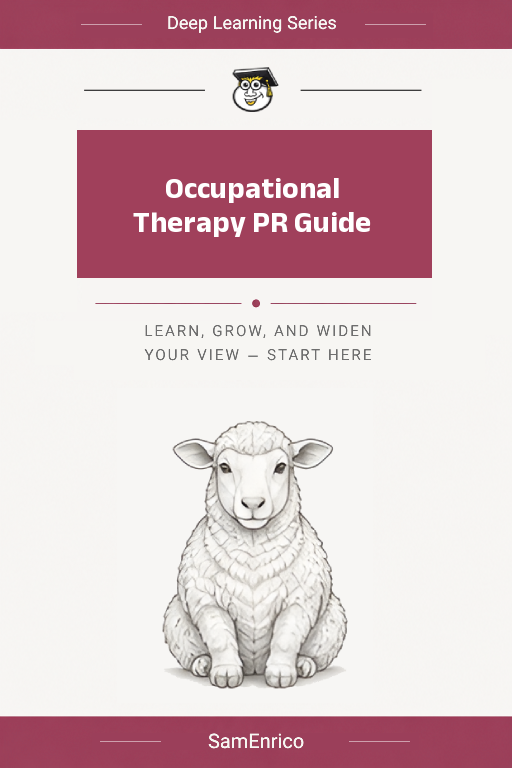
Occupational Therapy PR Guide eBook
Register with Occupational Therapy Board and compl
Register with Occupational Therapy Board and complete OTC skill assessment for PR.
Formats
Free sample
Chapter 1: The Two Pillars--–- Meera had spent eleven years as a senior occupational therapist at a tertiary hospital in Mumbai. She had treated hundreds of stroke survivors, trained a generation of junior OTs, and could recite the FIM score protocol in her sleep. When she decided to pursue permanent residency in Australia, she did what any diligent professional would do: she researched the visa requirements, booked her IELTS test, and paid the first installment to a migration agent who came recommended by a colleague. Eight months and approximately $6,000 AUD later, Meera received a letter from the Department of Home Affairs. Her visa application had been refused.
The reason was not her English score. It was not her age or her points total. It was a single sentence buried on page four of the refusal notice: "The applicant has not provided a valid skills assessment from the relevant assessing authority."Meera had never heard of the Occupational Therapy Council. She had assumed, like many overseas-trained OTs, that her degree and her registration in India would be sufficient. She was wrong.
And by the time she understood her error, she had lost nearly a year of her life and thousands of dollars that she would never recover.This book exists to ensure that you are never Meera.The Invisible Wall That Most Applicants Never See Coming Australia faces a persistent shortage of occupational therapists. According to the Department of Health and Aged Care, the demand for OT services is projected to outstrip supply by approximately 2,500 full-time equivalent positions by 2028. This shortage is particularly acute in regional and remote areas, where some communities wait six months or longer for a pediatric OT assessment. On paper, this should make migration for occupational therapists straightforward. The profession is listed on the Medium and Long-term Strategic Skills List (MLTSSL).
It attracts generous points for skilled independent visas. State governments actively nominate OTs under their sponsored visa programs.Yet despite this apparent welcome, hundreds of internationally qualified occupational therapists fail to secure Australian registration and permanent residency every year. They fail not because they are incompetent clinicians. They fail because they do not understand the fundamental architecture of Australian health regulation. They mistake the visa process for the registration process.
They confuse the Occupational Therapy Board of Australia with the Occupational Therapy Council. They assume that because they are qualified to practice in their home country, they are automatically qualified to practice in Australia.None of these assumptions is true.This chapter introduces the two pillars of permanent residency for occupational therapists. These pillars are separate. They are administered by different bodies. They have different requirements, different timelines, and different consequences for failure.
But they are also inseparable. You cannot achieve one without the other. Understanding how they fit together is the single most important factor in determining whether your migration journey takes twelve months or three years.Pillar One: The Occupational Therapy Board of Australia and AHPRAThe first pillar is clinical registration. In Australia, health practitioners cannot legally practice their profession without holding current registration with the relevant National Board. For occupational therapists, that board is the Occupational Therapy Board of Australia (OTBA).The OTBA does not operate alone.
It is one of fifteen National Boards that function under the umbrella of the Australian Health Practitioner Regulation Agency, known universally as AHPRA (pronounced "ay-fra"). AHPRA is the administrative engine that processes applications, maintains the national register of practitioners, and handles complaints about professional conduct. When you submit documents, pay fees, or receive your registration certificate, you are interacting with AHPRA. But the standards you must meet—the educational requirements, the recency of practice rules, the English language standards, the criminal history checks—are set by the OTBA.This distinction matters because it explains why your application can be delayed or rejected even when you have followed every instruction correctly. AHPRA processes thousands of applications annually across fifteen professions.
Its staff are generalists, not occupational therapy specialists. They apply the rules as written, often rigidly, without the discretion that a human assessor might exercise. If your Certificate of Good Standing is dated 91 days old instead of 90, your application will be rejected. If your English test scores are from a test sitting that occurred 24 months and one day before your application date, you will be asked to resit the exam. There are no exceptions for postal delays, public holidays, or administrative errors.The OTBA, by contrast, is a board of practicing occupational therapists who meet regularly to review standards and hear appeals.
They are the people who decide what counts as "substantially equivalent" training. They determine the number of supervised practice hours required for internationally qualified applicants. They approve the continuing professional development activities that registered OTs must complete each year.In practice, most applicants will never directly interact with the OTBA. Your communication will be with AHPRA. But the standards you are being measured against are the OTBA's standards.
Understanding this distinction helps you interpret the sometimes frustrating responses you receive from AHPRA assessors. They are not being difficult. They are applying rules that were written by clinicians, interpreted by lawyers, and implemented by administrators. Each layer of this process adds complexity, and each layer is an opportunity for your application to stumble.The Practical Implications of AHPRA Processing AHPRA publishes service standards that promise to process 80 percent of applications within a certain timeframe. For standard applications for general registration from internationally qualified applicants, that timeframe is currently six to eight weeks.
But this is a promise, not a guarantee. Applications that require additional verification—because your university is slow to respond to requests for confirmation, because your documents require translation, because your previous regulatory body is based in a country with limited digital infrastructure—can take four months or longer.During this processing period, you cannot work as an occupational therapist in Australia. You cannot bill Medicare or the National Disability Insurance Scheme. You cannot call yourself an occupational therapist in any professional context. If you are already in Australia on a bridging visa or a temporary work visa, this waiting period can be financially devastating.
Many applicants arrive in Australia confident that their registration will be processed within the advertised timeframe, only to find themselves unable to work for three or four months while AHPRA completes its checks.The solution is to apply for registration before you arrive in Australia. AHPRA accepts overseas applications. You can complete the entire registration process from your home country, receive your general registration certificate by email, and arrive in Australia ready to work. This is not only possible; it is strongly recommended. But it requires that you understand the order of operations, which brings us to the second pillar.Pillar Two: The Occupational Therapy Council and Skills Assessment The second pillar is migration skills assessment.
The Department of Home Affairs does not accept your degree or your clinical experience as proof that you are qualified to work as an occupational therapist in Australia. Instead, it requires a formal assessment from the designated assessing authority for your occupation. For occupational therapists, that authority is the Occupational Therapy Council (OTC).The OTC is a separate organization from AHPRA and the OTBA.…
This is the end of the free sample. Get the eBook to keep going. Buy now
About this book
Details
- Author
- Oswald Estela
- Publisher
- SamEnrico
- Language
- English
- Genre
- Non-Fiction, Student's Shortcut
- Released
- 2026-06-01
- Pages (approx.)
- 139
- Available as
- eBook, Audiobook

Read better in the ZLOADR app
Your eBooks on your phone or tablet. Sign in with your SamEnrico account and start reading.
More by Oswald Estela
 Whistleblower Recall ReportsOswald Estela$11.99
 The 1857 War in JhansiOswald Estela$11.99
 Temporary Retail Staff TrainingOswald Estela$11.99
 Venezuela Economic CollapseOswald Estela$11.99
 Mindfulness for Drug RecoveryOswald Estela$11.99
 Romanian Space Industry EmergenceOswald Estela$11.99
 Ralph Nader UnsafeOswald Estela$11.99
 High Intensity Interval TrainingOswald Estela$11.99
 The Whispering Waves: Chandrasekhar and the Pulsar RevolutionOswald Estela$11.99
 The Algorithm Whisperer: How Kevin Systrom Built Instagram’s Viral EmpireOswald Estela$11.99
 Operation Cyclone: The CIA's Secret Afghan WarOswald Estela$11.99
 Understanding Acute Lymphoblastic Leukemia Congenital Sporadic AniridiaOswald Estela$17.99
You may also like
 Hong Kong Handover 1997Dunn Johnnie$11.99
 Zumba For Postnatal Recovery CourseNeal Christian$11.99
 Zumba for BeginnersLadner Nikia$11.99
 YouTube Comment Mining GuideHumes Pandora$12.99
 Worry Box MeditationCarlin Rudy$11.99
 Workplace Stress MeditationNguyen Lynn$11.99
 Workplace Stress and Sleep RepairHawley Ivory$11.99
 Workplace Perfectionism CureDelaney Jeffry$11.99
 Workplace Injustice Anger GuideWallen Isabelle$11.99
 Work Addiction and Burnout LinkGreenwood Ester$11.99
 Women in Yoga and WellnessBeattie Galina$11.99
 Women in Stand Up ComedyChun Evangeline$11.99