
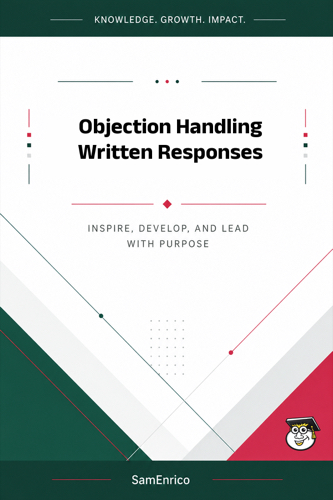
Non-FictionBusiness BriefObjection Handling
Objection Handling Written Responses eBook
Pre-write replies to common pricing, timing, and s
Pre-write replies to common pricing, timing, and scope objections before they arise.
Formats
Free sample
Chapter 1: The Brave Paradox...–- Every salesperson has felt it: the sting of a short, blunt email that says “Not interested” or “Too expensive” or simply nothing at all—followed by the hollow silence of a ghosted conversation. You wrote a thoughtful proposal. You answered every question. You built rapport. And then, without warning, the buyer disappeared into the digital void.
What happened? The answer lies in a fundamental misunderstanding of how written communication changes human behavior—a misunderstanding this entire book exists to correct.Most sales training was designed for face-to-face conversations or phone calls. Those environments come with social guardrails: eye contact, vocal tone, the discomfort of saying “no” to a real person sitting across a table. Written communication removes those guardrails. Your prospect can reject you at 11:00 PM in their pajamas with zero social cost.
They can ghost you without ever hearing your voice crack. They can lie about their budget without watching your face fall.But here is the paradox that confuses even experienced sellers: the same screen that makes buyers braver in expressing rejection also makes them more fearful of making a decision. They will bluntly say “No” to your face via email, yet they will stall for weeks on saying “Yes” because they are terrified of choosing wrong. This is The Brave Paradox—and until you understand it, every written response you send will be fighting the wrong battle.This chapter dismantles the myths of written objection handling and replaces them with a dual-psychology framework that will underpin every tactic in this book. You will learn why your carefully crafted ROI emails go unanswered, why “Let me think about it” is almost never about thinking, and why the first sentence of every reply you send should almost never be a defense of your product.The Screen of Courage: Why Buyers Are Braver in Writing Consider two scenarios.
In the first, you are sitting across from a prospect at a conference room table. You have just presented your solution. The prospect has a question about pricing. They hesitate. They look at their notes.
They say, “Well, we’ll need to think about it.” There is discomfort in the room. They are managing your feelings as much as their own.In the second scenario, that same prospect receives your proposal via email. They are alone. They are tired. They have forty-seven other unread messages.
They type: “This is outside our budget. Thanks anyway.” They click send. Done. No awkward goodbye. No watching your reaction.
The screen has given them courage—the courage to reject you swiftly and without guilt.This is the Screen of Courage Effect. Research in digital communication behavior suggests that people are approximately three times more likely to deliver negative news via text or email than in person or over the phone. The screen acts as a psychological shield. It absorbs the social consequences of rejection. The buyer does not have to witness your disappointment, so they feel liberated to say “no” faster, more bluntly, and with less explanation.The implications for objection handling are profound.
The traditional sales script that works in a live conversation—“I understand how you might feel that way, let me share why other clients thought the same thing before they saw the results”—fails when transcribed directly to email. Why? Because in a live conversation, you have the buyer’s attention. They cannot click away. They are socially obligated to listen.
In writing, they have already decided you are too expensive before you finish typing your first defensive sentence. They have already deleted your email while you were still citing client testimonials.The Screen of Courage means that your written responses must be faster, sharper, and fundamentally different from your verbal scripts. You cannot afford a long preamble. You cannot lead with defensiveness. You must get to the diagnostic question before the buyer’s finger reaches the archive button.The Fearful Decision: Why Buyers Stall on Saying Yes Now for the paradox.
The same screen that makes buyers brave in rejection makes them cowardly in commitment. When a buyer types “Let me think about it” or “I need to run this by my team” or “Can we revisit this next quarter?” they are almost never stalling because they need more information. They are stalling because they are afraid of making a mistake.This is the Fearful Decision dynamic, drawn from decades of research on buyer psychology including the work of Matthew Dixon and Ted Mc Kenna in The JOLT Effect. When faced with a significant purchase, buyers experience what psychologists call decision paralysis. The fear of choosing wrong—of wasting budget, disappointing their own boss, or looking foolish—overwhelms the potential upside of solving their problem.In a live conversation, you can see fear.
You notice the furrowed brow, the crossed arms, the glance toward the door. In writing, fear hides behind polite, vague language. “Let me think about it” is fear. “I need to check with my team” is fear. “Can you send me more case studies?” is often fear—more information is not the solution to fear, but the buyer does not know that.Here is the critical insight that most salespeople miss: Fear and price are not the same thing.
When a buyer says “Too expensive,” they are making a comparison against an anchor (a competitor, a past purchase, an internal budget). When a buyer says “Let me think about it,” they are expressing fear. Sending an ROI calculation to a fearful buyer is like offering a math textbook to someone who is drowning. It is the wrong tool for the wrong problem.This book will teach you to distinguish between price objections and fear objections using a diagnostic flowchart in Chapter 3. But for now, internalize this: the screen makes buyers both braver in rejection and more fearful in commitment.
Your written responses must account for both dynamics. Defending your price too early signals that you misunderstood the objection. Showing ROI math to a fearful buyer confirms their suspicion that you are not listening.Why Traditional Scripts Fail in Writing Most objection-handling training is based on linear scripts—a series of pre-written sentences designed to be delivered in a specific order during a live conversation. The classic “Feel, Felt, Found” framework is a perfect example: “I understand how you feel. Other clients felt the same way.
Here is what they found.”This framework works reasonably well in person because the buyer is captive. They cannot interrupt you mid-sentence. They are socially constrained to let you finish. The structure of live conversation forces a certain patience.In writing, all of that breaks. The buyer scans your email in 8 to 12 seconds.
If your first sentence does not engage them, they delete. If your first sentence is defensive (“I understand why you think we’re expensive…”), they have already dismissed you before you reach the second sentence. The linear script collapses because the buyer is not following your sequence—they are jumping ahead, making assumptions, and rejecting you before you make your point.Consider this real-world example. A prospect emails: “Your proposal came in 40% above our budget. We’re going to pass.”The traditional scripted reply might read: “Thank you for…
This is the end of the free sample. Get the eBook to keep going. Buy now
About this book
Details
- Author
- Cottrell Adan
- Publisher
- SamEnrico
- Language
- English
- Genre
- Non-Fiction, Business Brief, Objection Handling
- Released
- 2026-06-09
- Pages (approx.)
- 146
- Available as
- eBook, Audiobook

Read better in the ZLOADR app
Your eBooks on your phone or tablet. Sign in with your SamEnrico account and start reading.
More by Cottrell Adan
 High Performance Breath TrainingCottrell Adan$11.99
 Early Onset Bipolar GuideCottrell Adan$11.99
 CPR Training App GuideCottrell Adan$11.99
 Gratitude for AnniversariesCottrell Adan$11.99
 The Panama Canal SoloCottrell Adan$11.99
 BeReal Authentic InfluencerCottrell Adan$11.99
 Student Study Break NappingCottrell Adan$11.99
 Mickey Brown Holiday InnCottrell Adan$11.99
 The Last Broadcast: How a 1938 Radio Play Sparked a Nationwide PanicCottrell Adan$11.99
 The Sweethearts of Pasteur: Love and the Birth of Modern MedicineCottrell Adan$11.99
 Quantum Alchemists: The Secret Code of the I ChingCottrell Adan$11.99
 How to Start a Community Organisations Business (Beginners Guide)Cottrell Adan$11.99
You may also like
 Hong Kong Handover 1997Dunn Johnnie$11.99
 Zumba For Postnatal Recovery CourseNeal Christian$11.99
 Zumba for BeginnersLadner Nikia$11.99
 YouTube Comment Mining GuideHumes Pandora$12.99
 Worry Box MeditationCarlin Rudy$11.99
 Workplace Stress MeditationNguyen Lynn$11.99
 Workplace Stress and Sleep RepairHawley Ivory$11.99
 Workplace Perfectionism CureDelaney Jeffry$11.99
 Workplace Injustice Anger GuideWallen Isabelle$11.99
 Work Addiction and Burnout LinkGreenwood Ester$11.99
 Women in Yoga and WellnessBeattie Galina$11.99
 Women in Stand Up ComedyChun Evangeline$11.99