
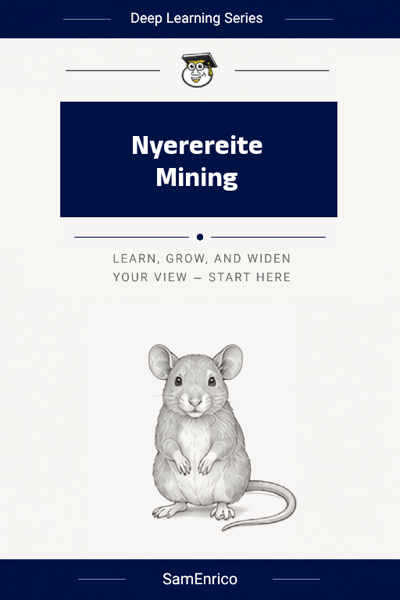
Non-FictionInformativeEducational
Nyerereite Mining eBook
A Coursebook on Nyerereite Mining
by Royal Kellee
A Coursebook on Nyerereite Mining
Formats
Free sample
Chapter 1: The Vanishing Mineral–- On a Tuesday morning in July 1963, a German mineralogist named Richard Wachter cracked open a freshly collected lava bomb from Tanzania’s most unusual volcano. He expected to find something strange—the local Maasai had long called Oldoinyo Lengai “the Mountain of God” for its habit of erupting cool, runny lava that turned white within hours. But when Wachter tilted his sample under the microscope, he saw crystals that should not exist. Within forty-eight hours, they were gone. Not dissolved, not melted—transformed into a white, powdery ghost of their former selves.
He had just witnessed the central paradox that would define nyerereite for the next six decades: a mineral born in fire that cannot survive the air we breathe.This book is about mining that impossible mineral. It is a coursebook written not for the faint of heart but for geologists, mining engineers, metallurgists, and advanced students who are willing to abandon nearly everything they learned about conventional mineral extraction. Nyerereite is not copper. It is not gold, iron, or lithium. It is a sodium-calcium carbonate (Na₂Ca(CO₃)₂) that forms in the coolest lavas on Earth—around 500 to 600 degrees Celsius, which is still hot enough to melt aluminum but frigid by igneous standards—and it degrades so quickly that a careless sneeze can ruin a week’s worth of sampling.
To mine nyerereite is to fight entropy itself. This chapter introduces you to that fight: the discovery, the naming, the impossible chemistry, and the roadmap for a book that will teach you how to extract value from a mineral that actively tries to disappear.The Discovery at the Mountain of God Oldoinyo Lengai dominates the skyline of the Gregory Rift in northern Tanzania. It is not a large volcano by global standards—rising about 2,960 meters above sea level—but it is utterly unique. All other volcanoes on Earth erupt silicate lavas: basalt, rhyolite, andesite. Oldoinyo Lengai erupts natrocarbonatite, a lava made almost entirely of sodium, calcium, and carbon dioxide.
When it flows, it looks like black crude oil, thinner than water, moving faster than a person can run. Within hours, it turns white as atmospheric moisture reacts with its minerals, leaches away sodium, and leaves behind a chalky crust.In the early 1960s, the German volcanologist J. B. Dawson began the first systematic study of this bizarre volcano. He collected samples, shipped them to laboratories in Europe, and watched with growing frustration as they disintegrated before anyone could analyze them.
But in 1963, working with Wachter, he managed to examine a fresh sample quickly enough to describe two new minerals. The first they named gregoryite, after the British geologist John Walter Gregory who had explored the Rift Valley decades earlier. The second, they named nyerereite, after Julius Kambarage Nyerere, the first president of newly independent Tanzania.The choice of name was deliberate and political. Dawson was a British colonial scientist working in a nation that had just thrown off colonial rule. By naming a mineral after Nyerere, he acknowledged Tanzania’s sovereignty and its contribution to science.
Nyerereite became one of the first minerals named after a post-independence African head of state. It was a gesture of respect, but also a practical recognition: the mineral belonged to Tanzania in every sense. To this day, the world’s only known source of fresh, unaltered nyerereite is within a few square kilometers of Oldoinyo Lengai’s crater.But discovery was only the beginning. For the next thirty years, nyerereite remained a scientific curiosity—too unstable to mine, too rare to value, too strange to understand fully. Geologists collected samples during brief field seasons, sealed them in glass vials with desiccants, and watched them transform anyway.
Museum specimens from the 1960s are now nothing more than pirssonite, a hydrated pseudomorph. The original mineral exists only in photographs and crystallographic descriptions. This is the first lesson of nyerereite: it does not want to be preserved.What Is Nyerereite? A Chemical Portrait Before we can mine a mineral, we must know what it is. Nyerereite belongs to the carbonate mineral class, meaning its crystal structure is built around the carbonate ion (CO₃)²⁻.
Its ideal chemical formula is Na₂Ca(CO₃)₂, though in nature it always contains impurities. The crystal structure is orthorhombic, space group Cmc2₁, which is rare for carbonates. More common carbonates like calcite (Ca CO₃) are trigonal. Nyerereite’s orthorhombic structure creates perfect cleavage in two directions, meaning it splits easily along flat planes. This is not a tough mineral.
Its Mohs hardness is around 3—about the same as calcite or a copper penny. You could scratch it with a steel knife, crush it between your fingers, or accidentally grind it to dust in a standard jaw crusher.But hardness is not the problem. The problem is hygroscopy. Nyerereite is so thirsty for water that it pulls moisture from the air at relative humidities above 10 percent. In tropical Tanzania, where humidity routinely exceeds 50 percent, a fresh nyerereite crystal begins to hydrate within seconds.
The reaction is:Na₂Ca(CO₃)₂ + 2H₂O → Na₂Ca(CO₃)₂·2H₂OThe hydrated product is pirssonite, a distinct mineral with a different crystal structure. Pirssonite is also a sodium-calcium carbonate, but it is less valuable because its REE content leaches out during hydration. If hydration continues, pirssonite may transform further to gaylussite or thermonatrite, losing even more of its original chemistry. By the time a sample has turned completely white and powdery, it is no longer nyerereite at all.This hydration reaction is exothermic—it releases heat. In large piles of ore, the heat can accelerate further hydration, creating a runaway reaction.
This is not a trivial chemical curiosity; it is a showstopper for conventional mining. Stockpiles of nyerereite would decompose from the inside out, generating heat, moisture, and a cascade of phase transformations that render the material worthless. If you cannot control humidity, you cannot mine nyerereite.Primary Versus Secondary Nyerereite: A Critical Distinction Throughout this book, we will distinguish sharply between two modes of occurrence: primary nyerereite and secondary nyerereite.Primary nyerereite crystallizes directly from natrocarbonatite magma. It is fresh, unaltered, and retains its full complement of trace elements, including the rare earth elements (REEs) that make mining economically interesting. Primary nyerereite is what you hope to find in an undisturbed deposit.
It is also the most difficult to handle because it degrades fastest.Secondary nyerereite refers to relict occurrences where the original mineral has already altered, but its pseudomorphs (shape-retaining replacements) remain. In many ancient carbonatites—some as old as 2 billion years—you can find the ghostly outlines of nyerereite crystals now filled with calcite, dolomite, or other secondary minerals. These are scientifically interesting but economically worthless for nyerereite extraction. The original chemistry is gone. However, the presence of these pseudomorphs tells you something important: this carbonatite was once sodium-rich enough to form nyerereite.
If you find pseudomorphs in an ancient deposit, you may find fresh material at depth, protected from weathering by an unbroken cap rock.A third category, sometimes called paleo-nyerereite, applies to deposits where the mineral formed millions of years ago but has been preserved in ultra-dry, sealed environments—for example, in the chloride-carbonate nodules of the Udachnaya kimberlite…
This is the end of the free sample. Get the eBook to keep going. Buy now
About this book
Details
- Author
- Royal Kellee
- Publisher
- SamEnrico
- Language
- English
- Genre
- Non-Fiction, Informative, Educational
- Released
- 2026-05-11
- Pages (approx.)
- 137
- Available as
- eBook, Audiobook

Read better in the ZLOADR app
Your eBooks on your phone or tablet. Sign in with your SamEnrico account and start reading.
More by Royal Kellee
 Shift Work Permanent Night ShiftRoyal Kellee$11.99
 Self Esteem for Autism Adults HandbookRoyal Kellee$11.99
 Micronutrient Herb InteractionsRoyal Kellee$11.99
 The Vendor Relationship GuideRoyal Kellee$11.99
 Self Esteem Age Gap RelationshipRoyal Kellee$11.99
 The Church of Eternal Silence: The Strange Case of the Silent RetreatRoyal Kellee$11.99
 The Last Breath of the Mammoth: Echoes of Ice Age ExtinctionRoyal Kellee$11.99
 Understanding ExophoriaRoyal Kellee$17.99
 Executive Summary Playbook for StartupsRoyal Kellee$12.99
 Strategic Sourcing GuideRoyal Kellee$12.99
 How to Become a MolderRoyal Kellee$11.99
You may also like
 Hong Kong Handover 1997Dunn Johnnie$11.99
 Zumba For Postnatal Recovery CourseNeal Christian$11.99
 Zumba for BeginnersLadner Nikia$11.99
 YouTube Comment Mining GuideHumes Pandora$12.99
 Worry Box MeditationCarlin Rudy$11.99
 Workplace Stress MeditationNguyen Lynn$11.99
 Workplace Stress and Sleep RepairHawley Ivory$11.99
 Workplace Perfectionism CureDelaney Jeffry$11.99
 Workplace Injustice Anger GuideWallen Isabelle$11.99
 Work Addiction and Burnout LinkGreenwood Ester$11.99
 Women in Yoga and WellnessBeattie Galina$11.99
 Women in Stand Up ComedyChun Evangeline$11.99