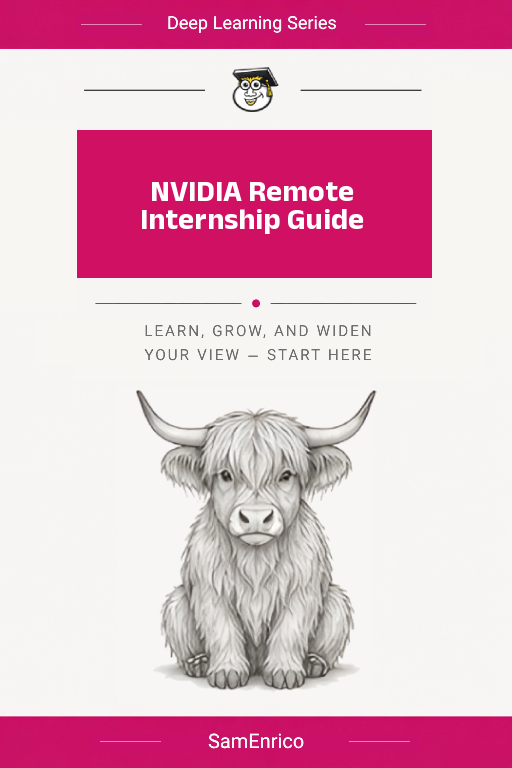
NVIDIA Remote Internship Guide eBook
Apply for virtual internships at NVIDIA in AI, gra
Apply for virtual internships at NVIDIA in AI, graphics, autonomous vehicles, or software engineering.
Formats
Free sample
Chapter 1: The GPU Mindset...–- On a Tuesday morning in Santa Clara, a senior engineer at NVIDIA receives approximately 247 internship applications. She will spend an average of six seconds on each resume before deciding "yes," "maybe," or "no." Six seconds. That is less time than it takes to read this sentence twice. By Thursday afternoon, 80 percent of those applicants have been silently eliminated. None of them will receive a rejection email explaining why.
Most will assume they weren't "qualified enough." But here is the truth that NVIDIA will never tell you: the majority of those rejected candidates had the technical skills to succeed. They failed not because they couldn't code, but because they didn't understand something far more fundamental. They didn't understand the GPU Mindset.This chapter is not about resumes. It is not about Leet Code. It is about rewiring how you think before you write a single line of code or submit a single application.
The GPU Mindset is the single most important differentiator between candidates who get remote internships at NVIDIA and candidates who do not. It is the lens through which NVIDIA engineers evaluate everything: your resume, your technical screen, your project portfolio, and ultimately your fit for the company. Without it, you are invisible. With it, you become inevitable.What is the GPU Mindset? In the simplest terms, it is the ability to think in parallel.
But that definition is too narrow and too technical. The GPU Mindset is actually a philosophy that extends far beyond hardware. It is the belief that any problem can be decomposed into independent, simultaneously executable units of work. It is the obsession with throughput over latency. It is the instinct to ask, "How can I do a thousand of these at once?" rather than "How can I do this one thing faster?" At NVIDIA, this mode of thinking permeates everything—from how engineers design software to how managers evaluate interns to how recruiters scan resumes.Let me give you a concrete example.
Imagine two candidates applying for the same AI internship at NVIDIA. Both have identical technical skills. Both have similar GPAs. Candidate A writes on their resume: "Helped train a computer vision model for stop sign detection." Candidate B writes: "Parallelized data loading across 4 GPUs, reducing training time from 14 hours to 90 minutes, enabling 3x more hyperparameter sweeps per week." Both candidates did the same work. But Candidate B demonstrated the GPU Mindset by quantifying parallelism and throughput.
Candidate A described serial effort. In six seconds, Candidate B moves to the "yes" pile. Candidate A does not.The GPU Mindset is not a natural way of thinking for most people. We are raised in a serial world. We wake up, brush our teeth, eat breakfast, commute, work, commute home, eat dinner, sleep.
One thing after another. Schools teach linear problem-solving: step one, step two, step three. Most coding interviews test serial thinking: solve this one problem as efficiently as possible. But GPUs are not serial devices. A modern NVIDIA H100 GPU has 18,432 CUDA cores.
That is not a typo. Eighteen thousand four hundred thirty-two independent processing units that can work simultaneously. When you write code for a CPU, you are a solo artist performing one note at a time. When you write code for a GPU, you are conducting an orchestra of eighteen thousand musicians, each playing their own part simultaneously. The GPU Mindset is learning to hear the symphony, not just the solo.This chapter will teach you the five core principles of the GPU Mindset.
By the end, you will not only understand how NVIDIA thinks—you will start thinking like NVIDIA. And once you think like NVIDIA, everything else in this book becomes exponentially easier.Principle One: Decomposition Over Reduction The first principle of the GPU Mindset is the ability to decompose problems into independent parallel units, rather than reducing them into sequential steps. This sounds abstract, so let me make it concrete with a problem you might actually encounter in an NVIDIA interview.Imagine you are asked: "Given a million 32-bit integers, find the sum of all numbers greater than 1000." A serial thinker writes a loop: for each number, if number > 1000, add to total. This is correct. It is efficient.
It runs in O(n) time. But it is serial. The GPU Mindset asks a different question: "How can I do this on 18,000 cores simultaneously?" The answer is to decompose the problem. First, divide the million numbers into 18,000 chunks of roughly 55 numbers each. Assign each chunk to a separate CUDA core.
Have each core calculate the sum of numbers greater than 1000 within its chunk. Then, combine the 18,000 partial sums into a final total. The algorithm is identical—sum numbers greater than 1000—but the execution is parallel. This is not faster for one million numbers on a single core. But for one billion numbers, or one trillion, the parallel approach dominates.
And at NVIDIA, you are always thinking about scale.Here is the insight that most candidates miss: you do not need to write CUDA code to demonstrate decomposition thinking. During a technical screen, if an interviewer asks you a serial algorithm question, you can demonstrate the GPU Mindset by saying, "I could solve this serially in O(n) time, but let me also describe how I would parallelize it for a GPU." That single sentence signals that you think like NVIDIA. It tells the interviewer that you understand the company's core technology. It takes five seconds to say and moves you to the top of the candidate pool.Decomposition thinking applies to non-technical problems as well. When NVIDIA evaluates your resume, they are implicitly decomposing it into parallel signals: technical skills, project quality, communication ability, cultural fit.
Each signal is evaluated independently by different people (recruiters, engineers, hiring managers) at different times. Your job is to ensure that every "chunk" of your application contains strong signals. Do not assume that a strong Git Hub portfolio will compensate for a poorly formatted resume. Do not assume that a great technical screen will erase a weak initial application. NVIDIA's hiring process is parallel.
You must succeed in all chunks simultaneously.Practical exercise: Take a problem you have solved recently—any problem, technical or not. Write down the serial solution. Then write down how you would decompose it into at least 10 independent parallel tasks. Practice this until decomposition becomes instinctive.Principle Two: Throughput Over Latency The second principle of the GPU Mindset is prioritizing throughput (how much work you complete per unit time) over latency (how quickly you complete one unit of work). This distinction is subtle but transformative.A latency-optimized engineer asks: "How can I make this one task finish faster?" A throughput-optimized engineer asks: "How can I complete more tasks in the same amount of time?" At NVIDIA, throughput almost always wins.
Why? Because most problems at NVIDIA are embarrassingly parallel—they involve processing massive datasets, running thousands of simulations, or training models that require billions of operations. Reducing the latency of a single operation from 1 microsecond to 0.5 microseconds is nice. But increasing the number of parallel operations from 1,000 to 10,000 changes the game.Consider the difference between two remote interns. Intern A spends two…
This is the end of the free sample. Get the eBook to keep going. Buy now
About this book
Details
- Author
- Albert Kanisha
- Publisher
- SamEnrico
- Language
- English
- Genre
- Non-Fiction, Student's Shortcut, AI
- Released
- 2026-06-01
- Pages (approx.)
- 156
- Available as
- eBook, Audiobook

Read better in the ZLOADR app
Your eBooks on your phone or tablet. Sign in with your SamEnrico account and start reading.
More by Albert Kanisha
 Negative State Relief GuideAlbert Kanisha$11.99
 Breaking the Casino Loyalty ProgramAlbert Kanisha$11.99
 Energy Sector Transaction AnalysisAlbert Kanisha$11.99
 Ayurvedic Heart HealthAlbert Kanisha$11.99
 The Neighbor TraffickerAlbert Kanisha$11.99
 Birthday Spending AddictionAlbert Kanisha$11.99
 Riptide Escape SkillsAlbert Kanisha$11.99
 Cannabis BipolarAlbert Kanisha$11.99
 The Last Stand of the Ball Boys: The Untold Story of the 1972 ABA FinalsAlbert Kanisha$11.99
 The Clockmaker of Leiden: Huygens and the Birth of PrecisionAlbert Kanisha$11.99
 How to Produce Horse and Livestock TrailersAlbert Kanisha$11.99
 Service Providers Guide to Fireplace Installation & RepairAlbert Kanisha$11.99