
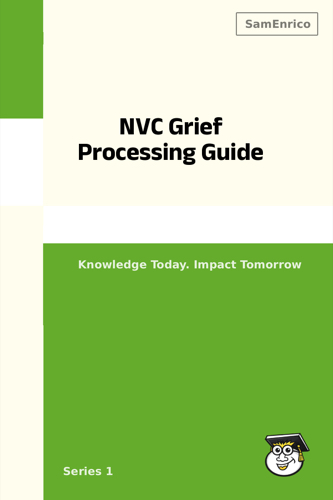
NVC Grief Processing Guide eBook
Support mourners by connecting to universal needs
Support mourners by connecting to universal needs underneath pain.
Formats
Free sample
Chapter 1: Beyond The Why--–- The question arrives like a splinter under the skin. It arrives in the middle of the night, in the quiet after the funeral, in the pause between the last phone call and the silence that follows. It arrives as a whisper and then becomes a roar: Why?Why did they die? Why didn’t I see it coming? Why them and not someone else?
Why is the world still spinning when mine has stopped? Why am I still breathing when they are not?The question of why is the most natural response to devastating loss. It is also, from the perspective of Nonviolent Communication, the most dangerous. Not because the question is wrong, but because it is unanswerable in any way that will satisfy the heart. You can spend years, decades, a lifetime searching for the why of a death, and you will never find a reason that makes the pain feel justified.
The brain will keep spinning theories. The heart will keep rejecting them. And you will remain stuck in what I call the Why Loop—a cognitive and emotional spiral that consumes enormous energy while producing zero healing.I know this loop intimately. After my father died, I spent eighteen months trying to answer the question of why. Why hadn't the doctors caught it sooner?
Why hadn't I visited more? Why did a good man die while cruel people lived? I assembled theories. I constructed elaborate causal chains. I blamed, I rationalized, I intellectualized.
And at the end of eighteen months, I had nothing but exhaustion and a deeper sense of meaninglessness than when I started.The breakthrough came not when I found an answer, but when I realized I was asking the wrong question entirely.The NVC approach to grief offers a radical substitution. Instead of asking Why did this happen?—a backward-looking question that seeks causes in the past—it asks What needs are unmet in me right now?—a present-moment question that opens the door to healing. This shift is not semantic gymnastics. It is a fundamental reorientation of your attention away from what cannot be changed and toward what can be understood, mourned, and gradually transformed.This chapter will teach you how to make that shift. You will learn why the human brain obsesses over why, why that obsession keeps you trapped, and how to redirect your attention toward the needs that are the true location of your grief.
You will learn to recognize the difference between mourning (the healthy, embodied process of feeling unmet needs) and misery (the stuck, cognitive loop of asking unanswerable questions). And you will learn the first practical skill of NVC grief work: the ability to hear the jackal's why and translate it into a giraffe's what do I need now?The Anatomy Of The Why Loop The Why Loop has a predictable structure. It begins with a trigger—a memory, a date, a sensory experience—that reminds you of the loss. The brain, desperate to make sense of chaos, generates a question beginning with why. That question feels urgent, important, even sacred.
Surely, if you could just understand why, the pain would lessen. Surely, there is a reason that would make everything okay.The brain then searches for answers. It scans the past for causes, for explanations, for someone or something to blame. It constructs narratives. It runs simulations: If only X had happened, then Y wouldn't have happened.
These simulations are called counterfactual thinking, and they are the brain's attempt to retroactively control an uncontrollable event.But here is the cruel trick: no answer ever satisfies. Every answer generates a new why. Why did the doctors miss it? Because they were overworked. Why were they overworked?
Because the healthcare system is broken. Why is the healthcare system broken? Because... and on and on, infinitely regressing. The Why Loop is a machine that consumes attention and produces only more questions.I worked with a man named David whose wife died suddenly of an aneurysm.
David was an engineer, trained to find causes and solve problems. He approached his grief like a diagnostic challenge. He researched her medical history. He interviewed her colleagues about her stress levels. He calculated the probability of an undetected genetic condition.
He spent two thousand hours—I am not exaggerating—trying to answer the question why did this happen?At the end of those two thousand hours, he had a binder full of data and a grief that was more entrenched than ever. The why had not led to healing. It had led to obsession. It had kept him oriented toward the past, toward the unchangeable, toward a question that death refuses to answer.David finally began to heal when he stopped asking why and started asking what do I need? What he needed, it turned out, was not an explanation.
What he needed was companionship, touch, shared meaning, and the sense that his wife's life had mattered. Those needs were unmet. They were causing his pain. And unlike the past, they could be addressed in the present.Why The Brain Demands Why The Why Loop is not a sign that you are weak, irrational, or spiritually immature. It is a sign that you have a functioning human brain.
Neuroscience has shown that the brain is a prediction engine. It constantly models the world, anticipates outcomes, and updates its models based on new information. When something violates the brain's predictions—like the sudden, permanent absence of someone you love—the brain experiences a prediction error. And the brain's primary response to a prediction error is to ask why?This is evolutionarily useful. If you hear a rustle in the bushes and your brain asks why?, you might discover a predator and survive.
If your crops fail and your brain asks why?, you might discover a soil deficiency and adapt. The question why is a tool for survival in a world of cause and effect.But death is not a rustle in the bushes. Death is not a crop failure that can be remedied by better fertilizer. Death is a permanent, irreversible violation of the brain's most fundamental prediction: that the people we love will continue to exist. The brain cannot update its model to accommodate this violation.
It can only keep asking why, over and over, hoping for an answer that will restore the shattered prediction.This is why grief feels like madness. It is not madness. It is a normal brain encountering an abnormal event that it was never designed to process. The Why Loop is the sound of a healthy brain failing at an impossible task.The good news is that you can learn to intervene in the loop. You cannot stop the brain from generating why questions.
But you can learn to recognize them, label them, and choose a different response. That different response is the pivot from why to what need is unmet?Mourning Versus Misery: A Crucial Distinction Before we go further, I need to introduce a distinction that will run throughout this book: the difference between mourning and misery.Mourning is the embodied, present-moment experience of feeling your unmet needs. It is messy. It is…
This is the end of the free sample. Get the eBook to keep going. Buy now
About this book
Details
- Author
- Acevedo Francesca
- Publisher
- SamEnrico
- Language
- English
- Genre
- Non-Fiction, Self-Help, Grief
- Released
- 2026-06-08
- Pages (approx.)
- 159
- Available as
- eBook, Audiobook

Read better in the ZLOADR app
Your eBooks on your phone or tablet. Sign in with your SamEnrico account and start reading.
More by Acevedo Francesca
 Breaking Free From Alcohol DependenceAcevedo Francesca$11.99
 Male Fertility Age GuideAcevedo Francesca$11.99
 Franchising Your Local Brand Across Borders Visual IdentityAcevedo Francesca$11.99
 Math Formula Memory GuideAcevedo Francesca$11.99
 Drug Influenced DisappearancesAcevedo Francesca$11.99
 Cocaine and DUIAcevedo Francesca$11.99
 Section 202 Housing GuideAcevedo Francesca$11.99
 The Siege of Manila: Blood in the Philippines (1899)Acevedo Francesca$11.99
 Jörmungandr and the Jade Serpent: A Norse-Dragon ClashAcevedo Francesca$11.99
 Mastering The Art of Cheena DiAcevedo Francesca$11.99
 How to Produce Stacking Racks and ShelvesAcevedo Francesca$11.99
 How to Produce Grease GunsAcevedo Francesca$11.99
You may also like
 The Funeral NonverbalsHaller Sandie$11.99
 The Parent Loss Grief GuideAviles Tiara$11.99
 The Breath and Grief ConnectionHanes Loreta$11.99
 Social Media Comparison and GriefGuzman Latoya$11.99
 Self Hypnosis For Grief Processing GuideTan Lonna$11.99
 Loneliness After Loss Healing GuideLynn Brinda$11.99
 Grief Related Anger TriggersSeiler Jacqui$11.99
 Forgiveness After GriefWeathers Taryn$11.99
 Empathy For Grieving PeopleEaton Hilario$11.99
 Anger And Grief ConnectionDaniels Seth$11.99
 The Sobriety Grief GuideReyna Trish$11.99
 Purpose After Loss GuideSolano Aurora$11.99