
Non-FictionSelf-HelpNonviolent Communication
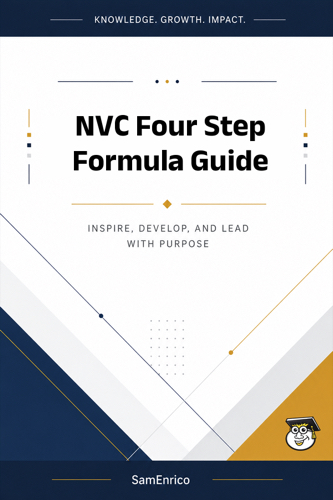
NVC Four Step Formula Guide eBook
Master observations, feelings, needs, and requests
by Arce Jenifer
Master observations, feelings, needs, and requests to transform difficult conversations.
Formats
Free sample
Chapter 1: The Jackal Inside--Most people believe they are good communicators. They are wrong.Not because they lack intelligence, charisma, or good intentions. They fail because they have been trained since birth to speak a language of war when what they actually want is peace. Every time you have walked away from an argument feeling exhausted, misunderstood, or secretly furious, you have been speaking the wrong language. Every time you have replayed a conversation in your head for hours afterward, thinking of the perfect comeback, you have been speaking the wrong language.
Every time you have shouted “You never listen!” or whispered “I’m fine” when you were anything but fine, you have been speaking the wrong language.This chapter will show you what that wrong language is, why you learned it, and what you can replace it with. By the end of these pages, you will understand why “winning” an argument usually means losing a relationship. You will take a self-assessment that reveals your default communication style. And you will meet two voices that live inside your head—one that starts fights and one that ends them.The problem is not that you are bad at communicating. The problem is that you have been using a tool designed for a battlefield to build a home.The Argument You Keep Having Think of the last three arguments you had.
Not the big, explosive ones necessarily—the small, repetitive ones. The ones that follow the same script every time. Maybe it is with your partner about whose turn it is to do the dishes. Maybe it is with your teenager about screen time. Maybe it is with your boss about a deadline that keeps moving.
Or maybe it is with yourself, at 2 AM, about why you said that stupid thing at the meeting.Now answer this question honestly: In those arguments, were you trying to understand or were you trying to win?If you are like ninety percent of people, you were trying to win. And here is the brutal truth that most communication books will not tell you: winning an argument almost always means losing something more important. You might win the point. You might get the last word. You might prove that you were right and they were wrong.
But you will lose connection, trust, intimacy, or respect. Often, you will lose all four.This is not a moral failure. It is a design flaw in how we are taught to communicate.From elementary school debate teams to televised political shouting matches to the comment sections of social media, we are surrounded by models of communication that value victory over understanding. We are taught to build walls, not bridges. We are taught to find the flaw in the other person’s argument, not the truth in their experience.
We are taught that language is a weapon, not a tool for connection.And then we wonder why we feel so alone in our closest relationships.The Two Voices Inside Your Head Dr. Marshall Rosenberg, the creator of Nonviolent Communication, spent decades studying how humans speak to each other during conflict. He noticed a pattern. In almost every argument, people fall into one of two modes of thinking and speaking. He gave these modes animal names to make them memorable: the Jackal and the Giraffe.These are not actual animals living in your brain.
They are metaphors for two different ways of processing conflict. And here is the most important thing you will read in this entire chapter: You have both voices inside you. The question is not how to eliminate the Jackal. The question is how to recognize it quickly enough to choose the Giraffe instead.The Jackal: The Voice of Judgment The Jackal is the prosecutor. The judge.
The critic. When you hear a voice in your head that says “They are so wrong,” “That is unfair,” “I cannot believe they did that,” or “What is wrong with them?”—that is the Jackal speaking.The Jackal speaks a language of moralistic judgment. It sorts the world into good people and bad people, right actions and wrong actions, deserving and undeserving. It uses words like should, should not, must, never, always, right, wrong, fair, and unfair. It is obsessed with blame.Here are some classic Jackal statements.
Read them aloud and notice what happens in your body:“You are so lazy.”“You never listen to me.”“That was a stupid thing to do.”“What were you thinking?”“You always do this.”“I cannot trust you.”“You are being selfish.”“That is not fair.”Do you feel your shoulders tighten? Your jaw clench? Your heart rate increase? That is the Jackal at work. The Jackal’s language triggers defensiveness—in you and in the person you are speaking to.
When you speak Jackal, the other person’s Jackal wakes up and prepares for battle. And then you are in a fight, not a conversation.The Jackal is not evil. It evolved to protect you. It alerts you to threats. It helps you name injustice.
But when the Jackal runs the conversation, connection dies. Because the Jackal is not interested in understanding. It is interested in winning.The Giraffe: The Voice of Compassion The Giraffe is the peacemaker. The heart. The one who sees the bigger picture.
Giraffes have the largest hearts of any land animal, and their long necks allow them to see far into the distance. In the metaphor of NVC, the Giraffe represents the ability to see beyond the immediate conflict to the universal human needs underneath.When you hear a voice in your head that says “I wonder what they are feeling right now,” “What need is not being met here,” or “I am hurt, but they are probably hurt too”—that is the Giraffe speaking. It is softer than the Jackal. It is slower. It does not provide the immediate satisfaction of a cutting comeback.
But it leads somewhere the Jackal never can: genuine connection.The Giraffe speaks a language of feelings and needs, not judgments and blame. Instead of asking “Who is wrong?” the Giraffe asks “What is alive in me right now?” Instead of saying “You are so inconsiderate,” the Giraffe says “I am feeling frustrated because I have a need for consideration.”Here is the same list of Jackal statements, translated into Giraffe language. Notice the difference in your body as you read them:“You are so lazy.” → “When I see the dishes still in the sink from last night, I feel tired because I need help.”“You never listen to me.” → “When I am speaking and you look at your phone, I feel sad because I need to be heard.”“That was a stupid thing to do.” → “When I see the spilled paint, I feel frustrated because I need order.”“You always do this.” → “This is the third time this week this has happened. I feel worried because I need reliability.”The Giraffe’s language does not attack. It does not blame.
It simply reports what is happening and what is alive inside the speaker. And because it does not trigger the other person’s Jackal, it creates space for actual conversation.Why We Default to…
This is the end of the free sample. Get the eBook to keep going. Buy now
About this book
Details
- Author
- Arce Jenifer
- Publisher
- SamEnrico
- Language
- English
- Genre
- Non-Fiction, Self-Help, Nonviolent Communication
- Released
- 2026-06-07
- Pages (approx.)
- 141
- Available as
- eBook, Audiobook

Read better in the ZLOADR app
Your eBooks on your phone or tablet. Sign in with your SamEnrico account and start reading.
More by Arce Jenifer
 Mindfulness for Older AdultsArce Jenifer$11.99
 Swimmer Shoulder RehabArce Jenifer$11.99
 Cosmetic Toxin PreventionArce Jenifer$11.99
 The Pyramid Builders of the Niger: Unveiling the Lost Architects of NubiaArce Jenifer$11.99
 How to Produce Chips (Snack Food)Arce Jenifer$11.99
 Shea Butter Export to Europe HandbookArce Jenifer$12.99
 RN Case ManagerArce Jenifer$11.99
 How to Start a Exhibition Stand Hire Business (Beginners Guide)Arce Jenifer$11.99
You may also like
 Hong Kong Handover 1997Dunn Johnnie$11.99
 Zumba For Postnatal Recovery CourseNeal Christian$11.99
 Zumba for BeginnersLadner Nikia$11.99
 YouTube Comment Mining GuideHumes Pandora$12.99
 Worry Box MeditationCarlin Rudy$11.99
 Workplace Stress MeditationNguyen Lynn$11.99
 Workplace Stress and Sleep RepairHawley Ivory$11.99
 Workplace Perfectionism CureDelaney Jeffry$11.99
 Workplace Injustice Anger GuideWallen Isabelle$11.99
 Work Addiction and Burnout LinkGreenwood Ester$11.99
 Women in Yoga and WellnessBeattie Galina$11.99
 Women in Stand Up ComedyChun Evangeline$11.99