
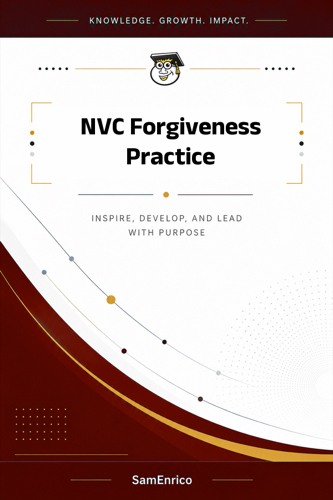
Non-FictionSelf-HelpForgiveness
NVC Forgiveness Practice eBook
Release resentment by identifying unmet needs behi
Release resentment by identifying unmet needs behind past hurts.
Formats
Free sample
Chapter 1: The Forgiveness Trap--–- I spent three years telling myself I had forgiven my father. I said the words in therapy. I lit a candle during a forgiveness ritual. I wrote him a letter I never sent, then burned it for catharsis. I repeated affirmations: I release you.
I let this go. I am free. And every single time I saw his face—in person, in a photograph, even just imagining him—my stomach turned to stone. My jaw clenched. A voice in my head whispered: You don't actually mean that, do you?That voice was right.
I didn't mean it. I had performed forgiveness like a script I was supposed to follow. And the result was not peace. It was shame layered on top of resentment. Now I was not only angry at him—I was angry at myself for being unable to do forgiveness correctly.
I had become a spiritual failure in my own story.This book exists because I finally learned that I was not the problem. The problem was the version of forgiveness I had been taught.The Myth of Forgive and Forget We live in a culture obsessed with quick forgiveness. Walk into any bookstore, and you will find shelves of books urging you to "let it go," "forgive and forget," "release the past," "choose peace." Well-meaning spiritual teachers tell you that holding onto resentment is like drinking poison and expecting the other person to die. Social media memes insist that unforgiveness only hurts you, so you might as well just decide to forgive.All of this advice contains a grain of truth. Yes, chronic resentment can damage your health.
Yes, staying stuck in blame harms no one but yourself. Yes, peace is preferable to bitterness.But here is what these well-intentioned voices almost never tell you: You cannot authentically forgive what you have not fully grieved.Forced forgiveness—saying "I forgive you" before you have processed the pain, named the need, and mourned the loss—does not heal. It represses. And what you repress does not disappear. It metastasizes.The Science of Spiritual Bypass Research from trauma specialists Gabor Maté and Bessel van der Kolk reveals something that should trouble anyone who has ever been told to "just forgive." When people suppress their emotional pain in the name of being "good" or "spiritual," their bodies keep the score.
Unexpressed grief, unacknowledged anger, and unnamed needs do not evaporate. They show up as:Chronic muscle tension, especially in the jaw, shoulders, and neck Digestive issues and irritable bowel syndrome Sleep disturbances and nightmares Unexplained fatigue or autoimmune symptoms Anxiety that spikes when you encounter the person who hurt you Depression that feels like it came from nowhere Van der Kolk's landmark study of trauma survivors found that the body literally cannot distinguish between "I have forgiven them" and "I am pretending not to be hurt." The nervous system responds to unprocessed pain the same way regardless of what your conscious mind declares. Your amygdala—the brain's alarm system—does not understand the word "forgiveness." It understands threat. And if you have not processed the original wound, it will continue to sound the alarm every time something reminds you of it.This is not a failure of your spirituality. This is biology.One study on forgiveness and physiological stress found that participants who were instructed to forgive (without processing the underlying hurt) showed higher cortisol levels and greater cardiovascular reactivity than those who were simply allowed to express their anger in a safe, structured way.
In other words: forced forgiveness is physically stressful.Let me say that again because it is that important. When you tell yourself to forgive before you are ready, your body experiences it as additional stress—not relief.The Two Kinds of Forgiveness Here is where Nonviolent Communication (NVC) offers a distinction that changed everything for me—and will change everything for you.Most of what we call "forgiveness" is actually forgiving as a gift to the other person. This version says: I am going to absolve you of what you did. I am going to stop holding this against you. I am going to be the bigger person and extend grace that you may not deserve.
There is nothing inherently wrong with this kind of forgiveness—when it comes from authentic completion. The problem is that we are told to offer it as a first step, not a last step.The NVC approach offers a radically different starting point: releasing resentment as a gift to yourself. This version asks: What do I need to heal, regardless of what the other person does or does not do? How can I become free inside my own skin, even if they never apologize?Notice the difference. The first kind of forgiveness requires something from the other person—if not an apology, at least their existence as someone you are willing to absolve.
The second kind requires nothing from anyone except your own willingness to do the internal work.The first kind is interpersonal. The second kind is intrapersonal.The first kind can only happen after the second kind is complete. You cannot genuinely offer forgiveness to another person until you have first released the resentment inside yourself. Otherwise, you are offering an empty gift—words without the embodied peace to back them up.This book is about the second kind. It is about the internal release that makes any external forgiveness possible, meaningful, and real.
Whether you ultimately choose to speak to the person who hurt you, write them a letter, or never see them again is your choice. This book does not require reconciliation. It requires only your willingness to meet your own pain with curiosity and compassion.A Radical Reframe: All Actions Are Attempts to Meet Needs Now I need to introduce you to the single most counterintuitive idea in this entire book. It may offend you at first. It may make you want to close these pages and walk away.
I am asking you to stay with it for just a few minutes.All human actions—including the ones that hurt you—are tragic attempts to meet universal human needs.I did not say all actions are justified. I did not say all actions are good. I did not say you should tolerate harmful behavior or stay in dangerous relationships. Let me be absolutely clear: understanding why someone did something is not the same as excusing it.But here is what this reframe offers that blame does not: a way out.When you see the person who hurt you as simply "evil," "selfish," "narcissistic," or "broken," you have nowhere to go. You have placed them outside the circle of human understanding.
That might feel satisfying for a while—and I am not here to take that satisfaction away from you prematurely. But ask yourself: has seeing them as a monster made you feel free? Or has it kept you trapped in a story that requires you to revisit their crime again and again?The NVC perspective says: That person who yelled at you was trying to meet a need. Perhaps a need to be heard. Perhaps a need for safety.
Perhaps a need for respect that they did not know how to ask for directly. The person who lied to…
This is the end of the free sample. Get the eBook to keep going. Buy now
About this book
Details
- Author
- Randle Adaline
- Publisher
- SamEnrico
- Language
- English
- Genre
- Non-Fiction, Self-Help, Forgiveness
- Released
- 2026-06-08
- Pages (approx.)
- 146
- Available as
- eBook, Audiobook

Read better in the ZLOADR app
Your eBooks on your phone or tablet. Sign in with your SamEnrico account and start reading.
More by Randle Adaline
 Franchising Your Local Brand Across Borders Packaging RegulationsRandle Adaline$11.99
 Stimulant Harm ReductionRandle Adaline$11.99
 Building a Sober Support NetworkRandle Adaline$11.99
 Charitable Donation Tax GuideRandle Adaline$11.99
 Staged Disappearances FraudsRandle Adaline$11.99
 Exam Essay Memory GuideRandle Adaline$11.99
 Cell Phone Radiation SpermRandle Adaline$11.99
 The Northern Star: Canada's Quest for the CosmosRandle Adaline$11.99
 A Collector's Handbook to the Datsun Laurel C30 2000Randle Adaline$11.99
 How to Produce Stage and Dance WearRandle Adaline$11.99
 Mastering The Art of Choi Kwang-doRandle Adaline$11.99
 How to Produce GreensRandle Adaline$11.99
You may also like
 Hong Kong Handover 1997Dunn Johnnie$11.99
 Zumba For Postnatal Recovery CourseNeal Christian$11.99
 Zumba for BeginnersLadner Nikia$11.99
 YouTube Comment Mining GuideHumes Pandora$12.99
 Worry Box MeditationCarlin Rudy$11.99
 Workplace Stress MeditationNguyen Lynn$11.99
 Workplace Stress and Sleep RepairHawley Ivory$11.99
 Workplace Perfectionism CureDelaney Jeffry$11.99
 Workplace Injustice Anger GuideWallen Isabelle$11.99
 Work Addiction and Burnout LinkGreenwood Ester$11.99
 Women in Yoga and WellnessBeattie Galina$11.99
 Women in Stand Up ComedyChun Evangeline$11.99