
Non-FictionSelf-HelpNegotiation
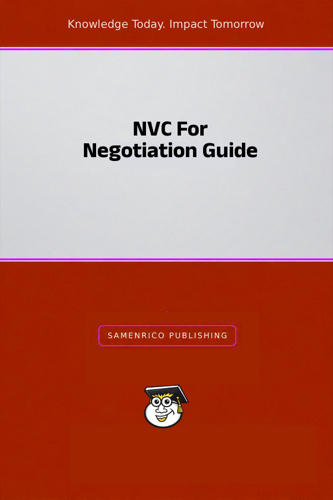
NVC For Negotiation Guide eBook
Use Nonviolent Communication to find win-win outco
by Earle Tora
Use Nonviolent Communication to find win-win outcomes in negotiations.
Formats
Free sample
Chapter 1: The Great Shift--–- The first time Sarah lost a deal she should have won, she blamed the other side. The second time, she blamed herself. The third time, she blamed the process. It never occurred to her, until much later, that the problem wasn't any of those things. The problem was the question she kept asking.She kept asking, "How do I get them to say yes?"And every answer to that question—every tactic, every concession, every carefully crafted argument—led her further away from the very thing she wanted.
A durable agreement. A relationship that didn't sour the moment the contract was signed. A win that didn't feel like a slow-motion loss.This book exists because that question is wrong. Not slightly off. Not in need of refinement.
Fundamentally, structurally, dangerously wrong.The right question—the one that turns losing battles into lasting partnerships—is this: "What do they need?"That single shift changes everything. It changes how you prepare, how you listen, how you speak, and how you know when to walk away. It transforms negotiation from a contest of wills into a collaboration of needs. And it is the foundation of everything you are about to learn.This chapter introduces the Great Shift: moving from moralistic judgments to needs-based awareness. It will dismantle the assumptions that have been costing you deals, relationships, and sleep.
It will give you a new map for understanding conflict. And it will establish the core framework—the NVC Grid and its four components—that every subsequent chapter will build upon.By the end of this chapter, you will never hear a demand the same way again. You will hear the need beneath it. And that is where the real negotiation begins.The High Cost of "Getting to Yes"In 1981, Roger Fisher and William Ury published Getting to Yes, a book that revolutionized negotiation by introducing the concept of "principled negotiation." The core idea was elegant: separate the people from the problem, focus on interests not positions, invent options for mutual gain, and insist on objective criteria. For decades, this has been the gold standard.
MBA programs teach it. Executives swear by it. Mediators build careers on it.It is incomplete.Not wrong. Incomplete. The fatal flaw in principled negotiation is not in its logic but in its assumption about human beings.
It assumes that people are rational actors who, once presented with a clear framework and objective criteria, will make decisions in their own best interest. But people are not rational actors. They are emotional, exhausted, defensive, proud, scared, and carrying twenty years of baggage into every conversation.You have experienced this. You have been in a meeting where the numbers were clear, the logic was sound, and the other person still said no—not because they didn't understand, but because they didn't feel heard. Or because they were protecting something they couldn't name.
Or because your perfectly reasonable proposal triggered a fear they didn't want to admit.Fisher and Ury knew this, which is why they included "separate the people from the problem." But in practice, that separation becomes an avoidance. Most negotiators hear "separate the people" and translate it as "ignore the emotions, focus on the deal." That is a catastrophic error.Emotions are not obstacles to good negotiation. They are the terrain. You cannot negotiate around them any more than you can hike around a mountain. You must go through.This book argues that the missing piece in every major negotiation framework is a systematic method for handling the human dimension—not as a sidebar to the "real" work of dealmaking, but as the central work itself.
Nonviolent Communication (NVC), developed by Marshall Rosenberg, provides that method. But NVC has traditionally been taught as a tool for healing, compassion, and interpersonal relationships. This book adapts it for the commercial and professional context. It weaponizes empathy. It turns listening into leverage.Let us be clear about what this book is not.
It is not a guide to being nice. It is not about sacrificing your needs to keep the peace. It is not about avoiding conflict or pretending that power imbalances don't exist. The negotiator who uses NVC skillfully is not soft. They are, in fact, more dangerous than the aggressive bargainer because they see what the aggressive bargainer cannot: the other person's deepest needs, fears, and openings.The Core Distinction: Negotiation vs.
Communication Before we go further, we must distinguish two processes that are almost always confused.Negotiation is the act of reaching an agreement about the distribution of resources, responsibilities, or rights. It answers the question: "What will each of us do or receive?"Communication is the act of building shared understanding. It answers the question: "Do we actually hear each other?"Most negotiation training focuses entirely on the first question. It teaches you how to make offers, counteroffers, concessions, and threats. It teaches you BATNA, ZOPA, anchoring, and bracketing.
All of this is useful. But if you cannot answer the second question—if the person across the table does not feel understood—then the first question is irrelevant. They will sabotage the agreement. They will comply resentfully and then ghost you. They will say yes to your face and no behind your back.The negotiator who masters only the first question wins battles and loses wars.
The negotiator who masters both wins deals and keeps relationships.Here is the uncomfortable truth: most of us are terrible at the second question. We think we are listening, but we are actually waiting for our turn to speak. We think we are hearing, but we are actually formulating our rebuttal. We think we are building understanding, but we are actually building a case for why we are right.This book will make you exceptional at the second question. And paradoxically, that will make you better at the first question than any hardball negotiator could ever be.The NVC Grid: A New Diagnostic Tool At the heart of Nonviolent Communication is a simple but profound diagnostic tool: the distinction between four components of human experience.
Every conflict, every demand, every frustrated silence can be understood through these four lenses.Component 1: Observations An observation is what a video camera would record. It is fact, not evaluation. "You have been late to our last three meetings" is an observation. "You are unreliable" is an evaluation. The first can be verified.
The second is a judgment dressed as fact.In negotiation, we habitually skip observations and leap to evaluations. We say "You are being unreasonable" instead of "You have rejected my last two proposals without counteroffers." We say "This team is impossible to work with" instead of "In the last four emails, no one has responded to my specific questions."The problem with evaluations is that they trigger defensiveness. If I tell you that you are unreliable, you will spend your energy defending yourself, not solving the problem. If I tell you that you have been late three times, we can talk about why.Component 2: Feelings Feelings are emotional states, not stories about what someone did to you. "I feel frustrated" is a feeling.
"I feel like you don't respect me" is a thought disguised as a feeling—it is an interpretation, not an emotion.In…
This is the end of the free sample. Get the eBook to keep going. Buy now
About this book
Details
- Author
- Earle Tora
- Publisher
- SamEnrico
- Language
- English
- Genre
- Non-Fiction, Self-Help, Negotiation
- Released
- 2026-06-08
- Pages (approx.)
- 152
- Available as
- eBook, Audiobook

Read better in the ZLOADR app
Your eBooks on your phone or tablet. Sign in with your SamEnrico account and start reading.
More by Earle Tora
 Tenzing Everest Interviews ArchiveEarle Tora$11.99
 The Workaholic's Mindfulness PracticeEarle Tora$11.99
 Cleopatra's Economic Policy WorkbookEarle Tora$11.99
 May TheresaEarle Tora$11.99
 The Mount Carmel CompoundEarle Tora$11.99
 Power Outage Preparedness KitEarle Tora$11.99
 Cash Flow for LaundromatsEarle Tora$11.99
 Cognitive Rehearsal for Hot ButtonsEarle Tora$11.99
 The Bitcoin Baron: How a Playboy Laundered Millions Through CryptoEarle Tora$11.99
 Black Samurai: The Ronin of EdoEarle Tora$11.99
 The Great Penguin Highway: A Waddle to FreedomEarle Tora$11.99
 Historical Documentary Faceless ChannelEarle Tora$12.99
You may also like
 Hong Kong Handover 1997Dunn Johnnie$11.99
 Zumba For Postnatal Recovery CourseNeal Christian$11.99
 Zumba for BeginnersLadner Nikia$11.99
 YouTube Comment Mining GuideHumes Pandora$12.99
 Worry Box MeditationCarlin Rudy$11.99
 Workplace Stress MeditationNguyen Lynn$11.99
 Workplace Stress and Sleep RepairHawley Ivory$11.99
 Workplace Perfectionism CureDelaney Jeffry$11.99
 Workplace Injustice Anger GuideWallen Isabelle$11.99
 Work Addiction and Burnout LinkGreenwood Ester$11.99
 Women in Yoga and WellnessBeattie Galina$11.99
 Women in Stand Up ComedyChun Evangeline$11.99