

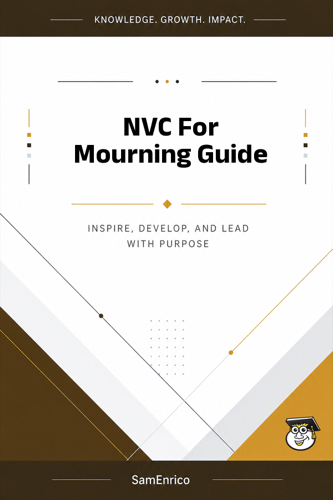
NVC For Mourning Guide eBook
Process loss by naming feelings and honoring needs
Process loss by naming feelings and honoring needs unmet.
Formats
Free sample
Chapter 1: The Mourning We Were Never Taught--–- You are about to learn something that no one taught you in school, that your family probably didn't know how to model, and that most grief books accidentally skip. It is the single most important distinction between staying stuck in pain and transforming that pain into self-connection. And it starts with a question you may have never been asked: What if your deepest suffering is not a sign that you are broken, but rather a precise, intelligent signal about what you need most?This question sounds gentle. But it is actually radical. It turns everything you have been taught about pain upside down.Most of us were raised in a culture that handles emotional pain in one of three ways: suppress it (""keep a stiff upper lip""), express it dramatically (""vent"" without resolution), or medicate it (through food, alcohol, distraction, or numbing).
None of these approaches actually processes the pain. They move it around, hide it, or amplify it. The pain remains, frozen inside you, waiting for the conditions that will finally allow it to melt.This book exists because there is a fourth way. It is called mourning — but not the mourning you think you know.The Problem with What You Think Mourning Means When most people hear the word ""mourning,"" they think of funerals, black clothing, and a period of sadness following a death. This is accurate as far as it goes, but it is tragically incomplete.
The popular understanding of mourning leaves out almost everything that matters: the loss of a relationship that did not end in death, the death of a dream you have carried since childhood, the grief of a version of yourself that you will never become, the quiet devastation of a promise broken by someone who is still alive, and perhaps most painfully — the mourning required when you are the one who caused the harm.This chapter introduces a radical expansion of what mourning can be. In the NVC (Nonviolent Communication) tradition, mourning is not a passive emotional state that happens to you. It is an active, deliberate, learnable skill — a practice of turning toward your unmet needs with the same tenderness you would offer a child who is crying.Let me say that again: Mourning is a skill. This means you can learn it. You can get better at it.
You can fail at it and try again. And the more you practice it, the more available it becomes in moments of real crisis.The Frozen Pain Phenomenon Imagine you are holding a ball of ice in your bare hands. As long as you keep moving it around, you can manage the cold. You can hide it behind your back, pass it to your other hand, or pretend it is not there. But the ice does not melt.
It remains frozen, solid, exactly as cold as the moment you picked it up.This is what most people do with emotional pain. They move it around — distracting themselves with work, numbing with television or wine, venting to friends, or ruminating in endless mental loops. The pain does not go away. It simply changes location.Mourning is the act of holding the ice still in your open palm, allowing your body heat to melt it. It is uncomfortable.
It requires courage. But it is the only way the ice actually transforms.In the chapters ahead, you will learn a precise, six-phase process for this transformation. But first, you need to understand what has been blocking you. Because if you have tried to heal and failed, it is almost certainly not because you are weak. It is because you have been using the wrong tools — or rather, you have been speaking the wrong language.The Four Languages of Disconnection This chapter diagnoses the four primary languages that keep pain frozen.
I call them the Four Languages of Disconnection because each one, however well-intentioned, disconnects you from the very information you need to heal. These are not bad habits to be ashamed of. They are survival strategies you learned — and they worked, in the sense that they helped you survive. But they are not helping you heal.Language #1: Diagnosis (Labeling)Diagnosis is the act of turning an experience into an identity. Instead of saying ""I did something I regret,"" you say ""I am a failure."" Instead of ""They acted cruelly in that moment,"" you say ""They are a toxic person."" Instead of ""This situation is challenging,"" you say ""My life is a disaster.""The problem with diagnosis is that it stops curiosity cold.
Once you have a label — for yourself, for someone else, for your situation — you stop asking questions. The label becomes the final answer. And if the label is negative, you become trapped inside it.Consider the difference between these two statements:Diagnosis: ""I am broken.""Observation: ""I have been crying every day for two weeks.""The first statement offers no path forward. If you are broken, what is there to do? Repair?
But repair implies that broken things can be fixed, and yet ""broken"" as a diagnosis carries a sense of permanence, of fundamental flaw. The second statement is simply data. Data invites curiosity: ""I wonder what is happening that I am crying so often. What need is not being met?""Diagnosis is the enemy of mourning because mourning requires specificity. You cannot mourn ""I am broken"" — it is too vague, too global, too shaming.
But you can mourn ""I acted in a way that did not meet my need for kindness, and I feel sad about that."" That sentence has a clear feeling (sadness) and a clear unmet need (kindness). The diagnosis had neither.Language #2: Denial of Responsibility This language erases choice. It includes phrases like: ""I had to,"" ""You made me feel,"" ""I couldn't help it,"" ""There was no other option.""On the surface, denial of responsibility can feel like self-compassion. ""I had to yell — the kids were out of control."" But notice what happens inside you when you say those words. Do you feel empowered?
Do you feel curious? Or do you feel collapsed, defensive, or stuck?Denial of responsibility blocks mourning because mourning requires agency. You cannot mourn something that you believe simply happened to you without your participation. Even when you are the victim of someone else's harmful actions, you still have agency in how you respond to that harm. Denial of responsibility pretends that agency does not exist.The NVC alternative is to translate ""I had to"" into ""I chose to because I was trying to meet my need for ________."" This is not about blaming yourself.
It is about reclaiming your power. When you say ""I chose to yell because I was trying to meet my need for order and efficiency,"" you are not excusing the yelling. You are becoming a person who can make different choices in the future because you understand what was driving you.Language #3: Demand (Should-Thinking)Should-thinking includes phrases like: ""I should be over this by now,"" ""He should have known better,"" ""Life shouldn't be this hard,"" ""I must not let this show.""Demands create resistance. Every time you tell yourself ""I should feel different than I…
This is the end of the free sample. Get the eBook to keep going. Buy now
About this book
Details
- Author
- Paterson Sylvie
- Publisher
- SamEnrico
- Language
- English
- Genre
- Non-Fiction, Self-Help, Mourning
- Released
- 2026-06-07
- Pages (approx.)
- 132
- Available as
- eBook, Audiobook

Read better in the ZLOADR app
Your eBooks on your phone or tablet. Sign in with your SamEnrico account and start reading.
More by Paterson Sylvie
 Teen Self Compassion WorkbookPaterson Sylvie$11.99
 Canva Brand Identity for Sports TeamsPaterson Sylvie$11.99
 Twelve Step Sponsorship ManualPaterson Sylvie$11.99
 The Dragon of Saint George's Last StandPaterson Sylvie$11.99
 Health and Dental Claims AnalystPaterson Sylvie$11.99
 AI Presentation Generation GuidePaterson Sylvie$12.99
 Learn to Play the BanduraPaterson Sylvie$11.99
 How to Start a Cardboard Business (Beginners Guide)Paterson Sylvie$11.99
You may also like
 Hong Kong Handover 1997Dunn Johnnie$11.99
 Zumba For Postnatal Recovery CourseNeal Christian$11.99
 Zumba for BeginnersLadner Nikia$11.99
 YouTube Comment Mining GuideHumes Pandora$12.99
 Worry Box MeditationCarlin Rudy$11.99
 Workplace Stress MeditationNguyen Lynn$11.99
 Workplace Stress and Sleep RepairHawley Ivory$11.99
 Workplace Perfectionism CureDelaney Jeffry$11.99
 Workplace Injustice Anger GuideWallen Isabelle$11.99
 Work Addiction and Burnout LinkGreenwood Ester$11.99
 Women in Yoga and WellnessBeattie Galina$11.99
 Women in Stand Up ComedyChun Evangeline$11.99