
Non-FictionSelf-HelpMen's Mental Health
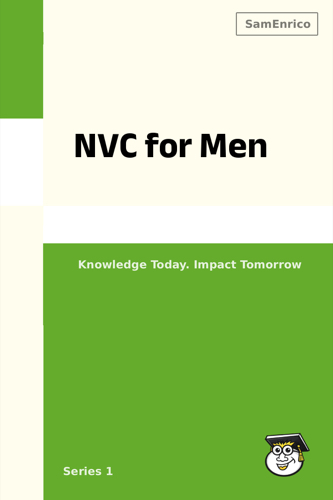
NVC for Men eBook
Masculine communication patterns transformed using
by Epps Collin
Masculine communication patterns transformed using emotional awareness and empathy.
Formats
Free sample
Chapter 1: The Armor You Forgot You Were Wearing--The first time a boy is told to “man up,” something inside him begins to close. It happens somewhere around age five or six, sometimes earlier, sometimes later. He falls off his bike and scrapes his knee. The pain is real, sharp, and immediate. His face crumples.
Tears come because that is what bodies do when they are hurt. But then an adult—loving, well-intentioned, often a father or mother—kneels down and says, “Big boys don’t cry.” Or “You’re okay, shake it off.” Or the classic: “Stop being so sensitive.”None of these statements are meant to harm. They are meant to help. They are meant to build resilience, to prepare the boy for a world that will not hold his hand. And in that moment, the boy learns his first lesson about the Male Code: Your pain is not welcome here.
Show strength. Hide the rest.By the time that boy becomes a man, the closing has become automatic. He does not decide to hide his feelings. His body does it for him. The jaw tightens.
The shoulders square. The voice drops into a flat, controlled register. When someone asks, “How are you?” he says “Fine” even when his marriage is falling apart, even when he hasn’t slept in three days, even when he cannot remember the last time he felt genuinely happy.This is the armor. And this chapter is about taking a long, hard look at it.The Quiet Man Syndrome There is a particular kind of loneliness that men do not talk about. It is not the loneliness of being alone.
Many men enjoy solitude. It is the loneliness of being with people and still feeling completely disconnected. A man can sit at a dinner table with his family, hear their voices, see their faces, and feel absolutely nothing except the dull thud of obligation. He is present in body. His mind is elsewhere.
His heart is somewhere he cannot even find.Psychologists have a term for this, though men rarely use it: emotional isolation. The Quiet Man Syndrome is not a clinical diagnosis but a cultural one. It describes the state of a man who has learned to perform strength so thoroughly that he can no longer access his own inner life. He solves problems because problems are tangible. He pays bills because bills are measurable.
He protects because protection is action. But when his partner asks, “What are you feeling?” he has no answer. Not because he is hiding something. Because he genuinely does not know.This is not a failure of character. It is a failure of training.Consider the data.
According to multiple longitudinal studies, men report having fewer close friends today than any generation in the last fifty years. In 1990, the average man said he had six close confidants. By 2021, that number had dropped to two. And nearly one in five men reported having zero close friends. Zero.
Not acquaintances, not coworkers, not drinking buddies—people they could call at 2:00 AM if they were in crisis.At the same time, men die by suicide at nearly four times the rate of women. They are less likely to seek mental health treatment. They are more likely to self-medicate with alcohol, work, pornography, or video games. They are more likely to have their first genuine emotional conversation in a therapist’s office at age forty-five, after a divorce or a health scare.The armor is not keeping men safe. It is slowly suffocating them.The Seven Unwritten Rules of the Male Code The Male Code is never written down.
No one hands a boy a manual. But by the time he is ten years old, he has absorbed its seven core commandments through a thousand small corrections: a glance, a joke, a warning, a silence.Here they are, named for the first time.Rule 1: Never admit weakness. Weakness is not defined as physical vulnerability. A man can break his leg and be a hero. Weakness means emotional exposure.
It means saying “I’m scared” or “I’m lonely” or “I need help.” These phrases are forbidden because they signal that you cannot handle your own life. A real man carries his own weight.Rule 2: Anger is the only acceptable emotion. Sadness becomes irritation. Fear becomes aggression. Grief becomes silence or, when it becomes unbearable, explosive rage.
Anger is permitted because anger looks like strength. It is loud, it is external, and it pushes others away—which feels safer than letting them in.Rule 3: Always have an answer. A man is supposed to know things. He is supposed to fix things. If his partner is crying, he must offer a solution.
If his child is struggling, he must provide a lesson. “I don’t know” is not allowed because “I don’t know” feels like incompetence. And incompetence feels like failure.Rule 4: Never ask for help. Asking for help is a confession of inadequacy. A man figures it out.
He reads the manual. He watches the You Tube tutorial. He struggles alone for hours rather than pick up the phone. The result is not competence but exhaustion.Rule 5: Control everything, especially yourself. Emotions are messy.
They are unpredictable. They leak out at inconvenient times. The solution is suppression. Tighten the lid. Breathe shallowly.
Keep moving. Do not stop because stopping means feeling.Rule 6: Your value is your production. A man is what he does. His job title, his salary, his ability to provide—these are the metrics of his worth. If he loses his job, he loses his identity.
If he retires, he becomes invisible. If he cannot produce, he fears he will not be loved.Rule 7: Never be a burden. This is the deepest rule, the one that underlies all the others. A man’s primary obligation is to not cause trouble. Do not make others uncomfortable with your feelings.
Do not ask for time or attention. Handle it yourself. Disappear before you become a problem.These seven rules are not evil. They evolved for a reason. They protected men in a world that demanded physical labor, emotional stoicism, and hierarchical competition.
But that world is not the world most men live in anymore. The rules have become obsolete. And yet they persist, passed down from father to son, encoded in every movie, every locker room, every unspoken expectation.The Hidden Costs No One Talks About Armor has weight. You cannot wear a suit of chainmail every day and expect to move freely. The same is true of emotional armor.
The costs are not abstract. They show up in measurable, painful ways.Chronic Loneliness. The man who cannot share his inner world is a man who cannot be known. And a man who cannot be known cannot be loved—not deeply, not in the way that matters. He can be admired for his competence.
He can be respected for his reliability. But he will sit in a room full of people who care about him and feel completely alone because no one actually knows who he is. He has never shown them.Explosive Anger. Suppressed emotion does not disappear. It transforms.
Fear becomes irritability. Sadness becomes numbness. Grief becomes a short fuse. The man who never learned to say “I’m scared”…
This is the end of the free sample. Get the eBook to keep going. Buy now
About this book
Details
- Author
- Epps Collin
- Publisher
- SamEnrico
- Language
- English
- Genre
- Non-Fiction, Self-Help, Men's Mental Health
- Released
- 2026-06-09
- Pages (approx.)
- 131
- Available as
- eBook, Audiobook

Read better in the ZLOADR app
Your eBooks on your phone or tablet. Sign in with your SamEnrico account and start reading.
More by Epps Collin
 Analogous Thinking Team GuideEpps Collin$11.99
 Letterboxd Film BuffEpps Collin$11.99
 Persuasive Proposal Design GuideEpps Collin$11.99
 Team Interruption TrainingEpps Collin$11.99
 The Posture Stress ConnectionEpps Collin$11.99
 The Medical EmergencyEpps Collin$11.99
 Metabolic Health NappingEpps Collin$11.99
 Blue Zone Resilience FactorsEpps Collin$11.99
 The Lost Sculptors of Ife: Masters of the Bronze RenaissanceEpps Collin$11.99
 The Siege of Chaco Canyon: Ancient Warriors of the SouthwestEpps Collin$11.99
 The Last Dance of the Blue Angels: A Legacy of Precision and PerilEpps Collin$11.99
 How to Start a Manometers (non-electronic) Business (Beginners Guide)Epps Collin$11.99
You may also like
 Hong Kong Handover 1997Dunn Johnnie$11.99
 Zumba For Postnatal Recovery CourseNeal Christian$11.99
 Zumba for BeginnersLadner Nikia$11.99
 YouTube Comment Mining GuideHumes Pandora$12.99
 Worry Box MeditationCarlin Rudy$11.99
 Workplace Stress MeditationNguyen Lynn$11.99
 Workplace Stress and Sleep RepairHawley Ivory$11.99
 Workplace Perfectionism CureDelaney Jeffry$11.99
 Workplace Injustice Anger GuideWallen Isabelle$11.99
 Work Addiction and Burnout LinkGreenwood Ester$11.99
 Women in Yoga and WellnessBeattie Galina$11.99
 Women in Stand Up ComedyChun Evangeline$11.99