
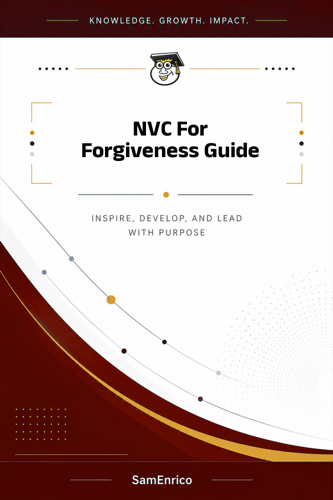
Non-FictionSelf-HelpForgiveness
NVC For Forgiveness Guide
Release resentment by connecting with needs behind
Release resentment by connecting with needs behind the hurt.
Formats
About this book
Free sample
Chapter 1: The Forgiveness Trap...--–- You have tried to forgive. Maybe you have said the words out loud: “I forgive you.” Maybe you have repeated affirmations: “I release this resentment. I let it go.” Maybe you have read the books that tell you that forgiveness is a choice, that holding onto anger is like drinking poison and expecting the other person to die. And yet, here you are. The resentment is still there.
It sits in your chest like a stone. It wakes you up at 3:00 AM. It colors every interaction you have with the person who hurt you—or worse, with people who had nothing to do with it but who now bear the weight of your unhealed wound.This chapter is not going to tell you to try harder. It is not going to tell you that you are spiritually immature because you cannot “just let it go.” In fact, this chapter is going to do something far more radical: it is going to suggest that the problem is not you. The problem is the advice you have been given.The Forgiveness Advice That Fails Let us name the most common pieces of forgiveness advice you have probably heard, and then let us examine why each one fails.“Just let it go.” This is perhaps the most ubiquitous and the most useless piece of advice ever offered.
Imagine telling someone with a broken leg to “just walk it off.” That is what “just let it go” does to emotional pain. It assumes that resentment is a switch you can flip, rather than a physiological response to a real injury. When you try to “just let go” without addressing the underlying need, you are not actually letting go. You are suppressing. And suppression does not eliminate resentment; it drives it underground, where it continues to do damage without your conscious awareness.“Forgive and forget.” This advice is not only unhelpful; it is dangerous.
Your brain is designed to remember threats because remembering keeps you alive. Telling someone to forget a betrayal is telling them to override their own…
This is the end of the free sample. Get the eBook to keep going. Buy now
Contents
- Chapter 1
- Chapter 2
- Chapter 3
- Chapter 4
- Chapter 5
- Chapter 6
- Chapter 7
- Chapter 8
- Chapter 9
- Chapter 10
- Chapter 11
- Chapter 12
Details
- Author
- Mckay Tynisha
- Publisher
- SamEnrico
- Language
- English
- Genre
- Non-Fiction, Self-Help, Forgiveness
- Released
- 2026-06-09
- Pages (approx.)
- 118
- Available as
- eBook, Audiobook

Read better in the ZLOADR app
Your eBooks on your phone or tablet. Sign in with your SamEnrico account and start reading.
More by Mckay Tynisha
 Teen Peer Pressure ResistanceMckay Tynisha$11.99
 Step Eight Harm List TemplateMckay Tynisha$11.99
 Canva Brand Identity for Martial ArtsMckay Tynisha$11.99
 The Ballad of the Last Cowboy Rodeo: The Rise and Fall of Lane FrostMckay Tynisha$11.99
 Learn to Play the BalalaikaMckay Tynisha$11.99
 How to Start a Card Club Business (Beginners Guide)Mckay Tynisha$11.99
 AI for Academic Paper ExtractionMckay Tynisha$12.99
 Head of ResearchMckay Tynisha$11.99
You may also like
 Hong Kong Handover 1997Dunn Johnnie$11.99
 Zumba For Postnatal Recovery CourseNeal Christian$11.99
 Zumba for BeginnersLadner Nikia$11.99
 YouTube Comment Mining GuideHumes Pandora$12.99
 Worry Box MeditationCarlin Rudy$11.99
 Workplace Stress MeditationNguyen Lynn$11.99
 Workplace Stress and Sleep RepairHawley Ivory$11.99
 Workplace Perfectionism CureDelaney Jeffry$11.99
 Workplace Injustice Anger GuideWallen Isabelle$11.99
 Work Addiction and Burnout LinkGreenwood Ester$11.99
 Women in Yoga and WellnessBeattie Galina$11.99
 Women in Stand Up ComedyChun Evangeline$11.99