
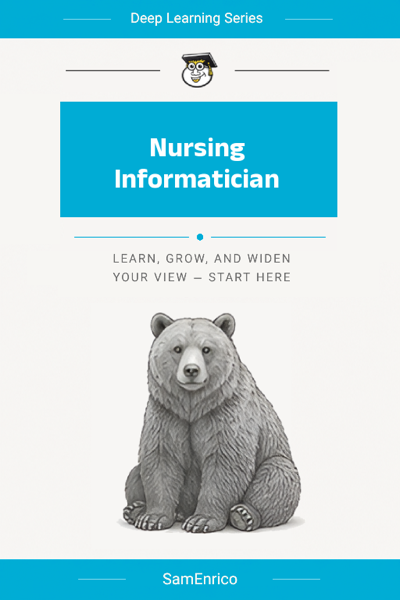
Non-FictionInformativeEducational
Nursing Informatician eBook
A Coursebook on Nursing Informatician
by Patten Marti
A Coursebook on Nursing Informatician
Formats
Free sample
Chapter 1: The Data Whisperer--–- The 2:00 AM page that changed everything. Sara Tran, a night-shift nurse on a busy medical-surgical unit, had just finished turning a patient when her pager buzzed. Not a rapid response. Not a fall. A notification from the Electronic Health Record: "Patient in Room 412B has a potassium level of 5.8 m Eq/L.
Critical value. Please notify provider."–- Sara had drawn that lab at 1:15 AM. The patient had chronic kidney disease, was on an ACE inhibitor, and had received a potassium-sparing diuretic earlier that evening. She knew, before the page even arrived, that this value was coming. She had already printed the protocol.
She had already called the nephrology fellow. The EHR's "critical value alert" arrived seventeen minutes after she had already fixed the problem.–- This is not a story about a broken system. It is a story about the difference between data and wisdom. The EHR knew the number. Sara knew the patient.
The informatician's job is to make sure the machine learns from Sara before Sara burns out.–- Welcome to the world of the nursing informatician—a role that did not exist in most hospitals thirty years ago, and yet today stands as one of the most critical, misunderstood, and powerful positions in healthcare. This chapter will not merely define the role. It will reveal why you are likely already doing informatics work without the title, why the DIKW framework (Data, Information, Knowledge, Wisdom) is both essential and overused, and why a new taxonomy of informatics roles—from bedside champion to C-suite executive—will determine your career trajectory.The Invisible Work You Already Do–- Every nurse is an informatician. This statement shocks most bedside nurses. They imagine informatics as something other people do—the ones who sit in windowless IT offices, wear business casual instead of scrubs, and speak in acronyms like HL7 and FHIR.
But consider what you already do every shift.–- You interpret data: a blood pressure of 90/50 is not simply a number; it is a signal that your post-op patient might be bleeding. You transform that data into information: you trend three pressures over an hour and notice a steady decline. You apply knowledge: you recall the post-operative hemorrhage protocol from your orientation. And occasionally, you demonstrate wisdom: you deviate from the protocol because the patient also has a history of aortic stenosis and a beta-blocker that masks tachycardia, and you know that the standard fluid bolus might worsen heart failure.–- That is the DIKW framework. It is not a theory invented by academics to torture nursing students.
It is a description of what excellent nurses do automatically, every single day. The problem is that most nurses do this work without recognition, without protection, and without the tools that modern technology could provide.–- The nursing informatician bridges the gap between what nurses know intuitively and what computers can process systematically. When Sara Tran knew the potassium was coming before the lab resulted, she was using pattern recognition built from thousands of prior patients. A machine learning model could learn that same pattern if someone—a nurse—designed it, trained it, and validated it. That someone is the informatician.The Birth of a Specialty: From Clerical Burden to Strategic Imperative–- Nursing informatics did not emerge from a single moment of revelation.
It emerged from decades of frustration. In the 1980s, a handful of pioneering nurses began asking a dangerous question: why are we handwriting care plans when computers exist? These early adopters were dismissed as hobbyists. Their work was not considered "real nursing."–- The 1990s brought the first electronic health records—primitive, expensive, and often harder to use than paper. Nurses were not consulted during design.
The result was systems that demanded nurses document in ways that made no clinical sense. To document a simple wound assessment, a nurse might click through seven screens, entering data that no one ever used.–- The turning point came in the early 2000s. The Institute of Medicine published "To Err is Human," revealing that preventable medical errors killed up to 98,000 Americans annually. A follow-up report, "Crossing the Quality Chasm," called for information technology as a solution. Suddenly, EHRs were not optional.
They were federal policy.–- The Health Information Technology for Economic and Clinical Health (HITECH) Act of 2009 injected billions of dollars into EHR adoption. Hospitals scrambled to implement systems. And in the chaos, a painful truth emerged: technology alone does not improve care. Bad technology makes care worse. The difference between a safety-enhancing system and a dangerous one was not the vendor.
It was the nurses in the room during design, testing, and implementation.–- Nursing informatics became a certified specialty in 1995. By 2025, over 10,000 nurses hold the ANCC Informatics Nursing Certification. But the demand far exceeds the supply. Every major health system is hiring. The Bureau of Labor Statistics projects informatics nursing as one of the fastest-growing nursing specialties, with a projected growth rate of over 30% in the next decade.–- Yet the title remains confusing.
Ask ten hospital administrators what a nursing informatician does, and you will receive ten different answers. Some will describe a super-user—the nurse who helps colleagues during an EHR upgrade. Others will describe a data analyst who runs quality reports. Still others will describe a strategic leader who shapes the organization's technology roadmap. All are correct.
None are complete.The Problem with One Role: Introducing the Four-Level Taxonomy–- The single greatest source of confusion in nursing informatics is the assumption that it is one role. It is not. It is a career ladder with four distinct levels, each requiring different skills, earning different salaries, and solving different problems. Until you understand these levels, you cannot plan your career, advocate for your position, or explain your value to administrators.Level I: The Super-User or Champion–- The super-user is a bedside nurse who, during an implementation or upgrade, receives additional training to support colleagues. They are not informaticians by title.
They are volunteers or hourly-paid champions who serve as the first line of defense when a user cannot find the "save" button.–- Strengths: Deep clinical credibility, understanding of real-world workflow, ability to translate "nurse" to "IT."–- Limitations: No formal informatics education, no authority to change system design, temporary role that ends when the project ends.–- Salary range: Base nursing salary plus small stipend (typically $2–5 per hour extra during go-live).–- Example: When a hospital implements a new barcode medication administration system, the super-user works the floor during the first week, shadowing nurses and solving real-time problems. They report bugs to the project team but do not fix them.Level II: The Certified Informatics Nurse Specialist–- This is the first professional informatics role. The specialist holds a bachelor's degree in nursing (at minimum), often a master's, and has passed the ANCC Informatics Nursing Certification exam. They are employed full-time in informatics, not as a bedside nurse with extra duties.–- Responsibilities: Workflow analysis, end-user training, system configuration (but not programming), troubleshooting, participating in governance committees, and serving as a liaison between clinical and technical teams.–- Limitations: Does not control budget, does not make strategic decisions about which projects to pursue, and often…
This is the end of the free sample. Get the eBook to keep going. Buy now
About this book
Details
- Author
- Patten Marti
- Publisher
- SamEnrico
- Language
- English
- Genre
- Non-Fiction, Informative, Educational
- Released
- 2026-06-02
- Pages (approx.)
- 160
- Available as
- eBook, Audiobook

Read better in the ZLOADR app
Your eBooks on your phone or tablet. Sign in with your SamEnrico account and start reading.
More by Patten Marti
 Legacy Of Learning GuidePatten Marti$11.99
 PagerDuty Incident OutagePatten Marti$11.99
 Zumba Strong by Zumba GuidePatten Marti$11.99
 Laci Peterson Warehouse SearchPatten Marti$11.99
 The Alumni Networking GuidePatten Marti$11.99
 Silent Revolutions: The Golden Age of Latin American Mime and Physical TheaterPatten Marti$11.99
 Factoring Fraud PreventionPatten Marti$12.99
 Bubble Cost OptimizationPatten Marti$12.99
 Understanding Verrucous NevusPatten Marti$17.99
 How to Start a Dental Wax and other Dental Plaster Preparations Business (Beginners Guide)Patten Marti$11.99
You may also like
 Hong Kong Handover 1997Dunn Johnnie$11.99
 Zumba For Postnatal Recovery CourseNeal Christian$11.99
 Zumba for BeginnersLadner Nikia$11.99
 YouTube Comment Mining GuideHumes Pandora$12.99
 Worry Box MeditationCarlin Rudy$11.99
 Workplace Stress MeditationNguyen Lynn$11.99
 Workplace Stress and Sleep RepairHawley Ivory$11.99
 Workplace Perfectionism CureDelaney Jeffry$11.99
 Workplace Injustice Anger GuideWallen Isabelle$11.99
 Work Addiction and Burnout LinkGreenwood Ester$11.99
 Women in Yoga and WellnessBeattie Galina$11.99
 Women in Stand Up ComedyChun Evangeline$11.99