
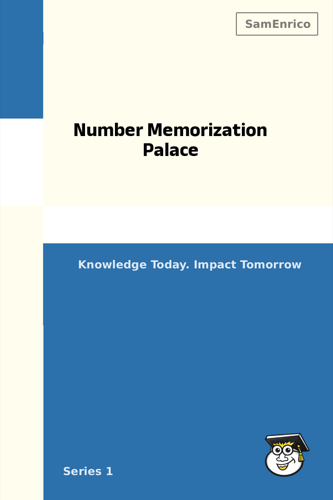
Number Memorization Palace eBook
Store long sequences of digits using number-image
Store long sequences of digits using number-image systems in loci.
Formats
Free sample
Chapter 1: The Invisible Shelf...--You have already forgotten something today. Perhaps it was a four-digit verification code that vanished the moment someone interrupted you. Maybe it was a new colleague’s name, a parking spot number, or the third item on a grocery list you swore you would remember. This is not a failure of intelligence. It is not a sign of aging or distraction or laziness.
It is the sound of your evolutionary heritage colliding with the demands of a digital world.The average human working memory can hold only seven plus or minus two discrete items at once. That number—seven—was established by the cognitive psychologist George Miller in 1956, and decades of subsequent research have only refined it downward. For most people, under most conditions, the reliable limit is closer to four. Four digits. Four words.
Four visual shapes. After that, the brain begins to leak. Information spills out like water from a cracked cup.This is not a bug in your biology. It is a feature. Your brain was not designed to remember 16-digit credit card numbers, 10-digit phone numbers, six-digit two-factor authentication codes, multiple PINs, passwords, and the birthdays of 300 Facebook friends.
Your brain was designed to remember where the river bends, which berries are poisonous, who smiled at you yesterday, and how to return to the cave where you found shelter during the last storm. The world has changed. Your hardware has not.But here is the truth that most people never discover: the limit of seven plus or minus two applies only to raw, unstructured information. When you learn how to structure information—when you give it a scaffold, a location, a vivid body—the ceiling lifts. Dramatically.
What feels like a bad memory is almost always a lack of technique. And technique can be learned.This book exists to teach you one specific, powerful, and deeply satisfying technique: how to memorize long sequences of digits using a combination of ancient spatial memory (the Memory Palace) and number-to-image conversion systems (the Major System, PAO, and their variants). By the time you finish this chapter, you will understand why your current approach to remembering numbers fails. By the end of this book, you will be able to memorize a 100-digit sequence in less than an hour and recall it days later without error. By the end of this book, you will have built a tool that works for the rest of your life.But first, you need to understand the architecture of memory itself.The Two Kinds of Memory You Use Every Day Psychologists distinguish between short-term memory (sometimes called working memory) and long-term memory.
Short-term memory is the sticky note on your mental desktop. It holds information for seconds or minutes, has a tiny capacity, and is easily erased by distraction. Long-term memory is the library. It holds information for years, has virtually unlimited capacity, and is robust against interruption. The problem is that numbers usually live in short-term memory.
You hear a phone number, repeat it silently, and then someone asks you a question—and the number is gone. The sticky note has been crumpled.The secret to memorizing long digit sequences is not to enlarge your short-term memory (that is largely fixed by biology) but to transfer digits into long-term memory almost instantly using a system of encoding, association, and location. You do this by converting abstract digits into concrete images, then placing those images into familiar locations. The locations act as retrieval cues. The images act as the data.
Together, they bypass the bottleneck of working memory.Every world memory champion you have ever heard of—Joshua Foer, Dominic O’Brien, Ben Pridmore, Nelson Dellis, Jonas von Essen—uses some variation of this method. None of them was born with a photographic memory. In controlled studies, memory champions score within the normal range on standard tests of memory span. They have not been gifted a superhuman brain. They have built one, piece by piece, using the same techniques you are about to learn.The Story of Simonides and the Collapsed Banquet Hall The foundational technique of this book—the Memory Palace—has a known origin story, and it is worth telling in full because it reveals the deep logic of spatial memory.Around 477 BCE, the Greek poet Simonides of Ceos was invited to recite a lyric poem at a banquet hall in Thessaly.
The hall was crowded with nobles, athletes, and politicians. Simonides performed his poem, collected half his fee, and stepped outside to speak with two young men who had arrived late. While he was outside, the roof of the banquet hall collapsed. The rubble was so complete that the bodies of the dead were unrecognizable to their grieving families. No one could identify who had been sitting where.Simonides closed his eyes and walked the scene in his mind.
He remembered exactly where each guest had been seated. He took the families by the hand and led them to their loved ones. In that moment, he realized something extraordinary: the human mind has a natural, powerful, and nearly automatic ability to remember spatial layouts. If you can remember where you sat at dinner last week, you can remember anything—provided you associate it with a location.This discovery became the Method of Loci (loci is Latin for "places"). For two thousand years, it was the dominant mnemonic technique in Western education.
Roman senators used it to memorize long speeches. Medieval scholars used it to memorize entire books. Then, with the printing press and the rise of written notes, the technique faded from popular use. It was relegated to sideshows and carnival tricks until the late twentieth century, when memory sports revived it.Now you are going to revive it for yourself.Why Most People Fail at Memorizing Numbers (And Why You Won't)Before we build your first Memory Palace, let us diagnose the common failure modes. If you have ever struggled to remember a long number, you have almost certainly experienced one or more of these:Failure Mode 1: Trying to store digits as digits.
Your brain hates digits. Digits are abstract, arbitrary, and context-free. The number 3 has no smell, no sound, no emotion, no location. The brain evolved to ignore meaningless symbols. When you try to force raw digits into memory, you are fighting your own neurobiology.Failure Mode 2: Rehearsal without encoding.
Most people "remember" a number by repeating it over and over (verbal rehearsal). This works for about 15 seconds. Then a distraction arrives, and the rehearsal loop breaks. You were never encoding; you were just postponing forgetting.Failure Mode 3: No retrieval structure. Even if you manage to memorize a number today, can you find it next week?
Without a systematic retrieval structure (like a Memory Palace), the memory drifts into the fog of unindexed long-term storage. You know it is in there somewhere, but you cannot find the file.Failure Mode 4: Mixing categories. You memorize your credit card number, your Pi digits, and your mother's birthday all in the same mental space. Then you try to recall Pi and get your credit card. Cross-category interference is a major cause of recall errors.This book solves each of these…
This is the end of the free sample. Get the eBook to keep going. Buy now
About this book
Details
- Author
- Smallwood Nena
- Publisher
- SamEnrico
- Language
- English
- Genre
- Non-Fiction, Self-Help, Numbers
- Released
- 2026-06-06
- Pages (approx.)
- 126
- Available as
- eBook, Audiobook

Read better in the ZLOADR app
Your eBooks on your phone or tablet. Sign in with your SamEnrico account and start reading.
More by Smallwood Nena
 Musician Performance Sleep GuideSmallwood Nena$11.99
 Hooper TV MasterSmallwood Nena$11.99
 Vehicle Winter Emergency KitSmallwood Nena$11.99
 RLS And Sleep Apnea Connection GuideSmallwood Nena$11.99RLS And Sleep Apnea Connection GuideSmallwood Nena$11.99
 Female Rulers Communication Cipher CourseSmallwood Nena$11.99
 The Branch Davidian ExilesSmallwood Nena$11.99
 Single Parent Burnout HelpSmallwood Nena$11.99
 Cleopatra Last PharaohSmallwood Nena$11.99
 The Sugar Baroness of the Caribbean: Madame C.J. Walker's Sweet SuccessSmallwood Nena$11.99
 Orpheus: The Lyre That Shattered HadesSmallwood Nena$11.99
 Love in the Time of War: The Secret Letters of Vera Brittain and Roland LeightonSmallwood Nena$11.99
You may also like
 Hong Kong Handover 1997Dunn Johnnie$11.99
 Zumba For Postnatal Recovery CourseNeal Christian$11.99
 Zumba for BeginnersLadner Nikia$11.99
 YouTube Comment Mining GuideHumes Pandora$12.99
 Worry Box MeditationCarlin Rudy$11.99
 Workplace Stress MeditationNguyen Lynn$11.99
 Workplace Stress and Sleep RepairHawley Ivory$11.99
 Workplace Perfectionism CureDelaney Jeffry$11.99
 Workplace Injustice Anger GuideWallen Isabelle$11.99
 Work Addiction and Burnout LinkGreenwood Ester$11.99
 Women in Yoga and WellnessBeattie Galina$11.99
 Women in Stand Up ComedyChun Evangeline$11.99