
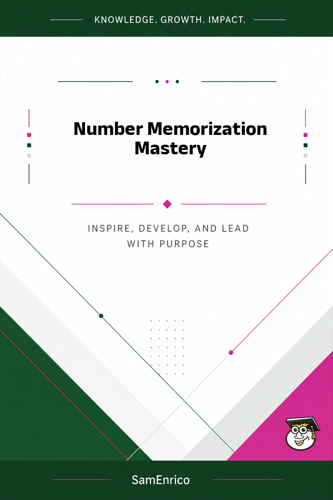
Non-FictionSelf-HelpNumber Memory
Number Memorization Mastery eBook
Use major system and person action object pegs to
by Colby Tyra
Use major system and person action object pegs to recall long number sequences.
Formats
Free sample
Chapter 1: The Seven-Second Failure--Chapter 1: The Seven-Second Failure--You are about to fail. And that failure will be the best thing that has ever happened to your memory.Find a quiet moment right now. Put down the book if you need to—it will wait. Look at the following twenty-digit number. You have exactly seven seconds to look at it.
Do not write it down. Do not repeat it out loud more than once. Just look.73924781629405836127Seven seconds are up. Close your eyes or look away. Now try to recall the number.
Go ahead—try. Write down what you remember on a scrap of paper.If you are like ninety-nine percent of the people who have ever taken this test, you remembered between four and seven digits. Maybe you got the first three correct and then everything dissolved into a fog of uncertainty. Perhaps you remember that there was a 7 and a 3 and something about a 9, but the order has already started to slip. You might feel a small sting of frustration, or worse, a quiet confirmation of what you have secretly believed for years: I’m just not good with numbers.That belief is a lie.
And this chapter is going to prove it to you—not with encouragement or platitudes, but with the hard, liberating truth about how your memory actually works.The Anatomy of a Seven-Second Failure Why did you fail to remember that twenty-digit number? The obvious answer—the one your inner critic is whispering right now—is that your memory is simply not strong enough. You might be telling yourself that some people are born with “photographic memories” or “number minds,” and you were not lucky enough to be one of them. You might be remembering a math teacher who sighed when you hesitated, a parent who compared you to a sibling, or an exam where the formulas vanished the moment you needed them.All of that is wrong. Not exaggerated.
Not partially true. Completely, demonstrably, scientifically wrong.Here is what actually happened during those seven seconds. You looked at the string of digits: 73924781629405836127. Your eyes scanned across them. Your brain, working exactly as it evolved to do, tried to make sense of the input.
But here is the crucial point: your brain does not naturally process raw numbers as memorable events. Numbers are abstract symbols. They have no color, no smell, no sound, no emotion, no story. Your brain evolved over millions of years to remember things that matter for survival: where the water hole is, which berries are poisonous, who in your tribe can be trusted, and what a growling sound in the tall grass means. Your brain is a masterpiece of relational, sensory, narrative memory.
It is not a calculator.When you looked at the number, you attempted to memorize it using a method called maintenance rehearsal. That is the technical term for what you just did: staring at something and repeating it, either out loud or in your head, hoping that the repetition will somehow weld the information into your neural circuits. Maintenance rehearsal is the default strategy for almost everyone who has never trained their memory. It is also, for all practical purposes, useless for anything beyond the next thirty seconds.Let me show you exactly why. Try to repeat the following sequence out loud: 4, 8, 3, 9, 2, 7.
You can do it easily because the sequence is short—within the famous “seven plus or minus two” limit of working memory that psychologists have known about since the 1950s. Now try the original twenty-digit number again. You cannot hold it in working memory because working memory is a tiny whiteboard, not a hard drive. Maintenance rehearsal tries to keep the numbers on that tiny whiteboard by frantically re-writing them over and over. But the moment you get distracted—the moment a car honks outside, or you wonder what is for dinner, or you simply blink—the whiteboard is wiped clean.Your seven-second failure was not a failure of memory.
It was a failure of strategy. You used the wrong tool for the job. It is like trying to dig a foundation with a toothbrush. The toothbrush is a perfectly good tool for cleaning your teeth. The problem is not the toothbrush.
The problem is using it to move dirt.The Two Kinds of Rehearsal (And Why One of Them Changes Everything)Cognitive psychologists have identified two fundamentally different ways that the brain can rehearse information. The first, which you just experienced, is maintenance rehearsal. Maintenance rehearsal is shallow. It treats information as a sequence of sounds or visual symbols to be parroted back. It does not ask what the information means.
It does not connect the information to anything you already know. It simply tries to hold on by sheer repetition. Maintenance rehearsal is why you can repeat a phone number to yourself while walking across the room to the phone, but the moment someone asks you a question, the number evaporates. It was never actually encoded into long-term memory. It was just bouncing around in your temporary mental buffer, waiting to be dropped.The second kind of rehearsal is called elaborative rehearsal.
Elaborative rehearsal is deep. It transforms raw information into something meaningful, connected, and sensory. Instead of asking “What sounds come next?” elaborative rehearsal asks “What does this remind me of? What image can I see? What story can I tell?
How does this connect to something I already know?” Elaborative rehearsal is the method that memory champions use to memorize the order of ten shuffled decks of cards or a thousand random digits. It is the method that allows people in traditional cultures to recite epic poems that take days to perform. It is the method that your own brain uses effortlessly every single day—just not for numbers.Think about the last time you remembered a scene from a movie. You did not memorize the sequence of pixels or the audio waveform. You remembered the characters, the conflict, the surprise twist, the expression on the actor’s face.
You remembered a story. Your brain is a story-making machine. It craves narrative. It craves images. It craves emotion.
It craves connection. And here is the liberating truth: you can give your brain exactly what it craves for numbers too. Not by working harder, but by working smarter.Your Brain Is a Relational Database, Not a Tape Recorder This is the most important metaphor you will encounter in this entire book. Please read it twice:Your brain is a relational database, not a tape recorder.A tape recorder captures information exactly as it arrives—a sequence of sounds, in order, with no interpretation. If you play the tape back, you hear exactly what was recorded.
But your brain does not work that way. You cannot simply “record” a twenty-digit number and play it back later. That is not a failure of your brain. That is a mismatch between the task and the tool.A relational database, by contrast, stores information by linking it to other information. In a relational database, you do not retrieve a fact by searching through a flat list.
You retrieve it by following connections. You ask: What is this related to? What category does it belong to? What…
This is the end of the free sample. Get the eBook to keep going. Buy now
About this book
Details
- Author
- Colby Tyra
- Publisher
- SamEnrico
- Language
- English
- Genre
- Non-Fiction, Self-Help, Number Memory
- Released
- 2026-06-10
- Pages (approx.)
- 140
- Available as
- eBook, Audiobook

Read better in the ZLOADR app
Your eBooks on your phone or tablet. Sign in with your SamEnrico account and start reading.
More by Colby Tyra
 Growth Hormone and DiabetesColby Tyra$11.99
 Diamond District Before HeistColby Tyra$11.99
 Layoff Anxiety Management GuideColby Tyra$11.99
 The Team Exquisite CorpseColby Tyra$11.99
 Nicotine Free Athlete GuideColby Tyra$11.99
 US Federal Green Tax Credits GuideColby Tyra$11.99
 Yogic Flying ExplainedColby Tyra$11.99
 HGH Replacement Therapy RisksColby Tyra$11.99
 The Last Words of the Titanic: Voices from the DeepColby Tyra$11.99
 Gold in the Shadows: The Untold Story of Eric MoussambaniColby Tyra$11.99
 The Last Elephant of the Pharaohs: A Ceremony of Ashes and IvoryColby Tyra$11.99
 Amazon Influencer StorefrontsColby Tyra$11.99
You may also like
 Hong Kong Handover 1997Dunn Johnnie$11.99
 Zumba For Postnatal Recovery CourseNeal Christian$11.99
 Zumba for BeginnersLadner Nikia$11.99
 YouTube Comment Mining GuideHumes Pandora$12.99
 Worry Box MeditationCarlin Rudy$11.99
 Workplace Stress MeditationNguyen Lynn$11.99
 Workplace Stress and Sleep RepairHawley Ivory$11.99
 Workplace Perfectionism CureDelaney Jeffry$11.99
 Workplace Injustice Anger GuideWallen Isabelle$11.99
 Work Addiction and Burnout LinkGreenwood Ester$11.99
 Women in Yoga and WellnessBeattie Galina$11.99
 Women in Stand Up ComedyChun Evangeline$11.99