
Non-FictionBusiness BriefDecision Science
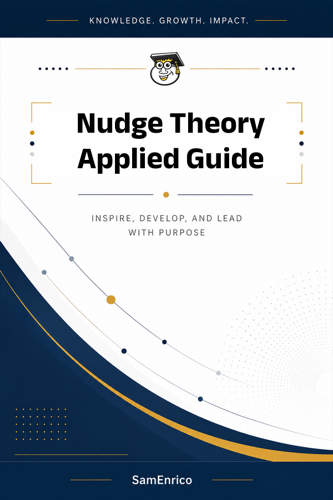
Nudge Theory Applied Guide eBook
Teaches how to design choice architecture for bett
Teaches how to design choice architecture for better decisions.
Formats
Free sample
Chapter 1: The Ghost in the Machine--–- Imagine walking into a brightly lit cafeteria. You are hungry, you are in a hurry, and you have ten dollars. Before you stands a long line of stainless steel trays: first the salad bar, then the sandwiches, then the hot entrees, then the desserts, then the checkout. You grab a tray, move past the salads without looking, pick a sandwich, add a bag of chips, pay, and leave. You have made a decision.
You believe it was your decision. You believe you freely chose the sandwich over the salad, the chips over the apple. But what if the order of those trays was flipped? What if the first thing you saw was the salad bar, then the fruit, then the sandwiches, then the hot food, and the chips were hidden behind a frosted glass divider at the very end? Would you still have chosen the sandwich and the chips?
Almost certainly not. The architect of that cafeteria—the manager who decided where each item would sit—made a choice that shaped your choice. You never saw that architect. You never thanked them or cursed them. But they were there.
They are always there.This is the ghost in the machine of every decision. It is the invisible hand that is not Adam Smith's market force but something far more mundane and far more powerful: the design of the choice environment itself. Every time you fill out a form, scroll through a website, walk through a grocery store, or enroll in a benefit at work, someone has arranged the options in a particular order, set a particular default, chosen a particular color for the “next” button, decided whether the opt-out box is checked or unchecked. That someone is a choice architect. And whether they know it or not, they are shaping your life.The central argument of this book—and the reason you are reading Chapter 1—is that you cannot choose not to be a choice architect.
If you manage a team, you design choices for your employees. If you build a product, you design choices for your users. If you write a policy, you design choices for the public. Even your own personal decisions are made within environments designed by others. The only question is whether you will design those environments deliberately, ethically, and effectively, or whether you will leave them to accident, inertia, and the default settings of a world that does not have your interests at heart.This chapter is the foundation for everything that follows.
It will introduce the core problem that nudges solve: the systematic gap between what people intend to do and what they actually do. It will explain why traditional economics got this problem so badly wrong for so long. And it will introduce the two families of cognitive machinery—System 1 and System 2—that operate beneath the surface of every decision you have ever made. By the end of this chapter, you will never look at a menu, a form, or a website the same way again. You will see the ghost.The Myth of the Rational Decision-Maker For most of the twentieth century, economics, law, and public policy were built on a single, elegant, and almost entirely false assumption: that human beings are rational actors.
In the world of the textbook, “Econs” (as Richard Thaler and Cass Sunstein would later call them) have perfect access to information, unlimited time to process it, stable preferences that do not change with context, and the self-control of a saint. When an Econ wants to save for retirement, they calculate the optimal savings rate, execute it, and never deviate. When an Econ chooses a health insurance plan, they read every page of every policy, compare the expected values of all options, and select the one that maximizes their utility. When an Econ walks past a slice of chocolate cake, they weigh the immediate pleasure against the long-term health consequences and make the choice that aligns with their true preferences.You have never met an Econ. You have never been an Econ.
And the world designed by Econs—the world of dense fine print, endless options, and the assumption that people will read everything and choose wisely—has been failing real humans for decades.The problem is not that people are stupid. The problem is that people are busy, distracted, tired, hungry, emotional, social, and finite. The brain did not evolve to compare 401(k) fund prospectuses; it evolved to spot predators, find food, and navigate social hierarchies. The cognitive machinery that kept our ancestors alive is the same machinery that leads us to eat the cake, skip the gym, and stick with the default retirement fund even when it charges high fees. These are not bugs in an otherwise perfect system.
They are features of a system that works remarkably well for most of life but fails systematically in the kinds of complex, abstract, delayed-reward decisions that modern life presents.Consider a simple experiment. Researchers gave two groups of people the same medical decision. The first group was told: “Treatment A has a 90 percent survival rate. Treatment B has a 50 percent survival rate.” Most chose Treatment A. The second group was told: “Treatment A has a 10 percent mortality rate.
Treatment B has a 50 percent mortality rate.” Most chose Treatment A again. The numbers are mathematically identical—90 percent survival is the same as 10 percent mortality. But the framing changed the choice. This is not rational. It is human.
And it is predictable.The implication for choice architects is profound. If people were rational Econs, the design of the choice environment would not matter. You could present the same information in any order, with any default, in any format, and the Econ would patiently recalculate the optimal choice every time. But because people are Humans—because they are influenced by defaults, by order, by framing, by social norms, by salience, by the way options are grouped and labeled—the choice architect has enormous power. And with that power comes enormous responsibility.The Two Systems: A Quick Tour of Your Own Mind If you want to design for Humans, you need to understand how the Human mind actually works.
No modern insight is more important for choice architects than the dual-process model popularized by Daniel Kahneman, the Nobel Prize-winning psychologist who spent a career demonstrating the limits of human rationality. The model is simple but profound: the brain has two operating systems.System 1 is fast. It is automatic, intuitive, emotional, and effortless. System 1 is what tells you that a face is angry, that a snake is dangerous, that a ripe peach smells good. It runs constantly in the background, using heuristics (mental shortcuts) and associative memory to produce quick judgments without you even knowing it is working.
System 1 is why you can drive a familiar route while listening to a podcast and not remember the last three turns. It is why you know that 2+2=4 without thinking. It is why you recoil from a photograph of a mutilated body even though you are perfectly safe. System 1 is ancient, shared with other animals, and responsible for most of your everyday decisions.System 2 is…
This is the end of the free sample. Get the eBook to keep going. Buy now
About this book
Details
- Author
- Packer Portia
- Publisher
- SamEnrico
- Language
- English
- Genre
- Non-Fiction, Business Brief, Decision Science
- Released
- 2026-06-06
- Pages (approx.)
- 156
- Available as
- eBook, Audiobook

Read better in the ZLOADR app
Your eBooks on your phone or tablet. Sign in with your SamEnrico account and start reading.
More by Packer Portia
 Silicon Bone Collagen GuidePacker Portia$11.99
 Persuasive Real Estate OfferPacker Portia$11.99
 No Evidence DiseasePacker Portia$11.99
 The Stress and Acne GuidePacker Portia$11.99
 Kenya Mau Mau RebellionPacker Portia$11.99
 Teaching Focus ShieldPacker Portia$11.99
 Teacher Classroom PresencePacker Portia$11.99
 Being Chased Dream SymbolPacker Portia$11.99
 Tangaroa's Tide and Hina's Moon: A Love That Shaped the WavesPacker Portia$11.99
 Swiped Right: The Tinder Revolution That Changed Dating ForeverPacker Portia$11.99
 Love, Loss, and 73 Home Runs: The Barry Bonds and Liz Watson Love StoryPacker Portia$11.99
 The Mineral Guide to NoseanPacker Portia$11.99
You may also like
 Hong Kong Handover 1997Dunn Johnnie$11.99
 Zumba For Postnatal Recovery CourseNeal Christian$11.99
 Zumba for BeginnersLadner Nikia$11.99
 YouTube Comment Mining GuideHumes Pandora$12.99
 Worry Box MeditationCarlin Rudy$11.99
 Workplace Stress MeditationNguyen Lynn$11.99
 Workplace Stress and Sleep RepairHawley Ivory$11.99
 Workplace Perfectionism CureDelaney Jeffry$11.99
 Workplace Injustice Anger GuideWallen Isabelle$11.99
 Work Addiction and Burnout LinkGreenwood Ester$11.99
 Women in Yoga and WellnessBeattie Galina$11.99
 Women in Stand Up ComedyChun Evangeline$11.99