
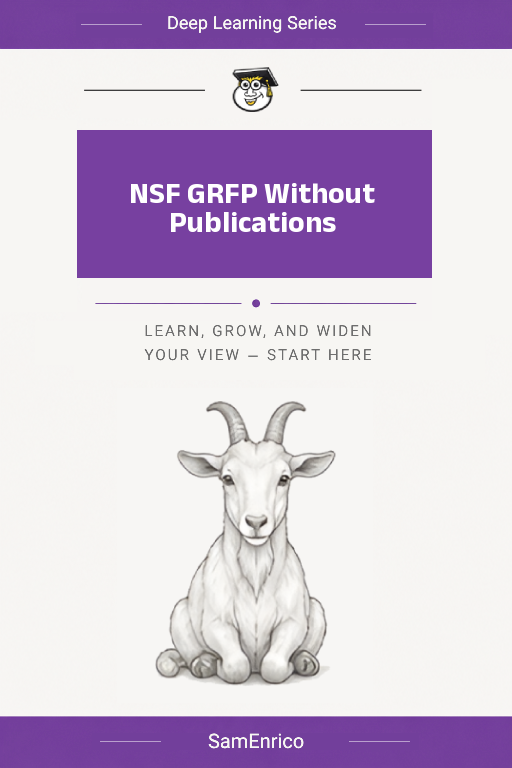
Non-FictionStudent's ShortcutNSF
NSF GRFP Without Publications eBook
Apply for NSF Graduate Research Fellowship emphasi
by Shores Hoa
Apply for NSF Graduate Research Fellowship emphasizing broader impacts and intellectual merit over papers.
Formats
Free sample
Chapter 1: The Paper Trap--–- Every fall, thousands of talented students decide not to apply for the NSF Graduate Research Fellowship. They have the grades. They have the research experience. They have professors who would write glowing letters. But they open their CVs, stare at the blank space under “Publications,” and close the document.
They tell themselves they will apply next year, after they finish that paper. They tell themselves the fellowship is for students who have already proven themselves. They are making a catastrophic mistake.This chapter exists to correct that mistake. By the time you finish reading, you will understand why the NSF explicitly designed the GRFP to reward potential over past productivity, why a blank publications section is not a red flag, and why the most dangerous applicant is not the one with zero papers but the one who cannot explain why their work matters to anyone outside their subfield. If you have been putting off applying because you lack publications, consider this your official permission to stop waiting.
Your time is now.The Admissions Hangover The confusion about publications begins with an understandable error. Most graduate students first encounter high-stakes applications during the Ph D admissions process. For admissions committees, publications are a valuable signal. When a department receives five hundred applications for twenty slots, committee members grasp for any evidence that an applicant can complete research independently. A first-author publication, even in a modest journal, says something powerful: this student has seen a project through from conception to completion.
They have navigated peer review. They have responded to reviewer feedback. They have done the hard, unglamorous work of revision and resubmission.That logic makes sense for admissions. But the GRFP is not admissions.Admissions committees look backward. They ask: What has this student already done?
They are trying to predict who will succeed in a specific program, under specific advisors, with specific resources. They are risk-averse because they have limited slots and their funding depends on graduating students who publish. Admissions is a scarcity game.The GRFP looks forward. Reviewers ask: What could this student do with three years of funding and no teaching obligations? They are not risk-averse; they are mandated by Congress to fund transformative potential.
They are not comparing you to third-year graduate students with multiple papers; they are comparing you to other early-career applicants, most of whom also lack publications. The official GRFP solicitation does not mention publications as a criterion. Not once. Read it yourself. What it does mention, repeatedly, is “potential for future contributions,” “broader impacts,” and “integrative thinking.”Yet the myth persists.
In survey data from university GRFP workshops, nearly seventy percent of eligible students report delaying their first application because they felt “not productive enough.” When asked what productivity meant, the overwhelming answer was “publications.” This is a quiet tragedy of self-selection. The students most likely to win — those with bold ideas, interdisciplinary training, and genuine commitment to broader impacts — are often the same students who have spent their undergraduate or early graduate years doing things that do not produce papers: building community partnerships, mentoring younger students, designing educational interventions, or working on high-risk projects that have not yet yielded results. They are exactly the kind of scientist the NSF wants to fund. And they are taking themselves out of the running because they misunderstood the rules of the game.The High Skilled Barbarian Let me introduce you to an archetype. I call it the High Skilled Barbarian.A barbarian, in this context, is a scientist with exceptional technical skill who cannot explain why their work matters to anyone outside their narrow subfield.
They can optimize parameters. They can write elegant code. They can troubleshoot finicky equipment. They produce beautiful data visualizations. But when asked “so what?” they freeze.
Their grant proposals are dense with jargon and empty of purpose. They assume the significance of their work is obvious to any reasonable reader. It is not obvious. It is never obvious.To understand why the High Skilled Barbarian loses in the GRFP, consider a thought experiment. Imagine two applicants.Applicant A has three publications.
Two are middle-author papers on a well-funded project in a large, prestigious lab. The third is a first-author paper in a respectable but niche journal. Applicant A’s research statement is technically flawless. The methods are sound. The hypotheses are testable.
The writing is clear. But when you read the statement, you have to work to understand why any of it matters. The broader impacts section, if it exists at all, consists of a single sentence: “I will present my findings at conferences and mentor undergraduate researchers.” The statement could have been written by any competent graduate student in the field. It is competent. It is also forgettable.Applicant B has zero publications.
They spent their undergraduate years working on a project that ultimately did not work out — the equipment failed, the samples were contaminated, the hypothesis turned out to be incorrect. But they also organized a campus-wide climate literacy campaign that reached five hundred students. They designed a tutoring program that increased retention in a high-failure-rate introductory course from fifty percent to eighty percent. They learned from their failed experiment and can articulate exactly what they would do differently next time. Their proposed research is about the same topic as their failed project, but they have reframed it based on what they learned.
Their broader impacts section is specific, integrated, and assessable: they plan to partner with a local school district to bring climate science modules into middle school classrooms, and they will measure success through pre- and post-surveys of student interest in science careers.Who wins?In the GRFP, Applicant B wins almost every time. Not because publications are irrelevant, but because the fellowship is not a reward for past productivity. It is an investment in future potential. Applicant A looks like someone who can execute a well-defined project in a well-resourced lab. That is valuable, but it is not transformative.
Applicant B looks like someone who can identify what matters, connect research to society, learn from failure, and bring others along. That is exactly what the NSF wants to fund.Now consider two versions of the same hypothetical proposal. The science is identical. The only difference is the framing.Barbarian version: “This research will optimize the Snorfblatz parameter using a 12-step quadrature method with iterative convergence criteria.”Winning version: “Optimizing the Snorfblatz parameter could reduce false positives in tuberculosis diagnostics by fifteen percent, directly impacting rural healthcare access. This research will use a 12-step quadrature method, with iterative convergence criteria, to achieve this optimization.”The High Skilled Barbarian assumes the connection between Snorfblatz optimization and human health is obvious.
The winning applicant knows that nothing is obvious to a reviewer who has read fifty proposals in two days. The winning applicant does the reviewer’s work for them. They connect the dots explicitly, sentence by sentence, paragraph by paragraph.What Reviewers Actually Look For The NSF publishes its review criteria publicly, but most applicants never read them carefully. Let us do that now.The review criteria have two main sections: Intellectual Merit and Broader Impacts. Neither mentions publications.
Let me repeat that because it is important. Neither criterion mentions publications.Intellectual Merit asks: “Does the proposal advance knowledge in…
This is the end of the free sample. Get the eBook to keep going. Buy now
About this book
Details
- Author
- Shores Hoa
- Publisher
- SamEnrico
- Language
- English
- Genre
- Non-Fiction, Student's Shortcut, NSF
- Released
- 2026-06-01
- Pages (approx.)
- 141
- Available as
- eBook, Audiobook

Read better in the ZLOADR app
Your eBooks on your phone or tablet. Sign in with your SamEnrico account and start reading.
More by Shores Hoa
 Gossip and Lies AngerShores Hoa$11.99
 Dating Rejection Self Esteem GuideShores Hoa$11.99
 Data Leak Customer Phone ScriptsShores Hoa$11.99
 Acupuncture For Sports InjuriesShores Hoa$11.99
 The Failure Integration PlanShores Hoa$11.99
 Calvin Geneva Reformation BlueprintShores Hoa$11.99
 Nightmare MeditationShores Hoa$11.99
 Pamela Harriman ChurchillShores Hoa$11.99
 Hospitality Burnout PreventionShores Hoa$11.99
 Vanished in the Wild: The Mystery of James KimShores Hoa$11.99
 The Stonemason’s Heart: A Gothic Love Between Faith and FormShores Hoa$11.99
 The Grand Design: How Christopher Wren Built a New LondonShores Hoa$11.99
You may also like
 Hong Kong Handover 1997Dunn Johnnie$11.99
 Zumba For Postnatal Recovery CourseNeal Christian$11.99
 Zumba for BeginnersLadner Nikia$11.99
 YouTube Comment Mining GuideHumes Pandora$12.99
 Worry Box MeditationCarlin Rudy$11.99
 Workplace Stress MeditationNguyen Lynn$11.99
 Workplace Stress and Sleep RepairHawley Ivory$11.99
 Workplace Perfectionism CureDelaney Jeffry$11.99
 Workplace Injustice Anger GuideWallen Isabelle$11.99
 Work Addiction and Burnout LinkGreenwood Ester$11.99
 Women in Yoga and WellnessBeattie Galina$11.99
 Women in Stand Up ComedyChun Evangeline$11.99