
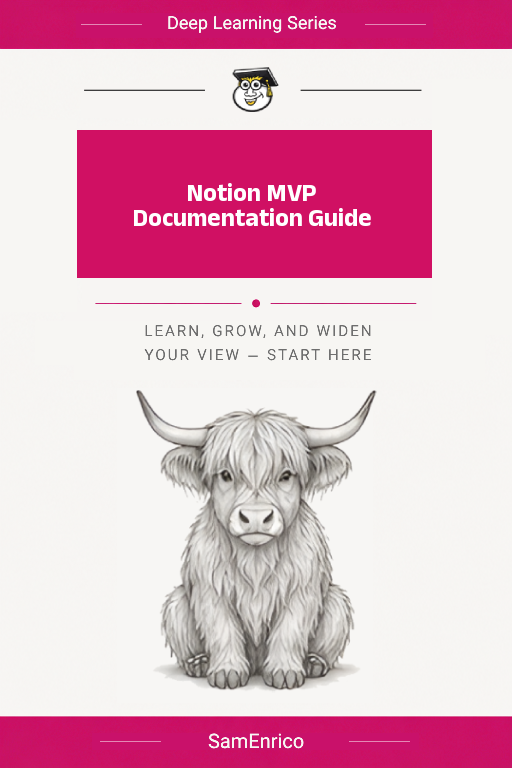
Non-FictionStartup GuideNotionDocumentation
Notion MVP Documentation Guide eBook
Build free Notion page describing your product fea
by Goff Renae
Build free Notion page describing your product features and measure interest through page view analytics.
Formats
Free sample
Chapter 1: The $100k Lie--–- I learned the 100,000lieona Tuesdayafternoonin March,sittinginacoffeeshopwithmylaptopopentoa Stripedashboardshowingexactly100,000 lie on a Tuesday afternoon in March, sitting in a coffee shop with my laptop open to a Stripe dashboard showing exactly 100,000lieona Tuesdayafternoonin March,sittinginacoffeeshopwithmylaptopopentoa Stripedashboardshowingexactly47.32 in revenue. Behind that number were six months of my life, forty thousand dollars of savings, and a product that three focus groups had said they would "definitely buy." They didn't. Nobody did. The app worked perfectly. The code was clean.
The login screen had animations that made grown designers weep. And none of it mattered because I had built something that exactly zero humans wanted.That morning, I had done what every failed founder does before admitting defeat: I scrolled through my analytics looking for someone to blame. Maybe the marketing was wrong. Maybe the pricing was off. Maybe the launch timing coincided with a major holiday.
But the data told a simpler, crueler story. In six months, exactly 312 people had visited my landing page. Of those, 211 had clicked away within five seconds. Of the remaining 101, only 12 had clicked the "Pricing" link. And of those 12, exactly zero had clicked "Buy Now." The problem wasn't my code.
The problem was that nobody had ever wanted what I was building in the first place. I had spent six months solving a problem that existed only in my head.That night, I deleted the entire project. Not the code—I kept that in a folder named "Lessons" where it still sits today, a monument to my own arrogance. What I deleted was the assumption that building something automatically makes it valuable. And I made a promise: I would never write another line of production code until I had proof that someone, somewhere, would actually use what I was planning to build.This book is the result of that promise.The Most Expensive Myth in Product Development There is a lie that runs through every startup conference, every tech Twitter thread, and every venture capital pitch deck.
It sounds reasonable. It sounds responsible. It sounds like the kind of advice that successful people give to people who want to become successful. The lie is this: "Your MVP should be the smallest thing you can build that delivers value."On its face, this seems wise. Don't overbuild.
Don't add features nobody asked for. Ship fast, iterate faster. But buried inside this advice is a fatal assumption: that you already know what "value" means to your customer. You don't. You can't.
Not until you've watched them ignore your solution.Eric Ries, the author of The Lean Startup, defined an MVP as "that version of a new product which allows a team to collect the maximum amount of validated learning about customers with the least amount of effort." Notice what he did not say. He did not say "the smallest thing you can build." He said "the smallest thing you can learn from." Those are two very different things. A login screen with working authentication is something you can build. But what does it teach you? It teaches you that you know how to build a login screen.
It teaches you nothing about whether anyone wants to log in.The confusion between "build" and "learn" has destroyed more startups than any other single cause. CB Insights analyzed 101 startup failures and found that 42 percent failed because there was "no market need" for their product. Not bad code. Not bad marketing. Not bad timing.
No market need. People simply did not want what they had built. And in almost every case, the founders could have discovered this before writing a single line of code—if they had known how to test for desire rather than functionality.Why Your Mother Lied to You (And Why That's Not Her Fault)Rob Fitzpatrick wrote a book called The Mom Test that should be required reading for anyone who has ever asked a friend "Do you like my idea?" The title comes from a simple observation: if you ask your mother whether your business idea is good, she will say yes. Not because she wants to see you fail, but because she loves you and doesn't want to hurt your feelings. Your friends will do the same.
Your colleagues will do the same. Even strangers in a focus group will do the same, because humans are wired to avoid conflict and polite disagreement.The problem is not that people are dishonest. The problem is that you are asking the wrong question. "Would you buy this?" is a question about the future, and humans are famously bad at predicting their own future behavior. Ask someone if they would exercise more if they had a gym membership, and they will say yes.
Then they will not exercise. Ask someone if they would pay for an app that helps them save time, and they will say yes. Then they will not pay. Words are cheap. Behavior is expensive.The only question that matters is not "Would you buy this?" but "Did you look at this?" And that is where Notion enters the story.The Document as Lie Detector Here is a truth that took me forty thousand dollars to learn: a well-structured document is a better lie detector than any prototype, any survey, and almost any interview.
Here's why.When you build a prototype, even a clickable one, you are inviting people to interact with something that feels like a product. They will click buttons. They will scroll through screens. They will give you feedback about button colors and font sizes and loading speeds—none of which matters if the core idea is wrong. Prototypes invite people to comment on execution before you have validated the premise.
It is like asking someone to critique the paint job on a car that has no engine.When you show a document—a simple, honest, text-based specification of what you plan to build—you strip away the distractions. There are no button colors to critique. No loading speeds to complain about. No animations to admire. There is only the idea, laid bare.
And when someone reads your document and then clicks away without taking action, you cannot blame the user interface. You cannot blame the load time. You can only blame the idea.This is brutal. This is also essential.A Notion document, shared publicly with analytics enabled, creates a clean experiment. You post a link.
People click it or they don't. They read it or they don't. They click your fake "Buy" button or they don't. Every action is a vote. Every inaction is a veto.
And because Notion is free, because it takes minutes to set up, and because it requires zero code, you can run this experiment on ten different ideas before breakfast. The one that survives is the one you build.The Real Cost of Building First Let me be precise about what "building first" actually costs, because most founders underestimate it by an order of magnitude.The Time Cost: A simple web application takes three to six months to build. A mobile app takes four to eight months. A Saa S platform with payment processing, user accounts, and a database takes six to twelve months.…
This is the end of the free sample. Get the eBook to keep going. Buy now
About this book
Details
- Author
- Goff Renae
- Publisher
- SamEnrico
- Language
- English
- Genre
- Non-Fiction, Startup Guide, Notion, Documentation
- Released
- 2026-06-01
- Pages (approx.)
- 128
- Available as
- eBook, Audiobook

Read better in the ZLOADR app
Your eBooks on your phone or tablet. Sign in with your SamEnrico account and start reading.
More by Goff Renae
 Sri Lankan Talent DrainGoff Renae$11.99
 Weight Loss After MenopauseGoff Renae$11.99
 Collaboration Space Design HandbookGoff Renae$11.99
 Workplace Stress Reduction for Fitness TrainersGoff Renae$11.99
 Gaming Addiction in TeensGoff Renae$11.99
 The Silent Siege: How a Single Whistleblower Exposed a $100 Billion FraudGoff Renae$11.99
 The Sunken Secrets of the Red Sea: Diving into Lost CivilizationsGoff Renae$11.99
 Understanding Chromosome 4, Trisomy 4q25 QterGoff Renae$17.99
 OSP Project ManagerGoff Renae$11.99
 How to Become a Cadmium-liquor MakerGoff Renae$11.99
 Business Tax ID Number GuideGoff Renae$12.99
You may also like
 Hong Kong Handover 1997Dunn Johnnie$11.99
 Zumba For Postnatal Recovery CourseNeal Christian$11.99
 Zumba for BeginnersLadner Nikia$11.99
 YouTube Comment Mining GuideHumes Pandora$12.99
 Worry Box MeditationCarlin Rudy$11.99
 Workplace Stress MeditationNguyen Lynn$11.99
 Workplace Stress and Sleep RepairHawley Ivory$11.99
 Workplace Perfectionism CureDelaney Jeffry$11.99
 Workplace Injustice Anger GuideWallen Isabelle$11.99
 Work Addiction and Burnout LinkGreenwood Ester$11.99
 Women in Yoga and WellnessBeattie Galina$11.99
 Women in Stand Up ComedyChun Evangeline$11.99