
Non-FictionSelf-HelpDigital PsychologyCompulsion
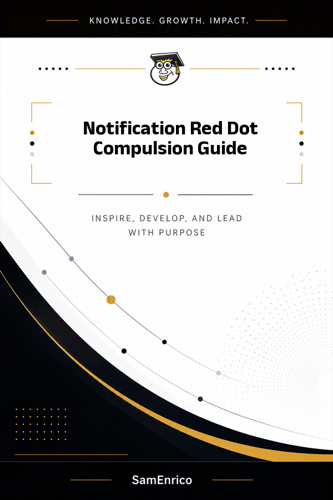
Notification Red Dot Compulsion Guide eBook
Overcome the urge to clear every red badge using b
Overcome the urge to clear every red badge using badge removal and batch checking schedules.
Formats
Free sample
Chapter 1: The Red Menace--The first time you saw a red notification badge, you probably didn't feel fear. You likely felt curiosity, maybe even a small spark of satisfaction when you tapped it and the number disappeared. That was by design. The red badge was never meant to look threatening. It was meant to look like a small, friendly nudge—a gentle reminder that something awaited you.
But somewhere between that first harmless tap and the three hundredth compulsive check of your day, something changed. The nudge became a nag. The nag became a command. And the command became something that felt almost impossible to disobey.You are not alone in this experience. Over eighty percent of smartphone users report feeling a twinge of anxiety when they see a red notification badge.
Nearly sixty percent admit they have unlocked their phone specifically to clear a badge, then locked it again without doing anything else inside the app. And the average user checks their phone over two hundred times per day, with a significant portion of those checks driven not by a conscious need for information, but by the mere presence of that small red circle. This chapter will deconstruct exactly what the red badge is, how it exploits your brain's most fundamental operating systems, and why resisting it has nothing to do with willpower and everything to do with understanding the billion-dollar psychology behind those three millimeters of crimson.The Accidental Invention That Changed Everything The red notification badge was not part of the original i Phone. When Steve Jobs introduced the first i Phone in 2007, notifications were a clumsy affair—pop-up windows that interrupted whatever you were doing, requiring a deliberate tap to dismiss. The concept of a persistent, non-intrusive visual indicator on an app icon did not exist.
That changed in 2011 with the release of i OS 5, Apple's fifth major operating system update. The red badge was introduced quietly, almost as an afterthought, in the release notes under a single bullet point: "App icons can now display badges with unread counts."The engineering team had designed the badge as a convenience feature. The thinking was simple: instead of opening an app to see if you had new messages or updates, the badge would tell you at a glance. It was efficient. It was respectful of your time.
It was, by all appearances, a small kindness from your device to you. Within eighteen months, every major mobile operating system had copied the feature. Android introduced its version in 2012. Windows Phone followed shortly after. By 2014, the red badge was universal—a standard element of the mobile experience that no one questioned.But something unexpected happened in those first two years.
App developers noticed that users were not just using badges for efficiency. They were becoming fixated on them. Email apps with badge counts saw significantly higher open rates than those without. Social media platforms discovered that users who had badges enabled checked their apps more often and stayed longer. The badge, intended as a neutral utility, had become the most powerful engagement tool in the history of consumer software.What the engineers at Apple did not anticipate—or perhaps, what some of them secretly hoped for—was that the human brain would react to the red badge not as a neutral piece of information, but as an urgent signal demanding immediate action.
They had accidentally created a psychological lever with no off switch.Why Red? The Biology of Alarm The choice of red was not arbitrary. Of all the colors in the visible spectrum, red has the longest wavelength. This means it travels through the eye's lens with less scattering than colors like blue or green, reaching the retina more directly and with greater intensity. But the biology goes deeper than mere visibility.
Human beings have evolved over millions of years to treat red as a special category of visual input. Red is the color of blood, of ripe fruit, of fire, of danger. In virtually every human culture, red signals something that requires immediate attention.Your brain processes red through a dedicated neural pathway that bypasses conscious analysis. When you see red, your visual cortex sends a signal directly to your amygdala—the brain's threat-detection center—before you have even consciously registered what you are looking at. This happens in less than two hundred milliseconds.
By the time you think "I should check that badge," your body has already released a small pulse of cortisol and adrenaline. You are already primed to act.This is not a design flaw. This is design exploitation. The engineers who chose red for notification badges knew exactly what they were doing. They could have chosen blue, which is calming and associated with stability.
They could have chosen green, which signals safety and permission. They chose red because red triggers a cascade of physiological responses that make it nearly impossible to ignore. The badge does not ask for your attention. It demands it, using the same biological machinery that once kept your ancestors safe from predators.The Zeigarnik Effect: Why Open Loops Haunt You In the 1920s, a Russian psychologist named Bluma Zeigarnik made a discovery that would become foundational to understanding human motivation. She observed that waiters in Viennese coffee shops could remember complex orders perfectly while the customers were still eating, but immediately forgot those same orders once the bill was paid.
Zeigarnik designed a series of experiments to test this phenomenon. She asked participants to complete simple tasks—puzzles, math problems, manual dexterity exercises—but interrupted half of them before they could finish. Later, when asked to recall the tasks, participants remembered the interrupted tasks nearly twice as well as the completed ones.This became known as the Zeigarnik Effect. The human brain has a deep, almost obsessive need for closure. When a task is incomplete, your brain continues to hold it in a state of active memory, allocating cognitive resources to monitor it and prompting you to return to it.
Once the task is complete, your brain releases those resources and discards the information. The open loop is closed, and your mind moves on.The red notification badge is a perfect Zeigarnik machine. Each badge represents an incomplete task. Your brain does not distinguish between a genuinely important unfinished project and a trivial notification badge. Both trigger the same cognitive mechanism.
Both occupy space in your working memory. Both generate a low-grade sense of unease that only dissipates when the badge is cleared. This is why you can be in the middle of a critical work assignment, see a red badge on your email app, and feel an almost irresistible pull to switch contexts. Your brain is not being lazy or distractible. It is trying to close an open loop, and it will continue to signal discomfort until you do.The cruel irony is that clearing a badge does not actually close the loop.
The notification itself—the email, the message, the update—still requires attention. The badge is merely a pointer. By clearing it, you have satisfied the Zeigarnik Effect without completing any real work. Your brain rewards you with a small dose of relief, but the underlying task remains undone. This…
This is the end of the free sample. Get the eBook to keep going. Buy now
About this book
Details
- Author
- Petit Georgianne
- Publisher
- SamEnrico
- Language
- English
- Genre
- Non-Fiction, Self-Help, Digital Psychology, Compulsion
- Released
- 2026-06-08
- Pages (approx.)
- 136
- Available as
- eBook, Audiobook

Read better in the ZLOADR app
Your eBooks on your phone or tablet. Sign in with your SamEnrico account and start reading.
More by Petit Georgianne
 Alone Not Lonely Recovery GuidePetit Georgianne$11.99
 LBO IRRs by Sector DatabasePetit Georgianne$11.99
 Bariatric Surgery Body Tightening TimelinePetit Georgianne$11.99
 Mindful Eating Stress Reduction GuidePetit Georgianne$11.99
 The Forgotten Sahara: The Race to Cross the World's Deadliest DesertPetit Georgianne$11.99
 The Pink Panther's Last Heist: The Unsolved Mystery of the 1960s Jewel CaperPetit Georgianne$11.99
 Understanding Cdg Syndrome Type 3Petit Georgianne$17.99
 Proposal Ethics Statement GuidePetit Georgianne$12.99
 AI Financial Data Profiling GuidePetit Georgianne$12.99
 Magnetic Resonance Imaging TechnologistPetit Georgianne$11.99
 How to Start a Postcard Publishing Business (Beginners Guide)Petit Georgianne$11.99
You may also like
 Hong Kong Handover 1997Dunn Johnnie$11.99
 Zumba For Postnatal Recovery CourseNeal Christian$11.99
 Zumba for BeginnersLadner Nikia$11.99
 YouTube Comment Mining GuideHumes Pandora$12.99
 Worry Box MeditationCarlin Rudy$11.99
 Workplace Stress MeditationNguyen Lynn$11.99
 Workplace Stress and Sleep RepairHawley Ivory$11.99
 Workplace Perfectionism CureDelaney Jeffry$11.99
 Workplace Injustice Anger GuideWallen Isabelle$11.99
 Work Addiction and Burnout LinkGreenwood Ester$11.99
 Women in Yoga and WellnessBeattie Galina$11.99
 Women in Stand Up ComedyChun Evangeline$11.99