
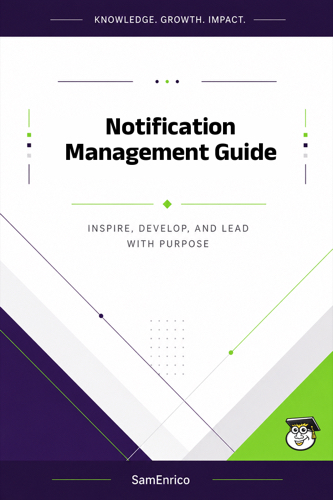
Notification Management Guide eBook
undefined
by Yamamoto Mui
undefined
Formats
Free sample
Chapter 1: The 23-Minute Thief--It begins, as it always does, with a ping.You are in the middle of something. It doesn't matter what—writing an email that requires actual thought, reading a bedtime story to your child, debugging a production error that has nine people waiting on you, or simply staring out a window letting your brain do the deep processing it desperately needs. The ping arrives. Your attention snags on it like a sleeve on a splintered railing. You tell yourself you will just glance.
Just see who it is. Just check if it matters. And then the math begins—the math you did not know you were doing, the math that is stealing your life one notification at a time.The average office worker receives ninety-four notifications per day across all devices. That number comes from a 2022 study by the University of California, Irvine, which has been tracking interruption science for over two decades. Ninety-four interruptions.
Not ninety-four tasks. Not ninety-four emails you chose to read. Ninety-four times that something external reached into your brain and yanked. Now here is the number that should terrify you: after each interruption, it takes an average of twenty-three minutes to return to the original task with the same depth of focus.Twenty-three minutes.Do the multiplication. Ninety-four notifications times twenty-three minutes is 2,162 minutes, or thirty-six hours per week.
That is a full-time job spent just recovering from interruptions, not counting the time spent on the interruptions themselves. You are working a second job called "trying to get back to work," and you are not getting paid for it. This is the math of the twenty-three-minute thief.But here is what the studies also found, and this is where the story gets stranger. The participants in the UC Irvine study did not know they were being interrupted as often as they were. When asked to estimate how many times they shifted attention during a work session, they guessed roughly half the actual number.
The thief is invisible. The cost is hidden. And the designers of your notification systems are counting on both.This chapter is about seeing the thief for the first time. It is about understanding the psychological architecture that makes notifications so effective at capturing you, the neuroscience that explains why you cannot simply "ignore" them, and the real-world costs—in dollars, in relationships, in creative output, and in sanity—that you are paying every single day. The remaining chapters of this book will give you tools, systems, and strategies to fight back.
But first, you have to see the size of the problem. First, you have to meet the thief.The Anatomy of Notification Fatigue There is a moment that every heavy technology user knows. It comes after the hundredth ping of the day, or the thousandth, or the ten-thousandth if you have been in the game long enough. It is not anger. Anger requires energy, and you have none left.
It is not frustration. Frustration implies an expectation that things could be better. No, this moment is something quieter and more dangerous. It is the moment you stop caring.Your phone buzzes. You look at it not with curiosity but with a dull sense of obligation.
You swipe the notification away without reading it. You do not even register what app it came from. A few minutes later, another buzz. Another swipe. Another burial.
This is notification fatigue: the psychological breaking point where users no longer see alerts as helpful tools but as hostile intrusions. At this stage, you are not managing your notifications. You are surviving them.The term "fatigue" is precise here, not metaphorical. Chronic interruption creates measurable cognitive depletion, similar to the exhaustion that follows prolonged mental effort. Every time you shift attention, your brain consumes glucose and depletes neurotransmitters.
After enough shifts, you enter a state that neuroscientists call "directed attention fatigue"—the inability to voluntarily control where you place your focus. You become reactive rather than proactive. The notifications are driving you, not the other way around.I have seen this in every industry I have consulted for. The hospital nurses who stopped hearing the beeps entirely, walking past critical alarms because ninety percent of them were false. The software developers who put their phones in Faraday bags—literal signal-blocking pouches—because they could not trust themselves to ignore a ping.
The high school teachers who reported that their students check phones an average of eleven times during a forty-five minute class, but when asked, those students estimated two or three checks.Fatigue has stages. Early stage: you check every notification because you are afraid of missing something important. Middle stage: you check most notifications but feel irritated while doing so. Late stage: you no longer distinguish between notifications—all of them feel like noise, and you have started leaving your phone in another room, turning off sound entirely, or deleting apps that used to bring you joy. The tragedy of late-stage fatigue is that you lose the good along with the bad.
You mute your team's Slack channel right along with the marketing spam. You silence your partner's text messages because your brain has learned that "buzz" equals "annoyance" regardless of the sender.This is not a failure of willpower. This is a design problem. And like all design problems, it can be solved. But first, we have to understand how we got here.The Dopamine Loop: Why Your Brain Betrays You You have heard of dopamine.
You have probably heard it called the "pleasure chemical," and you have almost certainly heard that your phone exploits it to keep you hooked. But the truth is more interesting and more disturbing than the pop-science version. Dopamine is not primarily about pleasure. It is about anticipation.The discovery came from a series of elegant experiments in the 1980s. Researchers at Cambridge University trained monkeys to expect a reward—a drop of sweet juice—after a light flashed.
They measured dopamine neurons in the monkeys' brains. When the juice arrived, the neurons fired. But something unexpected happened after repeated trials. The neurons stopped firing at the arrival of the juice and started firing at the flash of the light. Dopamine had shifted from reward to prediction.
It was not the pleasure of the juice that excited the monkeys' brains. It was the anticipation of the juice.This is the key to understanding notifications. The ping itself is the light flash. The content of the notification—the message, the like, the update—is the juice. Your brain releases dopamine not when you read the notification but when you hear the ping and wonder what it might be.
The uncertainty is the drug. This is called a variable reward schedule, and it is the most powerful form of behavioral conditioning known to psychology. Slot machines use it. Lotteries use it. And every major technology platform uses it.Here is how the loop works.
Step one: a trigger. Your phone buzzes, or you see a red badge on an app icon. Step two: anticipation. Your brain releases dopamine. You wonder who messaged you, what they said, whether it is good news or bad news.
Step three: reward. You check the notification. Usually, it is nothing. A like on a photo. A mention in a…
This is the end of the free sample. Get the eBook to keep going. Buy now
About this book
Details
- Author
- Yamamoto Mui
- Publisher
- SamEnrico
- Language
- English
- Genre
- Non-Fiction, Self-Help / Technology
- Released
- 2026-06-09
- Pages (approx.)
- 147
- Available as
- eBook, Audiobook

Read better in the ZLOADR app
Your eBooks on your phone or tablet. Sign in with your SamEnrico account and start reading.
More by Yamamoto Mui
 The Guilt Resolution ProtocolYamamoto Mui$11.99
 Pregnancy Loss for SiblingsYamamoto Mui$11.99
 Gambling Addiction in the WorkplaceYamamoto Mui$11.99
 Cocaine Use in Latinx CommunitiesYamamoto Mui$11.99
 SIDS Infant Loss GuideYamamoto Mui$11.99
 Nutrition During WithdrawalYamamoto Mui$11.99
 Gambling Addiction And Impulse ControlYamamoto Mui$11.99
 The Silk Road Bankers: How Merchants and Money Shaped EmpiresYamamoto Mui$11.99
 The Scourge of the Sea: Carthage's Naval Dominance in the First Punic WarYamamoto Mui$11.99
 Freemium Connection Quality DetectionYamamoto Mui$12.99
 Student Hospitality Jobs GuideYamamoto Mui$12.99
 How to Produce Motor Vehicle AmplifiersYamamoto Mui$11.99
You may also like
 Parent Time Apps GuideWoodruff Shiela$11.99
 Chunking Apps GuideSingleton Ada$11.99
 Scripting AppsDias Codi$11.99
 Loneliness and TechnologyEdmiston Isreal$11.99
 Caregiver Technology SolutionsCone Dorcas$11.99
 Habit Apps GuideTejada Dina$11.99
 Resilience Apps GuideFerris Carmelina$11.99
 Remote Work Tool StackHolland Kathy$11.99
 Pain Meditation AppsCroteau Elin$11.99
 Gratitude for TechnologyArreola Brenna$11.99
 Virtual Memory PalacesBillingsley Fe$11.99
 Senior Technology ConfidenceGallant Tonie$11.99