
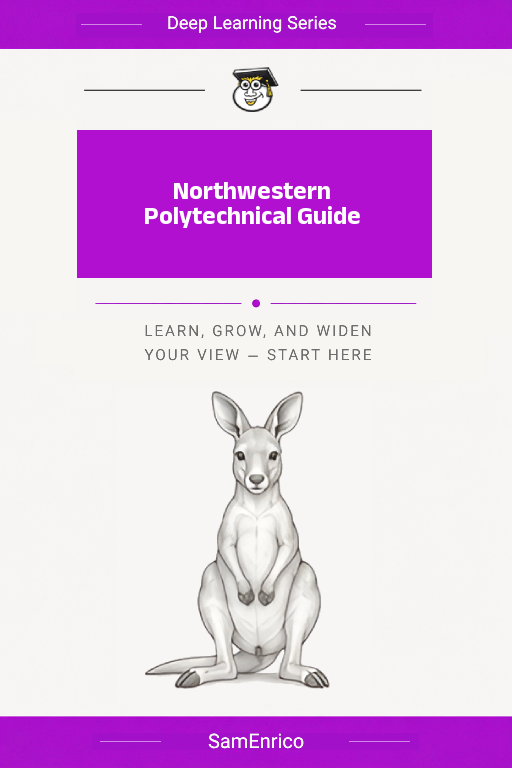
Northwestern Polytechnical Guide eBook
Apply for NPU scholarships in Xi'an for aerospace
by Bertram Hue
Apply for NPU scholarships in Xi'an for aerospace and defense-related programs.
Formats
Free sample
Chapter 1: The Sanctioned Advantage...--Every year, thousands of engineering graduates from across Africa, South Asia, the Middle East, and Latin America type the same desperate search into Google: “Fully funded aerospace master’s China.” The results pages are littered with broken links, outdated forums, and well-meaning but contradictory advice from strangers on Reddit. Buried on page four, after the paid advertisements for expensive study-abroad agencies, sits a link that most people scroll past without a second look: Northwestern Polytechnical University, Xi’an.What you do not know—what this book will spend the next eleven chapters revealing—is that scrolling past that link is one of the most expensive mistakes of your career. This is not hyperbole. This is not motivational speech. This is a financial and professional fact.While your classmates apply to expensive master’s programs in the United States, the United Kingdom, or Australia—programs that will leave them with 50,000to50,000 to 50,000to100,000 in debt and no guarantee of a job—you have the opportunity to receive a world-class aerospace engineering education for exactly zero dollars, zero euros, and zero pounds.
In fact, you will be paid to study. A monthly stipend. Free housing. Tuition eliminated entirely.The catch?The catch is that Northwestern Polytechnical University, known to everyone inside China as NPU, is not a normal university. It is not even a normal Chinese university.
It is a specialized institution with a focused, unambiguous mission: to produce the next generation of engineers for China’s aerospace and defense industries. This mission is not hidden. It is not secret. It is printed on NPU’s official website, repeated in its promotional materials, and embedded in every decision the university makes about admissions, scholarships, and research funding.Yet most international applicants misunderstand what this mission means for them. Some are attracted by the scholarship money but horrified when they realize the research involves military applications.
Others are eager to work on defense projects but have no idea how to position themselves as valuable candidates. Most simply have no reliable information at all.And then there is the sanction.In 2020, the United States Department of Commerce added NPU to its Entity List, a restricted trade blacklist that prohibits American companies from selling certain technologies to the university without government approval. The mainstream narrative, at least in Western media, was that this was a death blow. NPU would lose access to critical software, components, and research collaborations. International students would flee.
The university would wither.None of that happened.Instead, NPU did something characteristically Chinese: it adapted. It replaced American software with domestic alternatives. It deepened partnerships with Russian and European institutions. It doubled down on its core mission. And perhaps most surprisingly, its international enrollment increased.
Students from Pakistan, Kazakhstan, Egypt, Nigeria, Bangladesh, Sri Lanka, and dozens of other countries looked at the sanction and saw not a warning but a signal. If the United States is afraid of NPU, they reasoned, then NPU must be doing something right.That reasoning is correct.This chapter explains why. It covers the history and structure of NPU, the geography of Xi’an’s defense industry, the Three Aviation trifecta that makes NPU unique, and the strategic framing that turns a generic application into a winning one. By the end, you will understand not only what NPU is but also why your future self will thank you for applying.The Three Aviation Trifecta: More Than Aerospace Most universities that claim to specialize in aerospace engineering focus on one thing: airplanes. Maybe rockets, if they are feeling ambitious.
NPU operates on a different scale entirely.The university organizes its research, teaching, and admissions around what it calls the “Three Aviation” trifecta: Aeronautics, Astronautics, and Marine Engineering. At first glance, marine engineering seems out of place. Ships are not aircraft. Submarines do not fly. But this misses the point entirely.
The Three Aviation trifecta is not about the vehicles themselves. It is about the environments in which those vehicles operate and the engineers who must understand all three.Consider a modern aircraft carrier. It launches fighter jets into the air (aeronautics). It carries missiles that can be fired into space to intercept satellites (astronautics). It floats on the ocean (marine engineering).
An engineer who designs the catapult system for that carrier needs to understand the aerodynamics of the jet, the orbital mechanics of the missile, and the naval architecture of the ship. NPU trains that engineer.Consider a hypersonic glide vehicle. It launches on a rocket (astronautics), re-enters the atmosphere and flies like an aircraft (aeronautics), and may be deployed from a submarine (marine engineering). Three domains, one vehicle. NPU trains the engineers who make it work.Consider an autonomous underwater drone.
It navigates using principles of marine engineering. It communicates with satellites using astronautics. It may launch its own small aerial drones using aeronautics. The boundaries between domains are dissolving, and NPU is one of the few universities in the world that has organized itself around this reality.This has concrete implications for your application. You do not need to be an expert in all three domains.
You need to understand how your domain connects to the other two. A materials scientist working on carbon-fiber composites should be able to explain how the same composite could be used in an aircraft wing (aeronautics), a satellite body (astronautics), and a submarine hull (marine engineering). A propulsion engineer working on rocket engines should understand how the same combustion principles apply to jet engines and underwater turbines. A software engineer working on guidance systems should see the common algorithms across missiles, drones, and autonomous ships.The successful NPU applicant demonstrates this connective thinking. The unsuccessful applicant talks only about airplanes.NPU by the Numbers: Why Size Matters To understand NPU’s capabilities, it helps to look at the numbers.
These figures are drawn from the university’s official reports and verified through cross-referencing with Chinese government publications.NPU enrolls approximately 36,000 students, of whom about 6,000 are international. This ratio—approximately one international student for every five domestic students—is higher than at most Chinese defense universities. The international community is large enough to be supportive but small enough that you will not feel lost in a crowd. Among the international students, the largest contingents come from Pakistan, Kazakhstan, Egypt, Nigeria, Bangladesh, Sri Lanka, Thailand, Vietnam, and Russia. Smaller numbers come from countries across Africa, the Middle East, and Latin America.The faculty numbers approximately 3,800, of whom about 1,200 are full professors with doctoral advising privileges.
The student-to-faculty ratio of roughly 9.5 to 1 is excellent by international standards, meaning you will have access to your professors in ways that are simply not possible at larger, more comprehensive universities.The research budget exceeds 5 billion RMB annually, or approximately 700 million US dollars at current exchange rates. For comparison, this is larger than the research budgets of most American public universities. The money flows into defense-related projects, which means you will work on well-funded problems with real-world applications.NPU has produced 21 academicians of the Chinese Academy of Engineering, which is an extraordinarily high number for a university of its size. More relevant to you: NPU graduates hold senior engineering positions…
This is the end of the free sample. Get the eBook to keep going. Buy now
About this book
Details
- Author
- Bertram Hue
- Publisher
- SamEnrico
- Language
- English
- Genre
- Non-Fiction, Student's Shortcut, NPU
- Released
- 2026-05-30
- Pages (approx.)
- 145
- Available as
- eBook, Audiobook

Read better in the ZLOADR app
Your eBooks on your phone or tablet. Sign in with your SamEnrico account and start reading.
More by Bertram Hue
 Name Repetition InfluenceBertram Hue$11.99
 The Factory Sweatshop SlaveBertram Hue$11.99
 Panic Disorder Support GroupsBertram Hue$11.99
 Caregiving For Parent With Mixed DementiaBertram Hue$11.99
 German Defeat Verdun AnalysisBertram Hue$11.99
 Typhoon Shelter SeekingBertram Hue$11.99
 The One Day at a Time ManualBertram Hue$11.99
 Shopping Addiction Support GroupsBertram Hue$11.99
 Blood and Iron: The Forgotten Surgeon of the CrusadesBertram Hue$11.99
 The Last Call: How a Single Phone Line Changed the WorldBertram Hue$11.99
 How to Produce Tennis Ball SaversBertram Hue$11.99
 International Franchise Insurance RequirementsBertram Hue$12.99