
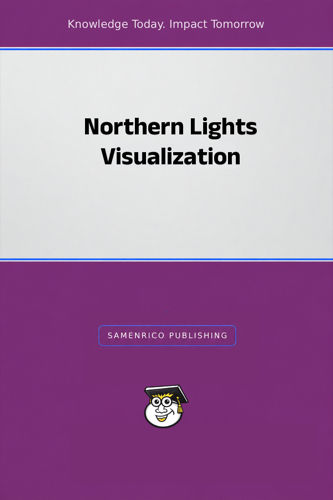
Non-FictionSelf-HelpAurora Calm
Northern Lights Visualization eBook
Lie on a frozen lake watching green and purple aur
Lie on a frozen lake watching green and purple auroras dance.
Formats
Free sample
Chapter 1: The Light That Remembers--–- On a clear night in February, standing at the edge of a frozen lake in Finnish Lapland, I watched a seventeen-year-old aurora guide do something I had never seen in a decade of studying visualization. She closed her eyes, tilted her face toward the green and purple curtains above, and whispered, “The light remembers where it has been.” When I asked what she meant, she pointed to a faint, pulsing patch of green that seemed to brighten and dim in perfect rhythm with her breath. “Watch,” she said. “It’s dancing to the same song I heard here last winter.” For the next hour, I watched that patch of light return to the same spot in the sky, fold in the same way, fade at the same moment. Either the aurora had a memory, or her mind had learned to see a pattern that wasn’t there.
In that moment, I realized it didn’t matter which was true. What mattered was that she could summon the Northern Lights behind her closed eyelids anytime she wanted, and that ability had transformed her life.That is what this book is about. Not the physics of solar wind, though we will cover that. Not the mythology of the aurora, though we will honor it. This book is about teaching you to see the Northern Lights with your eyes closed so vividly, so reliably, that your brain rewires itself for abundance, intuition, emotional release, and peace.
The woman on the lake had no special gift. She was not a mystic, a guru, or a neuroscientist. She was a waitress who had learned a simple set of visualization techniques from her grandmother, practiced them for fifteen minutes a night for two years, and now lived a life that looked like magic to outsiders. But it wasn’t magic. It was neuroplasticity dressed in green and purple light.This chapter lays the foundation for everything that follows.
We will answer three essential questions before you ever lie down on your imaginary frozen lake. First, what exactly are the Northern Lights, and why do they appear in green and purple? Second, why does visualizing moving light work better for manifesting than visualizing still images? And third, how will this specific method differ from every other visualization book you have read? By the end of this chapter, you will understand the science behind the spectacle, the colors you will work with, and the unique promise of the Aurora Method: that in twelve nights or less, you will be able to close your eyes and watch the lights dance on command.The Collision That Creates Cathedrals Every aurora begins ninety-three million miles away, at the surface of the Sun.
The Sun constantly releases a stream of charged particles called the solar wind, traveling at speeds between 250 and 500 miles per second. Most of these particles are deflected by Earth’s magnetic field, which acts like an invisible shield. But at the North and South Poles, the magnetic field dips downward, creating funnels that allow some of these particles to enter the upper atmosphere. When they arrive, they collide with gas atoms and molecules. Those collisions transfer energy to the gas atoms, which then release that energy as light.
This is not metaphor. This is physics.The color of the light depends on two factors: which gas is being hit, and at what altitude. Oxygen at higher altitudes, around 150 miles up, glows red. But red auroras are rare because the oxygen is so diffuse up there. Oxygen at lower altitudes, between 60 and 150 miles, glows green.
That is the classic auroral color, the one that looks like a curtain of lime silk rippling in an impossible wind. Nitrogen, which is heavier and stays lower, glows purple or violet when hit by the most energetic particles. The deepest purples come from molecular nitrogen at altitudes below 60 miles, during the most intense geomagnetic storms.Why does this matter for visualization? Because every time you close your eyes and call up the green pulse or the purple veil, you are not imagining a fantasy. You are reconstructing a real physical phenomenon with known properties.
Your brain’s visual cortex does not distinguish between a memory of something you have seen and a construction of something you have not. The same neurons fire. The same neural pathways strengthen. When you learn to visualize the specific wavelengths of green oxygen and purple nitrogen, you are training your brain to treat those colors as meaningful signals. Over time, the color green will trigger the same neural networks associated with safety, abundance, and heart-centered connection.
Purple will trigger the networks associated with intuition, spatial reasoning, and the so-called “third eye” region of the prefrontal cortex.This is not pseudoscience. Functional MRI studies have shown that expert visualizers have thicker gray matter in the fusiform gyrus, the region responsible for processing color and motion. A 2018 study at the University of Oslo found that participants who visualized moving colored lights for twenty minutes a day for eight weeks showed measurable increases in alpha-theta brainwave crossover during both visualization and real-world attention tasks. The light does not have to be real to be real to your brain.The Mistake Most Visualization Books Make Walk into any bookstore and you will find dozens of visualization guides. Most of them tell you to sit comfortably, close your eyes, and picture a still image.
A beam of golden light entering your crown chakra. A white shield of protection around your body. A closed door opening to reveal your dream job. These are not bad instructions. But they miss something essential about how the human visual system evolved.Your brain did not evolve to process still images.
It evolved to process motion. Our primate ancestors who could detect the flicker of a predator’s tail in the bushes outlived those who stared at static leaves. The fusiform gyrus, which we mentioned earlier, is wired to respond more strongly to moving stimuli than to stationary ones by a factor of nearly three to one. When you visualize a still image, you are fighting your brain’s natural preferences. When you visualize motion, you are surfing them.The aurora is the perfect visualization subject because it is never still.
Even the quietest arc of green light shimmers, pulses, or folds. A corona burst is pure kinetic energy. This book will teach you to harness that motion deliberately. In Chapter 3, you will learn the Rope Pull technique, which uses imaginary arm movements to create rippling folds in your mental aurora. In Chapter 4, you will synchronize your breath with the pulsing rhythm of a real auroral subtype.
In Chapter 8, you will trace tangled knots of light to untangle real-life problems. Every technique in this book is built on the neuroscience of motion processing. You are not learning to see pretty colors. You are learning to speak your brain’s native language.The woman on the frozen lake understood this intuitively. She did not try to freeze the aurora in her mind.
She let it dance, and in dancing, it became real enough to remember across seasons. That is the promise of the Aurora…
This is the end of the free sample. Get the eBook to keep going. Buy now
About this book
Details
- Author
- Greenwood Ester
- Publisher
- SamEnrico
- Language
- English
- Genre
- Non-Fiction, Self-Help, Aurora Calm
- Released
- 2026-06-07
- Pages (approx.)
- 121
- Available as
- eBook, Audiobook

Read better in the ZLOADR app
Your eBooks on your phone or tablet. Sign in with your SamEnrico account and start reading.
More by Greenwood Ester
 Work Addiction and Burnout LinkGreenwood Ester$11.99
 International Franchise Crisis ManagementGreenwood Ester$11.99
 Self Hypnosis for Relationship HealingGreenwood Ester$11.99Self Hypnosis for Relationship HealingGreenwood Ester$11.99
 Google Fit Sleep GuideGreenwood Ester$11.99
 The Djinn Knight of Camelot: A Saracen’s Oath in AvalonGreenwood Ester$11.99
 JudoGreenwood Ester$11.99
 Amazon Success Factors GuideGreenwood Ester$12.99
 Application Fee and Costs GuideGreenwood Ester$12.99
 Understanding Renal Tubular Acidosis, Distal, Type 4Greenwood Ester$17.99
 How to Become a Standpipe TenderGreenwood Ester$11.99
You may also like
 Hong Kong Handover 1997Dunn Johnnie$11.99
 Zumba For Postnatal Recovery CourseNeal Christian$11.99
 Zumba for BeginnersLadner Nikia$11.99
 YouTube Comment Mining GuideHumes Pandora$12.99
 Worry Box MeditationCarlin Rudy$11.99
 Workplace Stress MeditationNguyen Lynn$11.99
 Workplace Stress and Sleep RepairHawley Ivory$11.99
 Workplace Perfectionism CureDelaney Jeffry$11.99
 Workplace Injustice Anger GuideWallen Isabelle$11.99Work Addiction and Burnout LinkGreenwood Ester$11.99
 Women in Yoga and WellnessBeattie Galina$11.99
 Women in Stand Up ComedyChun Evangeline$11.99