
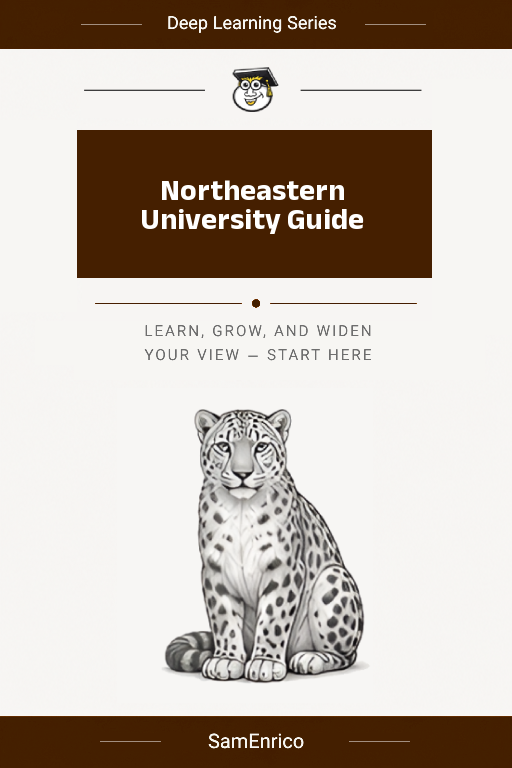
Non-FictionStudent's ShortcutNortheastern
Northeastern University Guide eBook
Complete Northeastern's Align or Data Science cert
Complete Northeastern's Align or Data Science certificates with co-op opportunities.
Formats
Free sample
Chapter 1: The Permission Slip--–- Emma had never written a line of code in her life. She was 31 years old, an art history major turned museum fundraiser, and she had just spent twenty minutes crying in her car outside Northeastern's Boston campus. She was convinced she had made a catastrophic mistake. The acceptance letter to the Align program had felt like a miracle three months ago. Now, sitting in the parking lot, she was certain they would discover their error on the first day of class.
The voice in her head was relentless: You don't belong here. Everyone else probably built their first app when they were twelve. You're going to be the oldest person in the room. You're going to fail.Three years later, Emma accepted a role as a machine learning engineer at a computer vision startup, building systems that automatically tag and categorize artwork for major museums. Her starting salary was 175,000.Herformercolleaguesinmuseumdevelopmentearned175,000.
Her former colleagues in museum development earned 175,000.Herformercolleaguesinmuseumdevelopmentearned65,000. She now manages a team of four engineers, two of whom have undergraduate degrees in computer science from top-tier universities. They come to her for guidance on product strategy and client communication. She comes to them for code reviews. "The degree got me in the door," she told me.
"But my art history background is why I got promoted."This chapter is for everyone who feels like Emma. It is for the English major who thinks math is a foreign language. It is for the nurse who has never used the command line. It is for the teacher who still prints out articles because the idea of learning Python feels like learning Mandarin. It is for the accountant who can build complex Excel models but freezes at the word "algorithm." This chapter is your permission slip to stop wondering if you are smart enough and start acting like you are.The Cognitive Diversity Thesis: Why Tech is Desperate for You The most common question prospective Align students ask is not "How much does it cost?" or "How long does it take?" It is, almost without exception: "Am I smart enough?"The premise behind that question is flawed.
It assumes that tech is a meritocracy of raw intelligence measured in IQ points and calculus scores. It assumes that the people who succeed in computer science are a narrow band of prodigies who have been coding since middle school. It assumes that if you did not take AP Computer Science or major in engineering, you are already behind and always will be.Every single one of those assumptions is false.Northeastern's Align program was built on a radical premise that has since been validated by over a decade of placement data: the tech industry's diversity problem is not just about race or gender. It is about cognitive diversity. Traditional computer science education selects for a very specific type of thinker—one who excels at abstract reasoning, mathematical formalism, and solitary problem-solving.
Those are valuable skills. But they are not the only skills that build great technology.The Align program was designed specifically for students who bring different cognitive tools: narrative thinking (the ability to tell a compelling story about user needs), pattern recognition across domains (connecting a problem in healthcare to a solution in logistics), stakeholder management (understanding what non-technical colleagues actually need), and the sheer grit that comes from having built a career in a completely different field before deciding to start over.A 2022 internal study by Northeastern's Khoury College tracked 500 Align graduates over five years. The findings were striking: Align graduates were promoted to senior roles 15% faster than their peers who entered the industry through traditional CS bachelor's degrees. The reason was not technical superiority—traditional CS graduates generally had stronger algorithmic fundamentals. The reason was that Align graduates were better at everything else: gathering requirements from confused clients, documenting their code for future maintainers, explaining technical trade-offs to non-technical stakeholders, and managing up to executives who did not understand the details of their work.Tech companies are not charities.
They are not offering six-figure salaries to Align graduates out of kindness or a desire for virtue signaling. They are offering those salaries because they have learned that a team composed entirely of traditional CS graduates builds elegant, efficient, unshippable software that nobody can use. A team that includes career switchers builds software that actually solves real human problems.Debunking the Math Genius Myth Let us name the fear explicitly. When prospective students describe themselves as "not a math person," they almost always mean one of two things: (1) they struggled with calculus, or (2) they did not take calculus at all. Neither disqualifies you from the Align program.Here is the complete list of mathematical prerequisites for the Align bridge courses: college algebra, basic probability (what is the chance of rolling a six on a fair die?), and propositional logic (if A implies B, and B is false, what can you conclude about A?).
That is it. You do not need calculus. You do not need linear algebra. You do not need differential equations. Those subjects appear in later electives, and you can learn them then if you choose to specialize.
They are not gatekeepers to the program.Let me be even more specific about what you actually need to know on day one of the bridge semester:Arithmetic: You should be comfortable with fractions, percentages, and basic order of operations.Algebra: You should understand variables, functions, and how to solve for x in equations like 2x + 5 = 13.Logic: You should understand "and," "or," "not," and the basic idea of implication (if-then).Probability: You should understand what a probability is (a number between 0 and 1 representing likelihood) and how to calculate simple combinations (how many ways to choose 2 items from 5?).If you have these skills, you are mathematically prepared for the Align program. Everything else—linear algebra for machine learning, discrete math for algorithms, statistics for data science—is taught from the ground up in the program itself.The "math genius" myth persists because computer science has a branding problem. The field was built by mathematicians and physicists, and the culture has never fully shed its reverence for pure abstraction. But the day-to-day work of most software engineers and data scientists involves far less advanced math than outsiders imagine. You will spend more time debugging why an API call is failing than you will solving integrals.
You will spend more time reading other people's code than you will deriving formulas. The math is a tool, not the job.The Real Admissions Criteria: What They Actually Look For If prior coding experience is not required and advanced math is not required, what does the admissions committee look for?After reviewing dozens of successful Align applications and interviewing former admissions staff, I have identified four criteria that consistently predict acceptance.Criterion One: Evidence of Grit in a Different Domain The admissions committee wants to see that you have struggled with something hard before and won. They do not care if that "something hard" was a Ph D in chemistry or a decade of teaching middle school. They care about the pattern: you faced a steep learning curve, you persisted through frustration, and you emerged competent.…
This is the end of the free sample. Get the eBook to keep going. Buy now
About this book
Details
- Author
- Stoddard Armand
- Publisher
- SamEnrico
- Language
- English
- Genre
- Non-Fiction, Student's Shortcut, Northeastern
- Released
- 2026-05-29
- Pages (approx.)
- 144
- Available as
- eBook, Audiobook

Read better in the ZLOADR app
Your eBooks on your phone or tablet. Sign in with your SamEnrico account and start reading.
More by Stoddard Armand
 Legal Consequences Navigation GuideStoddard Armand$11.99
 Gambling Among SeniorsStoddard Armand$11.99
 Broken Apart Then Whole Again MemoirStoddard Armand$11.99
 High School Pressure CookerStoddard Armand$11.99
 The Hotel Worker CaptiveStoddard Armand$11.99
 The Worth Beyond Wrinkle PrimerStoddard Armand$11.99
 Meditation For OCD IntrusionsStoddard Armand$11.99
 Early Retirement for WorkaholicsStoddard Armand$11.99
 The Last Scroll of the Library of AlexandriaStoddard Armand$11.99
 The Blood and the Blade: The Birth of Modern SurgeryStoddard Armand$11.99
 Growing DahliaStoddard Armand$11.99
 The Mineral Guide to Agate (Variety of Quartz)Stoddard Armand$11.99
You may also like
 Hong Kong Handover 1997Dunn Johnnie$11.99
 Zumba For Postnatal Recovery CourseNeal Christian$11.99
 Zumba for BeginnersLadner Nikia$11.99
 YouTube Comment Mining GuideHumes Pandora$12.99
 Worry Box MeditationCarlin Rudy$11.99
 Workplace Stress MeditationNguyen Lynn$11.99
 Workplace Stress and Sleep RepairHawley Ivory$11.99
 Workplace Perfectionism CureDelaney Jeffry$11.99
 Workplace Injustice Anger GuideWallen Isabelle$11.99
 Work Addiction and Burnout LinkGreenwood Ester$11.99
 Women in Yoga and WellnessBeattie Galina$11.99
 Women in Stand Up ComedyChun Evangeline$11.99