
Non-FictionSelf-HelpInterpersonal Skills
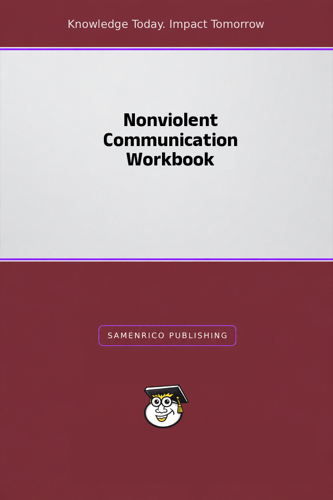
Nonviolent Communication Workbook eBook
Interactive exercises to transform blame and criti
by Combs Wen
Interactive exercises to transform blame and criticism into honest expression.
Formats
Free sample
Chapter 1: The Two Languages--Have you ever said something you regretted before the sentence was even finished? That moment when your mouth opens, the words come out—blaming, accusing, labeling—and you feel the other person shut down like a door slamming. Their face goes blank. Their arms cross. Or worse, they fire back with an attack of their own, and suddenly you are both trapped in a fight that nobody wanted and nobody can win.This book is about what happens in that split second before the words come out.
It is about retraining your brain to see blame not as a weapon but as a translation problem. And it starts with a simple but radical idea: there are two languages we speak as human beings, and most of us have been fluent in the wrong one our entire lives.The first language—the one we learn from culture, from families, from television, from every argument we have ever witnessed—is what we will call Jackal Language. It is the language of blame, of diagnosis, of "you always" and "you never." It is the language that sounds like: "You are so selfish." "What is wrong with you?" "Why can't you just be normal?" "You should have known better."The second language—the one this book will teach you—is Giraffe Language. It is the language of honest expression, of feelings and needs, of requests instead of demands. It sounds like: "When I saw the dishes in the sink this morning, I felt frustrated because I need order in our shared spaces.
Would you be willing to load the dishwasher before you leave for work?"Notice the difference. The first sentence ("You are so lazy") is a diagnosis. It is a judgment about the other person's character. The second sentence is an observation about a specific event, a feeling about that event, a need that is not being met, and a request for a specific action. One sentence starts a fight.
The other starts a conversation.But here is what most people get wrong about this distinction. They think the goal is to become "nice." To suppress their anger. To pretend they don't have judgments. That is not what this book teaches. The goal is not to stop having judgments—you will have them anyway.
The goal is to translate them. To hear the Jackal in your head and say, "Ah, there is a Jackal. What need is it trying to express? What Giraffe words would actually help me get what I want?"This chapter introduces the two languages, helps you identify which one you speak by default, and gives you your first tool: the Judgment Inventory. This inventory will be the raw material you return to throughout the entire workbook.
Do not skip it. Do not rush it. The quality of your work in Chapter 1 determines the quality of everything that follows.The Problem with Blame (It Has Never Worked, and It Never Will)Let us be honest with each other. You have tried blame. You have tried telling someone "You are so thoughtless" or "You never listen" or "What is wrong with you?" And how did that work?
Did the person suddenly become thoughtful? Did they start listening? Did they thank you for your insightful diagnosis and immediately change their behavior?No. They got defensive. Or they got angry.
Or they shut down. Or they blamed you back.Blame has never, in the history of human relationships, successfully changed anyone's behavior in a lasting way. Not once. Why? Because blame is an attack on the other person's character.
And when someone feels attacked, their nervous system does one of three things: fight (attack back), flight (shut down or leave), or freeze (go silent). None of those responses include "thank you for that helpful feedback, I will now change everything about myself."Think about the last time someone blamed you. Maybe your partner said, "You are so inconsiderate." What happened inside your body? Did your chest tighten? Did your jaw clench?
Did your mind immediately start generating counter-arguments: "Oh, I am inconsiderate? What about the time you forgot my birthday? What about the time you left me waiting for forty-five minutes?" You did not think, "You know, you are right. I am inconsiderate. Let me reflect on that."Blame triggers defensiveness.
Defensiveness triggers counter-blame. Counter-blame triggers escalation. And escalation triggers the death of connection. This is not a moral failure on your part. This is neuroscience.
The human brain is wired to treat social threats (like blame) the same way it treats physical threats (like a predator). Your amygdala hijacks your prefrontal cortex. You lose access to the part of your brain that thinks creatively, empathizes, or solves problems. You are now in survival mode. And survival mode is not a good place to have a conversation.So if blame has never worked—and you already know this because you have tried it hundreds of times with the same results—why do we keep doing it?
Because it feels good in the moment. For about half a second, releasing blame gives you a hit of dopamine. You feel righteous. You feel powerful. You feel like you have identified the problem and the problem is them.But that feeling is a trap.
It is the emotional equivalent of eating sugar when you are hungry. It gives you a quick spike and then a crash. And the crash is the defensiveness, the fight, the distance, the loneliness.This book is for people who are ready to stop eating sugar and start eating vegetables. It is less immediately satisfying, but it actually nourishes you.Introducing Jackal Language (The Language of Diagnosis)Jackal Language gets its name from the jackal—an animal that hunts close to the ground, attacks from behind, and is known for its sharp, aggressive bark. Jackal Language is the default language of most human cultures.
It is the language of:Moralistic judgments: "He is a bad person." "She is unethical." "They are wrong."Comparisons: "Why can't you be more like your brother?" "You are not as smart as you think you are." "Everyone else manages to do this."Diagnoses: "You are passive-aggressive." "You have anger issues." "You are codependent."Denials of responsibility: "I had to do it." "You made me angry." "I don't have a choice."Demands: "You need to do this." "You should have known better." "If you loved me, you would..."Notice what all of these have in common. They are statements about what the other person is rather than statements about what you need. They are static. They are final. They leave no room for negotiation, no room for growth, no room for the other person to be a complex human being who sometimes makes mistakes and sometimes does wonderful things.Jackal Language turns people into characters.
"He is lazy" turns a person who has not done the dishes into a permanent identity. The moment you say "lazy," you have stopped being curious. You have stopped asking questions like: "What is going on for him today? Is he exhausted? Is he overwhelmed?
Is he avoiding something?" You have replaced curiosity with certainty. And certainty is the enemy of connection.Here is the most…
This is the end of the free sample. Get the eBook to keep going. Buy now
About this book
Details
- Author
- Combs Wen
- Publisher
- SamEnrico
- Language
- English
- Genre
- Non-Fiction, Self-Help, Interpersonal Skills
- Released
- 2026-06-09
- Pages (approx.)
- 151
- Available as
- eBook, Audiobook

Read better in the ZLOADR app
Your eBooks on your phone or tablet. Sign in with your SamEnrico account and start reading.
More by Combs Wen
 Psychological Safety Creativity GuideCombs Wen$11.99
 Migraine Rescue Medications GuideCombs Wen$11.99
 Buy Me a Coffee StoryCombs Wen$11.99
 The Gift of TimeCombs Wen$11.99
 The Skin Stress Reaction HandbookCombs Wen$11.99
 Blue Zone Olive OilCombs Wen$11.99
 The Wellness Retreat PrisonCombs Wen$11.99
 Triphasic Sleep Nap ScheduleCombs Wen$11.99
 The Radiocarbon Revolution: Unlocking the Secrets of the Pacific's Lost CivilizationsCombs Wen$11.99
 The Golden Age of Athens: Socrates, Plato, and the Birth of Western ThoughtCombs Wen$11.99
 Operation Midnight Sun: The Secret Cyberwar That Almost Changed a U.S. ElectionCombs Wen$11.99
 Career Development and Employability SkillsCombs Wen$11.99
You may also like
 Hong Kong Handover 1997Dunn Johnnie$11.99
 Zumba For Postnatal Recovery CourseNeal Christian$11.99
 Zumba for BeginnersLadner Nikia$11.99
 YouTube Comment Mining GuideHumes Pandora$12.99
 Worry Box MeditationCarlin Rudy$11.99
 Workplace Stress MeditationNguyen Lynn$11.99
 Workplace Stress and Sleep RepairHawley Ivory$11.99
 Workplace Perfectionism CureDelaney Jeffry$11.99
 Workplace Injustice Anger GuideWallen Isabelle$11.99
 Work Addiction and Burnout LinkGreenwood Ester$11.99
 Women in Yoga and WellnessBeattie Galina$11.99
 Women in Stand Up ComedyChun Evangeline$11.99