
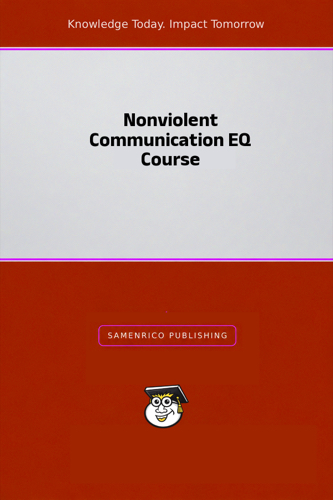
Non-FictionSelf-HelpNonviolent Communication
Nonviolent Communication EQ Course eBook
Integrates Rosenberg's NVC framework with emotiona
by Lira Nakita
Integrates Rosenberg's NVC framework with emotional intelligence principles.
Formats
Free sample
Chapter 1: The Two Animals Within–- Every time you open your mouth to speak during a conflict, you make a choice. You may not feel like you are choosing. It may feel like the words simply explode out of you—a hot rush of blame, defense, or silence that leaves you wondering, ten minutes later, why you said what you said. But neuroscience is clear: between the moment of trigger and the moment of speech, there is always a gap. It may be a fraction of a second.
But it is there. And in that gap, one of two animals wakes up and takes over.The first animal is the Jackal.The Jackal is cunning, territorial, and fast. It lives on the savannah of your survival brain, scanning constantly for threats. Its ears are tuned to criticism. Its eyes track for disrespect.
Its entire nervous system is wired for one purpose: to protect you from danger by either attacking or fleeing. When the Jackal speaks, it sounds like blame: "You always do this." It sounds like diagnosis: "You're so selfish." It sounds like moral judgment: "That's wrong." It sounds like the silent treatment, which is the Jackal's version of playing dead. The Jackal believes, with every fiber of its being, that the way to get safety, respect, and love is to prove that the other person is wrong.The second animal is the Giraffe.The Giraffe has the largest heart of any land animal—a heart that weighs twenty-five pounds and pumps blood two meters up the neck to the brain. Marshall Rosenberg, the founder of Nonviolent Communication, chose the Giraffe as his symbol for compassionate communication because a Giraffe can digest thorns. When the Giraffe speaks, it does not take attacks personally.
It hears the need beneath the blame. It sees the fear beneath the anger. The Giraffe's long neck represents a wider perspective—the ability to see the whole system, not just the immediate threat. When the Giraffe speaks, it sounds like curiosity: "Are you feeling hurt because you need understanding?" It sounds like honesty without brutality: "When I hear that, I feel scared because I need safety." It sounds like a request: "Would you be willing to sit with me for ten minutes?"Here is the truth that most self-help books will not tell you: you will never kill the Jackal. You are not supposed to.
The Jackal is not your enemy. It is your ancient protector, forged in the fires of human evolution. Ten thousand years ago, the Jackal kept you alive by reacting instantly to rustling grass that might hide a predator. Today, the Jackal reacts instantly to a text message left on read, a partner's sigh, a coworker's tone. The Jackal cannot tell the difference between a physical threat and a social one.
It treats a slight as a lion. And it reacts in twenty milliseconds—far faster than your conscious brain can intervene.This chapter is not about killing the Jackal. It is about learning to recognize when the Jackal is driving, pausing long enough to let the Giraffe wake up, and then consciously choosing which animal gets to speak. This is the essence of Emotional Intelligence (EQ) as defined by Daniel Goleman: self-awareness to know which animal is active, self-regulation to pause before reacting, empathy to hear the Jackal in others, and social skill to respond in Giraffe even when every cell of your body wants to bite.By the end of this chapter, you will take the EQ-NVC Audit, a twenty-question diagnostic that reveals whether you are speaking Giraffe while thinking Jackal—a phenomenon we call Stealth Jackal. You will learn the neuroscience of the amygdala hijack.
And you will receive your first tool: the Amygdala Warning Card, a physical reminder to pause before the Jackal speaks. This is not abstract theory. This is the first step in rewiring your nervous system for compassion.The Jackal's Playbook: How Blame Becomes Habit Let us begin by listening to the Jackal. Not in someone else's voice—in your own. Think of the last conflict you had.
It could have been with a partner, a child, a parent, a coworker, or the driver who cut you off in traffic. Now, recall what you said. Or, even more revealing, recall what you wanted to say. The Jackal's playbook contains a handful of classic scripts. How many of these sound familiar?Diagnosis: "You're so lazy." "You're being passive-aggressive." "You have anger issues." Diagnosis is when you tell someone what they are, as if you have x-ray vision into their character.
The Jackal loves diagnosis because it positions you as the expert and the other as the problem.Moral Judgment: "That's wrong." "You shouldn't do that." "It's not fair." Moral judgment is when you hold up your personal values as universal law. The Jackal uses this to recruit the weight of the universe to your side.Blame: "This is your fault." "You made me angry." "If you hadn't done that, I wouldn't have reacted." Blame is the Jackal's masterpiece. It simultaneously discharges your discomfort and assigns responsibility to someone else. The problem with blame is that it never meets the need you actually have. You cannot blame your way into connection.Comparison: "Why can't you be more like your sister?" "My last partner never did this." "Everyone else manages just fine." Comparison is the Jackal's way of saying "you are not enough" without taking responsibility for saying it.Demand: "You need to stop that right now." "If you do that again, I'm leaving." "You should apologize." Demands are requests that have been weaponized.
They leave no room for a genuine "no." And because they leave no room, they trigger rebellion, compliance without connection, or silent withdrawal.The Silent Treatment: Sometimes the Jackal says nothing at all. Silence can be a weapon—a withdrawal of presence designed to punish. The Jackal believes that if it disappears, the other will feel the loss and change their behavior. This almost never works. It almost always escalates.Here is what the Jackal does not understand: every single one of these strategies feels effective in the moment.
When you blame someone, you feel a rush of righteousness. When you diagnose them, you feel smart. When you give the silent treatment, you feel powerful. But these feelings are not signals of effectiveness. They are signals of discharge—the nervous system releasing pressure.
The Jackal confuses discharge with resolution. The Giraffe knows that true resolution leaves both parties with their dignity intact.The Giraffe's Perspective: What Compassion Actually Sounds Like If the Jackal's language is familiar, the Giraffe's language may feel foreign. This is not because it is unnatural. It is because most of us were raised in Jackal cultures—homes, schools, and workplaces where blame, judgment, and demand were the default. The Giraffe speaks a different grammar.
Here is how the Giraffe handles the same situations that trigger the Jackal.Instead of diagnosis ("You're so lazy"), the Giraffe makes observations: "I notice that the dishes have been in the sink since yesterday." Observations are video-camera descriptions. They can be verified by anyone. They do not attack identity.Instead of moral judgment ("That's wrong"), the Giraffe…
This is the end of the free sample. Get the eBook to keep going. Buy now
About this book
Details
- Author
- Lira Nakita
- Publisher
- SamEnrico
- Language
- English
- Genre
- Non-Fiction, Self-Help, Nonviolent Communication
- Released
- 2026-06-06
- Pages (approx.)
- 148
- Available as
- eBook, Audiobook

Read better in the ZLOADR app
Your eBooks on your phone or tablet. Sign in with your SamEnrico account and start reading.
More by Lira Nakita
 CrossFit Rope ClimbsLira Nakita$11.99
 GoodNotes Reminder SystemLira Nakita$11.99
 Small Talk for Widows and WidowersLira Nakita$11.99
 Math Formula MemoryLira Nakita$11.99
 Coworker Interruption Stoppage GuideLira Nakita$11.99
 The Foster Care to TraffickingLira Nakita$11.99
 The Clove Cigarette QuitLira Nakita$11.99
 Twin Loss DeathLira Nakita$11.99
 The Great Cartographic Heist: How a Map Redrew a NationLira Nakita$11.99
 The Silent Scream: The Forgotten Patients of Pennsylvania's Farview State HospitalLira Nakita$11.99
 Ironclads and Iron Will: The Naval War That Split a NationLira Nakita$11.99
 Growing Hedyscepe (Umbrella Palm)Lira Nakita$11.99
You may also like
 Hong Kong Handover 1997Dunn Johnnie$11.99
 Zumba For Postnatal Recovery CourseNeal Christian$11.99
 Zumba for BeginnersLadner Nikia$11.99
 YouTube Comment Mining GuideHumes Pandora$12.99
 Worry Box MeditationCarlin Rudy$11.99
 Workplace Stress MeditationNguyen Lynn$11.99
 Workplace Stress and Sleep RepairHawley Ivory$11.99
 Workplace Perfectionism CureDelaney Jeffry$11.99
 Workplace Injustice Anger GuideWallen Isabelle$11.99
 Work Addiction and Burnout LinkGreenwood Ester$11.99
 Women in Yoga and WellnessBeattie Galina$11.99
 Women in Stand Up ComedyChun Evangeline$11.99