
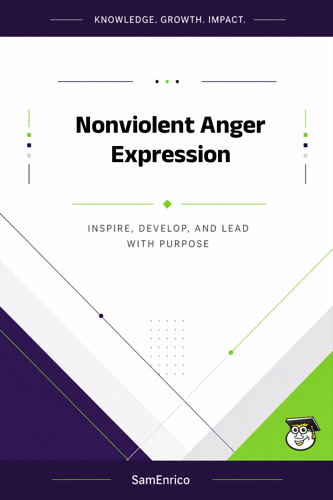
Nonviolent Anger Expression eBook
Express anger assertively without blame or aggress
by Poe Brook
Express anger assertively without blame or aggression using I feel statements.
Formats
Free sample
Chapter 1: The Dashboard Warning--–- The first time Daniel threw a chair across the break room, he was certain his coworker deserved it. Mark had been stealing his ideas for six months—presenting them in meetings as if they were his own, smiling at Daniel afterward, clapping him on the shoulder like they were old friends. Daniel said nothing. He swallowed each incident like a stone, and over time the stones piled into a wall. The day Mark took credit for the quarterly report Daniel had stayed up until 2 AM to finish, something inside Daniel did not snap so much as it exploded.
He stood up, his chair screeching against the floor, grabbed the nearest object—a lightweight office chair, not the heavy wooden one, mercifully—and hurled it across the room. It bounced off the far wall, missing Mark by six feet. No one was hurt. But everything was broken.In the HR meeting that followed, Daniel could not explain himself. "I don't know what happened," he said, hands shaking.
"I just... I couldn't take it anymore." The therapist his employer required him to see asked a different question: not "Why did you throw the chair?" but "What did you feel right before you threw it?" Daniel had to think. "I felt invisible," he said finally. "Like I didn't matter. Like nothing I did would ever be seen." The therapist nodded.
"That's not rage," she said. "That's grief dressed up as rage."Daniel had been taught, like most of us, that anger is a single thing—a hot, red, dangerous substance that must be controlled or released. But anger is not a substance. It is a signal. A dashboard warning light.
And like any warning light, ignoring it does not make the problem go away. It only ensures that when the system finally fails, the failure will be catastrophic.This chapter dismantles the most common myth about anger: that it is a destructive force which must be either suppressed or unleashed. Instead, you will learn that anger is a biological alarm system, hardwired into your brain over millions of years of evolution, designed to alert you to a single, critical event: the perception that a valued need or boundary has been violated. You will learn the crucial difference between the stimulus of your anger (what triggered it) and the cause of your anger (the unmet need inside you). And you will learn why the question "What made you angry?" is almost always the wrong question.
The right question is "What need of yours is being threatened?"By the end of this chapter, you will never see anger the same way again. You will see it not as an enemy to be defeated, but as data to be decoded.The Alarm System You Never Asked For Let us begin with a thought experiment. Imagine you are driving down a highway at 70 miles per hour. Suddenly, a red light appears on your dashboard. It is the oil pressure warning.
What do you do?If you are like most people, you do not respond by punching the dashboard. You do not scream at the light. You do not pull over to the side of the road and try to meditate the light away. You do not blame the light for being dramatic. Instead, you recognize the light as a messenger.
You slow down. You check your oil. You address the underlying problem.Now imagine you respond differently. Imagine you see the red light and think, "I need to manage this anger better. I will take deep breaths.
I will count to ten. I will suppress this feeling until it goes away." That is what most of us do with our emotional dashboard lights. We try to manage the anger without ever reading the signal. The light keeps flashing. We keep breathing.
Eventually, the engine seizes on the highway, and we wonder what went wrong.Anger is your brain's oil pressure warning. It is not the problem. It is the indicator that a problem exists.Here is what happens inside your body when you perceive a threat to a need or boundary. Your amygdala—a small, almond-shaped cluster of neurons deep in the primitive part of your brain—detects the threat. It does not analyze the threat.
It does not weigh evidence or consider context. The amygdala reacts in milliseconds, faster than conscious thought. It sends a cascade of signals through your nervous system: adrenaline releases, heart rate increases, blood flow shifts to your large muscles, your pupils dilate, your hearing sharpens. You are now ready to fight, flee, or freeze.This is the anger response. It is not a moral failure.
It is not a sign of poor character. It is a survival mechanism that has kept humans alive for 200,000 years. The problem is not that you have this mechanism. The problem is that the mechanism does not know the difference between a saber-toothed tiger and a coworker who interrupted you. It responds the same way to both: full alert, maximum readiness, prepare for battle.You cannot turn off this mechanism.
You can only learn to read its signal before you act on its command.The Critical Distinction: Stimulus vs. Cause Most people believe that anger works like this:Something happens → You feel angry → You express the anger (or suppress it)This model is missing an entire step. The accurate model looks like this:Something happens (stimulus) → You interpret the event as threatening a need → You feel anger → You express the anger The stimulus is the external event. Your coworker interrupts you. Your partner forgets an important date.
A stranger cuts you off in traffic. These are stimuli. They are real. They happen. But they are not the cause of your anger.The cause is your interpretation of the event.
Specifically, the cause is your perception that a valued need—respect, consideration, safety, fairness, autonomy—has been violated or is being threatened. The cause lives inside you, not outside you. This is why two people can experience the exact same stimulus and have completely different emotional responses. One person hears a joke and laughs. Another person hears the same joke and feels humiliated.
The joke did not change. Their needs did.Here is the most important sentence in this chapter: No one has ever made you angry. Not once. Not your mother, not your spouse, not your boss, not the stranger who cut you off. What they did was provide a stimulus.
Your anger came from your interpretation of that stimulus—specifically, from the unmet need that the stimulus activated inside you.This is not semantics. This is the difference between powerlessness and agency. As long as you believe "You made me angry," you are a puppet. Your emotional strings are in someone else's hands. They pull, you react.
But when you understand that your anger arises from your own unmet needs, you reclaim control. The other person cannot make you angry. Only your needs—and your perception of whether they are being met—can do that.Let us be precise. Consider a man named Robert whose partner, Elena, arrives home forty-five minutes late without calling. Robert feels a surge of anger.
His internal story goes like this: "She is so selfish. She does not care about me. She made me angry."Now…
This is the end of the free sample. Get the eBook to keep going. Buy now
About this book
Details
- Author
- Poe Brook
- Publisher
- SamEnrico
- Language
- English
- Genre
- Non-Fiction, Self-Help, Nonviolent Communication
- Released
- 2026-06-08
- Pages (approx.)
- 144
- Available as
- eBook, Audiobook

Read better in the ZLOADR app
Your eBooks on your phone or tablet. Sign in with your SamEnrico account and start reading.
More by Poe Brook
 Ending Relationship Compassionately GuidePoe Brook$11.99
 Pattern Recognition for GamesPoe Brook$11.99
 CRE Property Condition ReportPoe Brook$11.99
 Forgiveness for Educational FailurePoe Brook$11.99
 Benzo Taper Support For Families ManualPoe Brook$11.99
 Resume For Postdocs IndustryPoe Brook$11.99
 Self Esteem After DivorcePoe Brook$11.99
 Gaslit Childhood Truth Seeker PrimerPoe Brook$11.99
 Vanishing Act: The Mysterious Disappearance of George SmithPoe Brook$11.99
 The Fire Below: Ancient Seafarers and the Mystery of Atlantic RadiationPoe Brook$11.99
 The Iron Genius of the Kongo: The Forgotten Metallurgists of Central AfricaPoe Brook$11.99
 Gamification and Engagement DesignPoe Brook$11.99
You may also like
 Nonviolent Assertiveness GuideStaggs Margy$11.99
 Non-Violent Anger ExpressionPetit Stanford$11.99
 The Nonviolent Communication PrimerHaslam Louis$11.99
 The Nonviolent Assertiveness GuideGuillory Vicente$11.99
 Resentment Expressing GuideGist Herta$11.99
 I Statements vs You StatementsPuente Akilah$11.99
 Nonviolent Communication GuideSasser Arcelia$11.99
 The Interruption Nonviolent ScriptAshmore Antonio$11.99
 NVC Four Step Formula GuideArce Jenifer$11.99
 The Non Violent Parent AngerLudwig Norah$11.99
 NVC Four Step Communication GuideIrizarry Evelyne$11.99
 Nonviolent Communication EQ CourseLira Nakita$11.99