
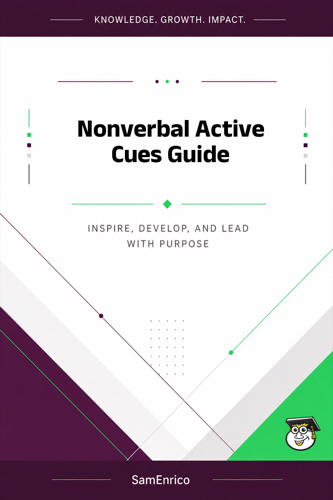
Non-FictionSelf-HelpBody Language
Nonverbal Active Cues Guide eBook
Uses eye contact, nodding, and posture to signal a
Uses eye contact, nodding, and posture to signal attention.
Formats
Free sample
Chapter 1: The Gaze Contract--–- Every conversation begins before a single word is spoken. By the time you say “hello,” the other person has already decided whether you are friend, foe, or furniture. That decision takes less than three seconds, and it is based almost entirely on your eyes.Think about the last time someone looked just a moment too long at you on an elevator. Your skin prickled. Your shoulders rose.
You calculated escape routes without consciously thinking. Now think about the last time someone met your eyes warmly and then looked away at exactly the right moment. You exhaled. You trusted them a little more. Same eyes.
Same duration, within a second. Completely different outcome.This is the Gaze Contract—the silent, instantaneous agreement between two nervous systems about whether it is safe to be near each other. You have been signing and breaking this contract thousands of times per day without ever reading the fine print. Most people violate the Gaze Contract constantly and never understand why others seem uncomfortable, dismissive, or oddly aggressive in return.The science behind this is both ancient and urgent. Your brain has a dedicated circuit for detecting eyes.
Not faces in general—specifically eyes. The superior temporal sulcus activates within milliseconds of another pair of eyes entering your peripheral vision. Before you know you are looking at someone, your brain has already decided whether to approach, ignore, or flee. This is not metaphor. This is the limbic system doing its job, the same way it has for two hundred million years of mammalian evolution.Here is what most books get wrong about eye contact.
They tell you to “make eye contact” as if it were a light switch—on or off, good or bad. But eye contact is a volume dial, not a switch. And the correct volume changes depending on who you are talking to, where you are, what you are discussing, and crucially, whether you are the one speaking or listening.This chapter is not about staring at people until they squirm. It is about understanding the neuroscience, the cultural mathematics, and the moment-to-moment calibration that transforms eye contact from a weapon into a bridge. By the end of this chapter, you will know exactly how long to look, where to look, when to break, and how to recover when you get it wrong.
You will never again wonder why someone seemed “creepy” or “cold” when all they did was look at you.The Two-Brain Conversation Every exchange of eye contact is actually two nervous systems negotiating in real time. Your gaze does two things simultaneously: it sends a signal to the other person, and it receives data from them. Most people focus entirely on the sending and ignore the receiving. That is like trying to have a conversation while covering your ears.When you look at someone, their brain processes your gaze through two parallel pathways. The first is fast and unconscious—the amygdala, the threat detector.
This pathway asks one question: “Is this person dangerous?” It answers in less than two hundred milliseconds, long before you have consciously registered that someone is looking at you. The second pathway is slower and more deliberate—the prefrontal cortex, the social calculator. This pathway asks: “What does this person want from me?” It takes about half a second to answer.Here is the key insight that changes everything. The fast pathway—the threat detector—cannot be reasoned with. You cannot talk someone out of their amygdala’s verdict.
If your gaze triggers a threat response, every word you say afterward will be filtered through suspicion. You will be fact-checked, doubted, and dismissed, not because of what you said but because of what your eyes did before you opened your mouth.The good news is that the threat detector is predictable. It triggers under specific, measurable conditions. Avoid those conditions, and you bypass the threat response entirely. You start every conversation from neutral or, better yet, from trust.What triggers the threat detector?
Three things, and three things only: gaze that is too long, gaze that is too short, or gaze that goes to the wrong place at the wrong time.The 60/70 Rule: Your Baseline After synthesizing decades of research from nonverbal communication studies, cross-cultural psychology, and neuroimaging, one number emerges as the universal baseline for non-threatening eye contact: sixty to seventy percent of the conversation. This is the sweet spot. Below forty percent, you signal avoidance, fear, or disinterest. Above seventy percent, you signal aggression, intimidation, or romantic interest (which, in a professional context, is its own form of threat).Sixty to seventy percent sounds simple. It is not.
Because “percent of the conversation” is a moving target. You are not supposed to stare at a clock and calculate fractions while someone is talking to you. Instead, you need a behavioral rule that produces the right percentage automatically.Here is that rule: hold eye contact for the duration of a single complete thought, then break to the side or downward for a breath, then return. A “complete thought” in conversation lasts approximately four to seven seconds. That means you look for four to seven seconds, break for one to two seconds, look again.
Repeat.The break is as important as the gaze. Looking away laterally—to the side—signals thoughtfulness. Looking away downward signals respect or submission. Looking away upward signals boredom or dismissal. Never look away repeatedly to the same spot, especially if that spot is a door, a phone, or another person’s face.
Those breaks signal escape, not thoughtfulness.And never, under any circumstances, break gaze by checking your phone. A single phone check during someone’s sentence tells their limbic system: “This device is more important than your existence.” You cannot recover from that in the same conversation. Some violations of the Gaze Contract are fatal.The Geography of Gaze Where you look matters as much as how long you look. The human face is divided into three gaze zones, each with a different social meaning.The social zone runs from the eyes to the mouth. This is where you look during normal conversation.
It signals attention without intensity. The social zone is safe, professional, and appropriate for almost every context. Within the social zone, moving your gaze between the eyes and the mouth keeps your look dynamic and engaged. Fixed staring at any single point—even within the social zone—begins to feel strange after about three seconds.The power zone is the triangle formed by the eyes and the bridge of the nose. Looking here signals focus, authority, and evaluation.
It is appropriate when you are in a leadership role, delivering criticism, or making a consequential decision. But the power zone is also threatening in prolonged doses. Use it in short bursts—two to three seconds at a time—then return to the social zone.The intimacy zone runs from the eyes down to the chest. Looking here signals romantic or sexual interest. In professional or casual contexts, even a glance into the intimacy zone triggers the threat detector.
Men, especially, should note that their natural gaze tends to drop lower than they think. If you are being accused…
This is the end of the free sample. Get the eBook to keep going. Buy now
About this book
Details
- Author
- Pridgen Kerstin
- Publisher
- SamEnrico
- Language
- English
- Genre
- Non-Fiction, Self-Help, Body Language
- Released
- 2026-06-06
- Pages (approx.)
- 158
- Available as
- eBook, Audiobook

Read better in the ZLOADR app
Your eBooks on your phone or tablet. Sign in with your SamEnrico account and start reading.
More by Pridgen Kerstin
 Diarrhea Management GuidePridgen Kerstin$11.99
 Evidence Log for ImpostersPridgen Kerstin$11.99
 Contract Abstraction Security ProtocolsPridgen Kerstin$11.99
 Forgiveness VisualizationPridgen Kerstin$11.99
 The Breath Retreat GuidePridgen Kerstin$11.99
 Storytelling Elder Wisdom GuidePridgen Kerstin$11.99
 Self Talk For Step ParentingPridgen Kerstin$11.99
 Kenya Women Enterprise FundPridgen Kerstin$11.99
 The Opium King's Last FormulaPridgen Kerstin$11.99
 Into the Abyss: The Hidden Rivers of Southeast Asia's Last FrontierPridgen Kerstin$11.99
 Jazz, Jazz, and More Jazz: The Underground Speakeasies That Fueled the Harlem RenaissancePridgen Kerstin$11.99
 The Dancer's Guide to CalusPridgen Kerstin$11.99
You may also like
 Hong Kong Handover 1997Dunn Johnnie$11.99
 Zumba For Postnatal Recovery CourseNeal Christian$11.99
 Zumba for BeginnersLadner Nikia$11.99
 YouTube Comment Mining GuideHumes Pandora$12.99
 Worry Box MeditationCarlin Rudy$11.99
 Workplace Stress MeditationNguyen Lynn$11.99
 Workplace Stress and Sleep RepairHawley Ivory$11.99
 Workplace Perfectionism CureDelaney Jeffry$11.99
 Workplace Injustice Anger GuideWallen Isabelle$11.99
 Work Addiction and Burnout LinkGreenwood Ester$11.99
 Women in Yoga and WellnessBeattie Galina$11.99
 Women in Stand Up ComedyChun Evangeline$11.99